By: M. Kathy Raines
Special to the PARADE
A swirl of energy, the black-crested titmouse is never still, well, not by human standards. This perky creature gleans an ant from a branch, stops, then, rotating its head, peers every which way. Then it eats another, scans the scene, and hops up to another limb. Sometimes it hangs upside down.
No wonder this tiny acrobat is on high alert. Though a predator itself—it dines mainly upon insects— the titmouse innately knows it’s on the menu of domestic cats and Cooper’s or sharp-shinned hawks— raptors that especially prey upon birds. And, with the demands of fast avian metabolism, a titmouse must constantly refuel.
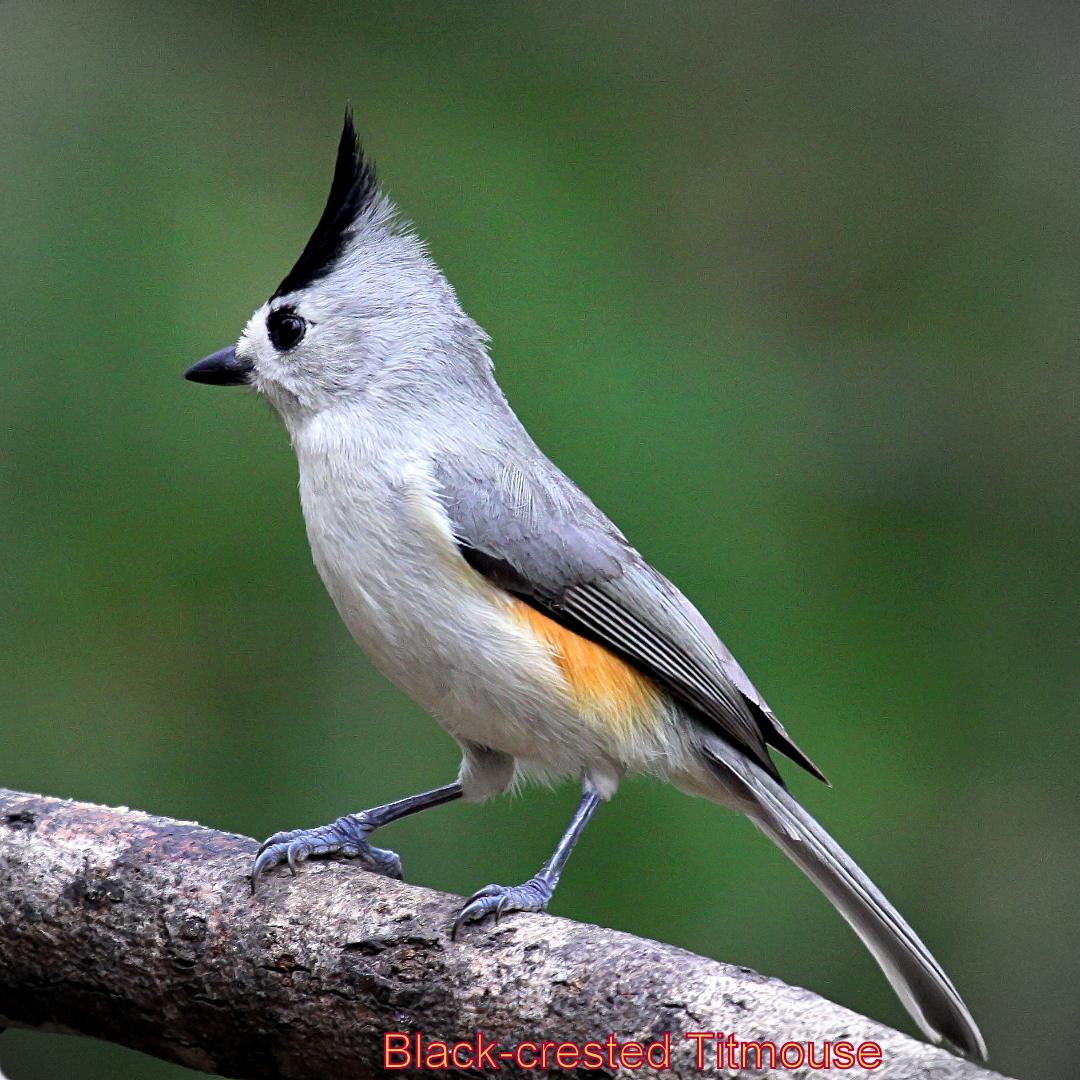
Instantly recognizable, a male black-crested titmouse (Baeolophus atricristatus) wears a distinctive black crest—a female’s or juvenile’s is dark brown— which gives it a triangular, “conehead” appearance. The titmouse raises its crest, over which it has muscular control, to communicate excitement—as when defending territory during breeding— and lowers it when feeling more relaxed. Perhaps what we especially find endearing is that, with its topknot, round, dark eyes and stubby bill, the titmouse evokes the image of an alert and curious child.
The word “tit” is Old Icelandic for “something small” and “mouse” is a corruption of the Old English word “mase” which denoted a small bird. The British may call a tiny bird a “tit”. Titmice and chickadees, also small, stout-billed woodland birds, share the family Paridae.
One of five species of American titmice, this year-round Brownsville resident, prior to 2002, shared a species name with the tufted, which occupies much of the eastern U.S. When sharing territory, these two may interbreed. The black-crested titmouse, a non-migratory species, commonly occupies thorn scrub, forests, parks and backyards in South and much of West Texas, a strip of southern Oklahoma and eastern Mexico.
Primarily an insectivore, the black-crested titmouse, flicking its wings and tail, hunts slowly and deliberately. Mainly an arboreal feeder, it usually hunts within a tree’s interior, along its trunk and large branches, at heights below 20 feet. Also, it regularly visits feeders, especially in wintertime. There, the bird carefully sorts seeds, selecting those which are most caloric—often determined by weight— which it can deftly carry to a perch to eat or cache. Titmice hide particles of food beneath bark, in cracks and among piles of branches or twigs. A bird will hold a sizeable morsel, say an acorn, in its feet and, with its bill, hammer it against a branch and pry it open.
Black-crested titmice flock with other birds in the wintertime but break off to form pair bonds from late January to February. During courtship, the male feeds his mate, and she creates a nest in an old woodpecker hole, a tree or post. Also, a titmouse may lay eggs in a nestbox, even one close to human activities.
The female packs this cavity with items like leaves, bark, grasses, hair and snakeskins, and she alone sits on the nest. Fortunately for titmouse parents, cowbirds— brood parasites that drop their eggs into the nests of other birds—usually avoid cavity nests like these. Since tufted titmice employ “helpers”—immature birds that assist with nesting and childcare—likely, the less-studied black-crested do the same. Chicks, which leave the nest in from 15-18 days, are born pink with dark grayish down.
The black-crested titmouse’s flight is direct, and it hops rather than walks. It hangs upside down, but less often than does the chickadee. The titmouse signals to other birds with its crest. Only rarely have people witnessed it battling intruders.
A bold and curious bird, the black-crested titmouse, like other Parids, will approach a person who is “pishing”, or imitating its call, usually by repeatedly calling “pish-pish-pish.” Both males and female titmice make calls, but, as with most species, males do most of the singing. A typical song may be written as “pete-thee-thee-thee,” or a whistled, “hew-hew-hew-hew.”
Black-crested calls tend to be sharper and more nasal than those of tufted titmice, perhaps to assure that their vocalizations are audible in their more open habitats.
U.S. populations of black-crested titmice appear to be stable, though recent deforestation in Tamaulipas and Nuevo Leon concern many. Also, while tufted-titmice have been fully studied, research on the black-crested is lacking, particularly that concerning their social lives and vocal variations.