By: M. Kathy Raines
In the Rio Grande Valley, April is not, as poet T.S. Eliot called it, “the cruelest month”—not by a longshot. Here, April is a pure joy.
Furtive bobcats, awash in breeding hormones, suddenly appear along trails. Cottontails pop out, along with a host of lizards. Birds dolled up in breeding finery—great egrets with lime-green lores and lacy plumes suggestive of bridal dress; brown pelicans with yellowish crowns and chestnut-colored neck feathers—court and nest. White pelicans and other wintering guests fly off to northern breeding grounds, but scissor-tailed flycatchers and groove-billed anis return from winter sojourns to breed. Plus, thousands of migrating warblers and other lovelies, incited by winds and fronts, plop onto South Padre Island and thereabouts to fortify themselves for the rest of their trips northward.
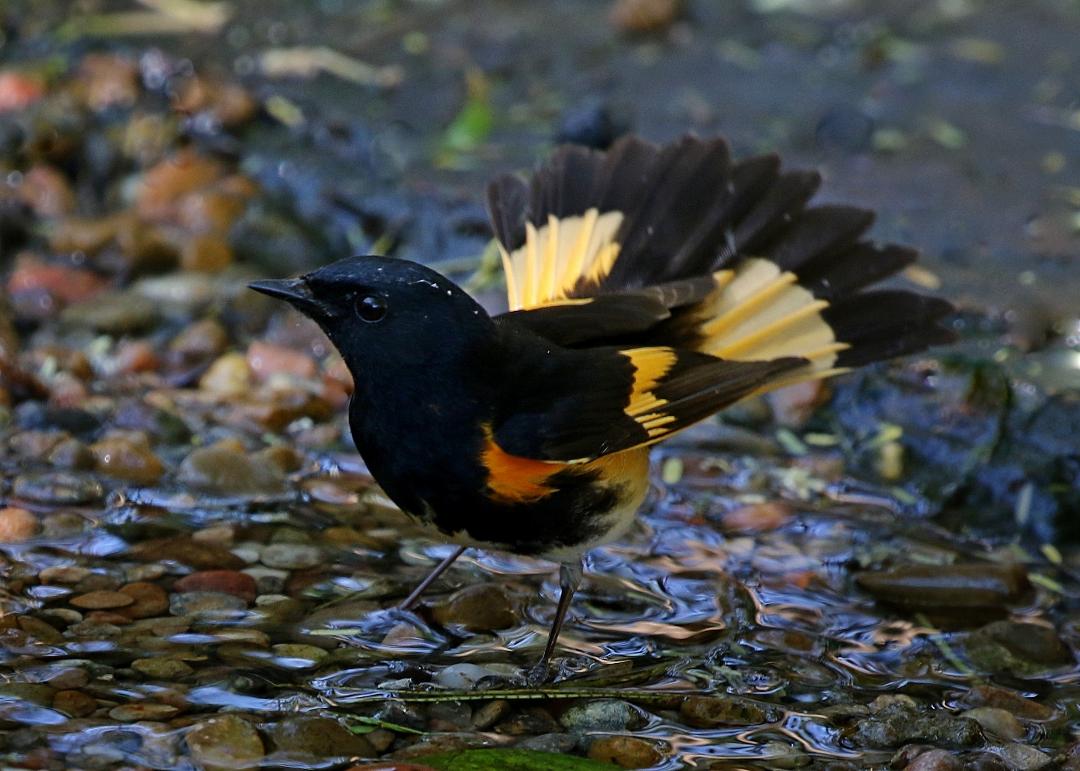
One of these warblers, the energetic, flashy American redstart (Setophaga ruticilla), is a standout even among its fellow beauties. Nicknamed the “butterfly” of birds, it is a whirl of motion that doesn’t pose for photos. Drooping its wings, a redstart flashes, fans, and flicks its colorful tail—in adult males, orange; females and juveniles, yellow—which likely serves to startle and flush insects from foliage as well as maintain contact with a mate.
The name “redstart” comes from Old German rothstert, meaning “red-tail.” Some, smitten by the male’s orange and black markings, dub it the “Halloween warbler.” Some Spanish speakers call it “candelita,” or “little candle.”
The male redstart’s face is black; the female’s, gray. While his sides, tail, and wings flame in brilliant orange, hers—better suited to nesting camouflage—are a subtler yellow. The redstart has a flat bill and a wedge-shaped tail. As with a flycatcher, rictal bristles (hair-like feathers) sprout around its bill. Though once erroneously thought to serve as a net to capture prey, the bristles seem to protect a bird’s eyes from injury by a struggling insect. Like a cat’s whiskers, they may also assist in orientation.
We can expect to see this regular visitor on South Padre Island and thereabouts from mid-April to early May. Redstarts are now fattening up to journey from winter homes in southeastern Mexico, Central America, Caribbean islands, or northern South America to breeding grounds in forests—especially second-growth ones—in the eastern U.S., including parts of East Texas.
Our current drought won’t deter warblers and other songbirds from stopping by, predicts Justin LeClair, Avian Conservation Biologist with the Coastal Bend Bays & Estuaries Program. He thinks these insectivores—unlike “inland-migrating shorebirds,” which, seeing scant water, “may skip our area entirely in search of better foraging areas farther north”—may remain unaffected since local insects are “somewhat adapted to environmental processes here,” and our native trees are greening, blossoming, and fruiting.
With its long tail and rictal bristles, the redstart hunts much like a flycatcher. An active forager, the bird—more than most warblers—sallies out to snag insects in mid-air or, hovering above, snatches them from leaves. Besides flashing its tail, the redstart spins around, kicking up prey. It sometimes hovers over insects or plucks them from leaves. After breeding, the redstart may eat fruits and berries.
Males arrive first on breeding grounds. Soon, pairs form, and mating rituals begin. During one, a redstart lifts its head, moves its breast toward the ground, and spreads its tail. In another, a female approaches; the male glides away, then chases her, and she flies toward the ground. The male suggests various nesting sites, which she may wiggle around in. Then she selects one. She alone builds the nest—a tightly constructed open cup often nestled in a tree’s crotch, built with, among other items, bark strips, fur, and plant fibers. With spider silk, she glues it to the branches, assuring it’s well-hidden. She usually lays three to four eggs.
The male may feed her during nesting. Both vigorously defend the nest, partly from brown-headed cowbirds, which lay eggs in other birds’ nests, leaving their owners to nurture oversized cowbird chicks, often at the expense of their own. A redstart may abandon a cowbird-infested nest or build a new nest over it. Fearing a predator will disturb a nest, a redstart may, as a distraction, fly to the ground, crouch, spread and vibrate its wings and tail, and twitter to entice the creature away from eggs or hatchlings. Extra copulations are not uncommon among redstarts. Both parents feed, defend, and instruct chicks, which they supervise in two distinct groups.
Aloft, a redstart may make a sharp tzi sound, with a descending sweet. A song may have two to eleven phrases with thin, sibilant notes, some ending in an accent, others not, with the rapid-fire tune lasting from about one to one-and-a-half seconds. A phonetic rendering of one song is: see see see see or tsit tsit tsit tsit. Females, as well as males, sing, but not as often. On breeding grounds in early morning, a male may sing continuously for 40 minutes. He sings while leading and chasing his mate as well as during incubation. Both birds make alarm calls, one specifically, it appears, to alert birds to a lurking sharp-shinned hawk—a notorious bird-eater.
Though not endangered, redstarts, like so many birds, are declining due to habitat loss and fragmentation of forests—both on breeding and wintering grounds—pesticides, and window collisions. Interestingly, some thinning of trees due to logging may benefit redstarts, who are dependent upon second-growth deciduous forests.