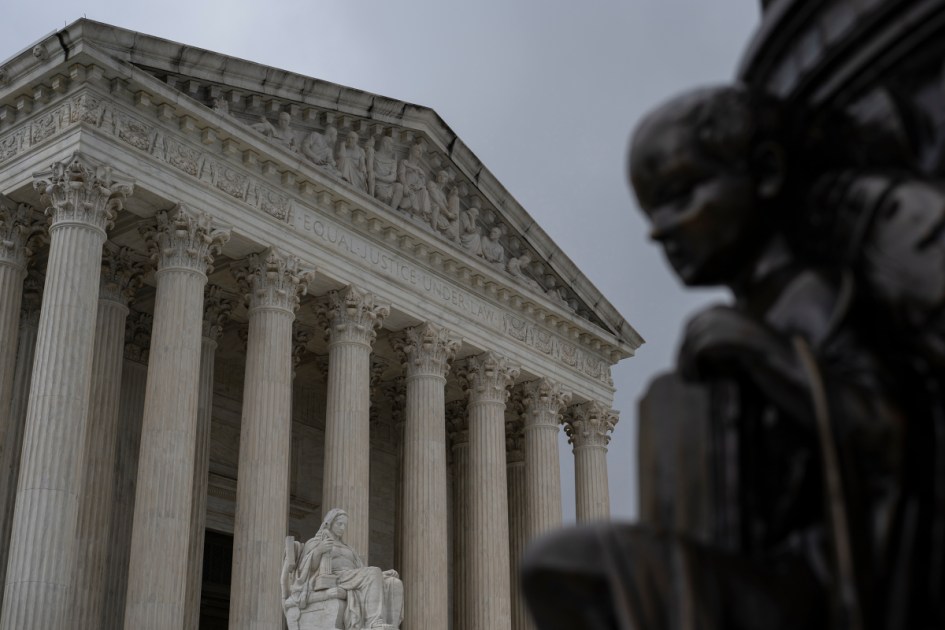

The U.S. Supreme Court weakened but did not eliminate a key provision of the Voting Rights Act on Wednesday, making it harder to bring voter discrimination claims against electoral maps while stopping short of a widely anticipated full strikedown.
The 6-3 ruling narrows how courts may interpret Section 2 of the Voting Rights Act, the seminal civil rights legislation signed into law by President Lyndon B. Johnson in 1965. This provision, seen as the cornerstone of the law, outlaws practices denying or abridging the right of any citizen to vote based on their race, including political maps that dilute the electoral power of voters of color.
Republicans, including many in Texas, have been pushing the court to overturn this aspect of the law for years, saying it’s no longer necessary and forces states and counties to overemphasize race in redistricting.
The conservative majority on the Supreme Court has been whittling away the Voting Rights Act since 2013, when it got rid of the requirement that some jurisdictions, including Texas, have their maps precleared by the Department of Justice. While Wednesday’s ruling did not eliminate Section 2 entirely, Justice Elena Kagan in her dissent said it “renders Section 2 all but a dead letter.”
Texas has had at least one of its political maps blocked under Section 2 of the Voting Rights Act every decade since it went into effect. With this limitation narrowed significantly by the court, the state could push to reconsider its current congressional, state House and Senate and State Board of Education maps, a possibility some Republicans have already teased. The maps have been under litigation since they went into effect in 2021.
The governor of Mississippi has said he would call a special session to rapidly redraw the state’s voting maps if the court struck down Section 2. Other states are expected to follow suit, especially amid the redistricting arms race Texas kicked off last summer. But with Texas’ unusually early primaries already in the rearview mirror, Lone Star lawmakers may wait until the next regular session begins in January to embark on any redraws.
Source link