|
Only have a minute? Listen instead |
More than 50 plaintiffs on Thursday filed a federal lawsuit against SpaceX alleging that sonic booms from the company’s test launches at Boca Chica Beach are damaging their homes.
The lawsuit was filed by 58 households in Port Isabel, South Padre Island and Laguna Vista.
The petition says that between April 2023 and October 2025, “SpaceX completed eleven fully integrated Starship/Super Heavy test flights.”
“Additionally, between 2020 and May 2021, the company completed six non-full-stack test flights. Further, at various times the company has completed static Starship engine tests at the Starbase facility,” the lawsuit stated. “As a result of SpaceX’s Starship operations, Plaintiffs’ homes have been subjected to repeated intense and damaging acoustic events.”
The lawsuit says the Boca Chica Beach location was intended to be a commercial space port for existing Falcon 9 and Falcon Heavy rockets.
“In 2018, however, SpaceX dedicated the site exclusively to the development and launch of its next-generation Starship vehicle. To accommodate this program, SpaceX acquired hundreds of acres of coastal land, transforming a quiet beach community into a sprawling industrial spaceport and manufacturing complex,” the petition said. “Starbase is now the exclusive testing, launching, and landing site for the largest rockets in human history.”
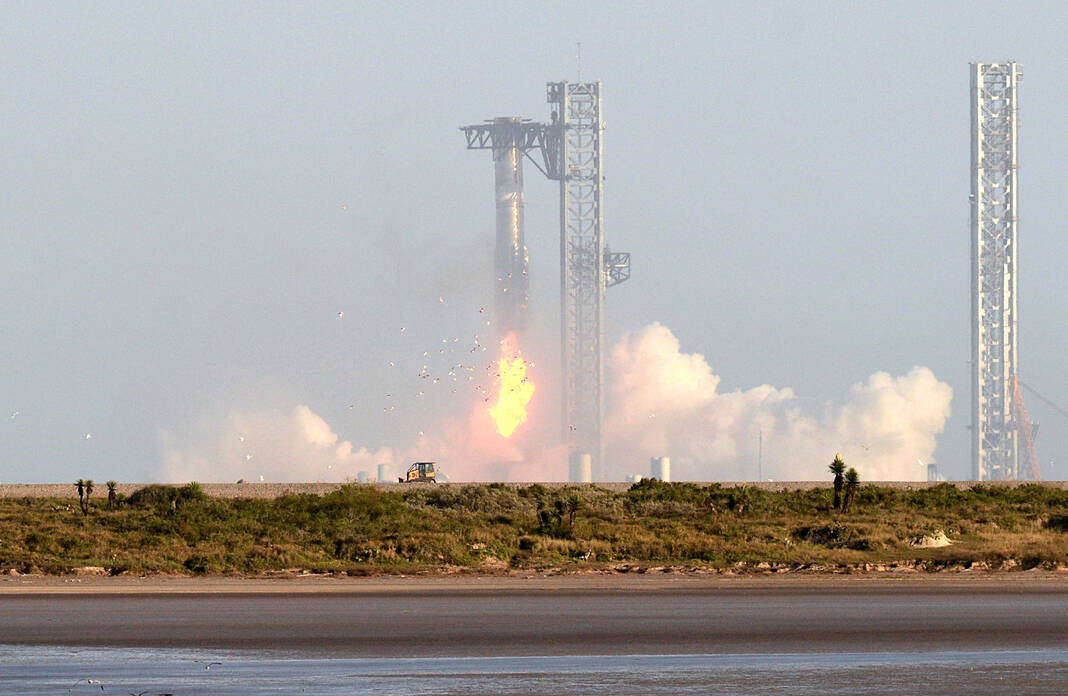
At the spaceport’s launch pads, there are massive integration and catch towers that are the tallest launch towers in the world, the petition said.
“SpaceX deliberately constructed this colossal, skyscraper-sized infrastructure mere miles from coastal residential communities,” the document stated.

LACK OF DATA
The petition details the “colossal” size of the launch site’s infrastructure, with the Starship spacecraft and its Super Heavy Booster standing as tall as a 30 story building when prepared for flight.
The Super Heavy Booster relies on 33 Raptor 2 engines to lift onto the launch mount, according to the document.
They burn liquid oxygen and methane propellants which “collectively generates 16.7 million pounds of thrust,” the lawsuit states. The engines’ power creates a “violent aeroacoustic phenomena.”
“By comparison, Starship generates nearly twice the thrust as NASA’s SLS (Space Launch System) and nearly ten times the thrust of SpaceX’s own Falcon 9 rocket,” the lawsuit continued.
“SpaceX has publicly acknowledged scientific and regulatory deficits,” the document stated, referring to the company’s use of oxygen and methane propellants.
The lawsuit cited a SpaceX document that notes a lack of “data to make refined, accurate clear zones” for blast and acoustic impacts.
For instance, the lawsuit referred to SpaceX’s inaugural Starship test flight in April 2023 that completely blew up the launch pad and carved a crater into the ground while generating a massive debris cloud of pulverized concrete and metal shrapnel reaching residential areas nearly seven miles away.
Following the test launch, the Federal Aviation Administration grounded the Starship program for months so the company could make corrective actions.
“SpaceX’s Starship operations are therefore experimental and iterative by nature. Each launch generates new acoustic data for SpaceX and its regulators,” the lawsuit says.

LIKE A GUNSHOT
As SpaceX continued testing at Boca Chica much to the delight of space flight enthusiasts who gather at Isla Blanca Park on South Padre Island and on Highway 48 between the Island and Brownsville, it has also piqued the curiosity of researchers.
For instance, a team from Brigham Young University (BYU) monitored the acoustic energy of test flights by placing measuring devices at eight locations various distances from the rocket launch pad, including in homes of some residents who filed the lawsuit.
“And they concluded that, by comparison, ‘one Starship launch is equivalent to around 4-6 SLS (NASA’s Space Launch System) and at least 10 Falcon 9 launches,” the lawsuit said.
The sonic boom generated from Test Flight 5 generated a “greater risk of structural damage, such as glass breaking and falling bric-a-brac,” according to the lawsuit’s citation of the researcher’s notes.
One researcher was cited saying that the sonic boom sounded like a gunshot at close range.
The launches pose a serious problem to sensitive populations, said Victor Sparrow, director of the Graduate Acoustics Program at Penn State University, according to the lawsuit.
BYU researchers continued to study test flight sonic booms and published findings, though they had variation in results per test due to changes in the environment as well as the number and nearness of recording stations.
“While these independent acoustic scientists successfully recorded actionable acoustic data during Test Flights 5 and 6, SpaceX’s orbital test campaign spans far beyond two isolated events,” the lawsuit says.
“Test Flights 5, 7, and 8 inflicted even greater acoustic trauma on Plaintiff’s homes. Because these flights involved the return and catch of the Super Heavy booster at Starbase, they subjected the surrounding areas to severe triple exposure acoustic events,” the lawsuit stated.
As of Friday afternoon, SpaceX had not filed a response to the lawsuit and no initial hearing in the case had been scheduled, court records indicate.