Spring football felt much quieter this time around, considering players and coaches weren’t busy pulling double duty by preparing for an impending transfer portal window while also trying to improve on the field.
Think of it as a much-needed reprieve, if only momentarily, for a sport that has moved at warp speed the last handful of years.
With the last smattering of power conference programs holding spring games over the weekend, the dust is finally beginning to settle. Early enrollees have settled in, transfers are acclimated to their new environments, the coaching carousel has stopped and depth charts are taking shape ahead of fall camp.
That means it’s a good time for a team-by-team breakdown of where things stand in the Big Ten following spring practice. So here’s an offseason batch of Big Ten Power Rankings:
The Rest
For the second consecutive season — albeit with a different leader at the helm this time — the Boilermakers finished winless in Big Ten play, mired at the bottom of an increasingly top-heavy conference. Head coach Barry Odom, formerly of UNLV, hired Kevin Kane to be Purdue’s new defensive coordinator following one season as the outside linebackers coach at Minnesota. Kane will aim to improve a group that finished tied for 117th in scoring (31.8 points per game) and 120th overall (423.5 yards per game).
The Boilermakers added 29 new players via the transfer portal in a group that ranked 39th nationally, according to 247Sports. But Odom’s 55th-ranked high school recruiting class, which does not include a single four- or five-star prospect, remains an obvious weakness.
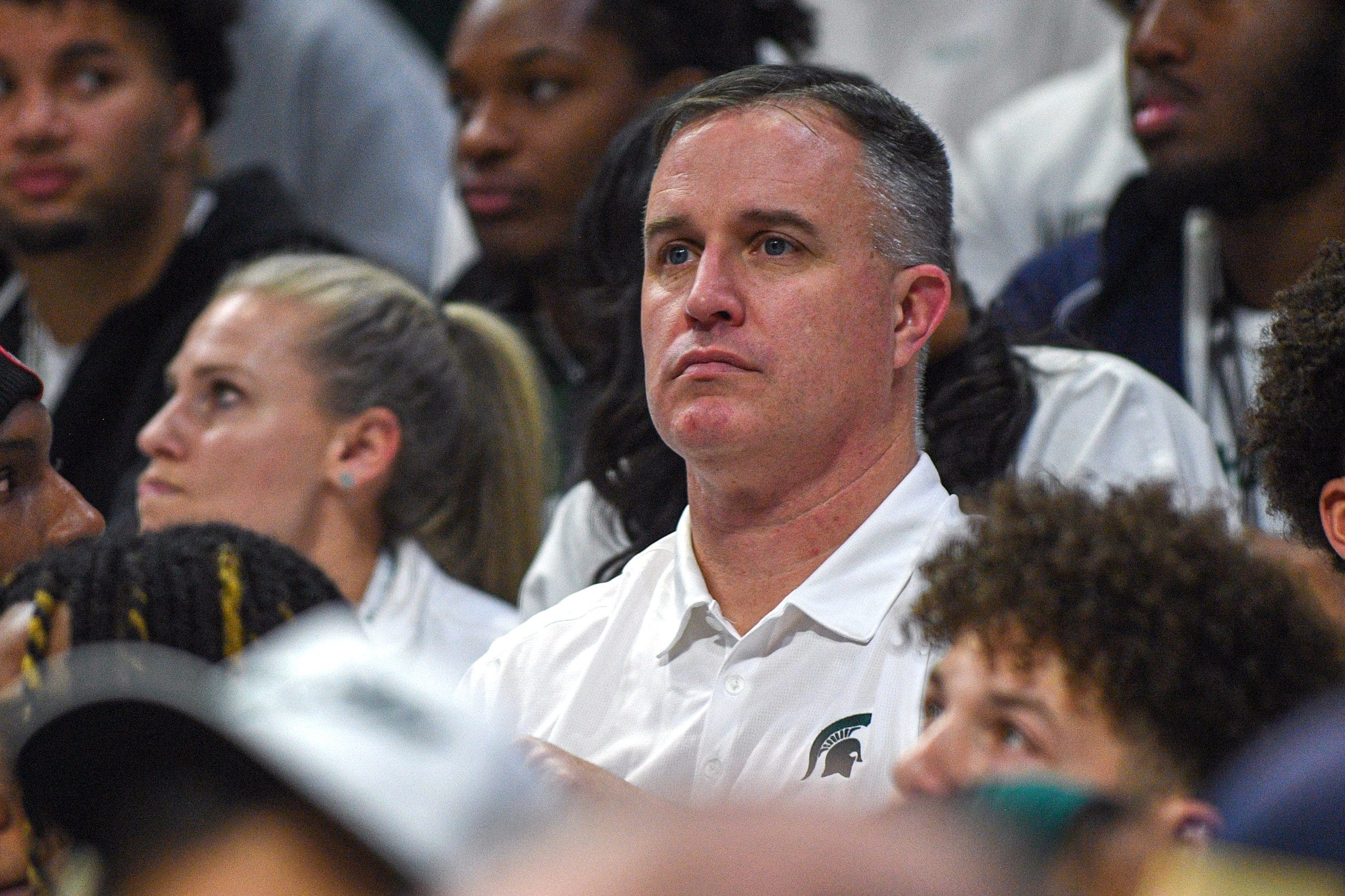
Michigan State head coach Pat Fitzgerald looks on during the first half of a college basketball game. (Photo by Aaron J. Thornton/Getty Images)
After three years away from football, former Northwestern head coach Pat Fitzgerald takes over a Michigan State program desperate to regain its footing following two failed hires in Mel Tucker (2020-23) and Jonathan Smith (2024-25). Fitzgerald retained defensive coordinator Joe Rossi and tabbed promising youngster Nick Sheridan, the former co-offensive coordinator and quarterbacks coach at Alabama, to lead the other side of the ball.
The Spartans added 29 new players via the transfer portal, including 13 from power-conference programs, but none of them are viewed as four- or five-star prospects. Fitzgerald’s early team-building efforts were more successful at the high school level, with his first recruiting class housing five blue-chip prospects. The headliner is four-star offensive tackle Collin Campbell (No. 196 overall, No. 20 OT) from Arizona.
Drastically different conference and college football backdrops have made it significantly tougher for head coach Greg Schiano to find his footing amid this second stint with the Scarlet Knights. Back-to-back winning seasons in 2023 and 2024 largely papered over the fact that Rutgers, which joined the Big Ten more than a decade ago, still hasn’t produced a winning record in league play.
Schiano’s player-acquisition efforts ahead of the 2026 campaign are rather fascinating: His transfer portal class ranks last in the conference and 71st nationally, sandwiched between San Diego State and James Madison. But the Scarlet Knights’ incoming high school class cracked the top 40 overall and features more blue-chip recruits (four) than programs like Arizona State, TCU, Arkansas, Louisville, NC State and Kentucky.
Two bowl victories in three seasons represents a great start for head coach David Braun, whose team began the 2026 campaign 5-2 overall before stumbling a bit down the stretch. Since then, Braun has revamped his staff by hiring six new coaches and promoting another from within to give the Wildcats a new feel entering the fall. The biggest swing was Braun’s high-profile addition of Chip Kelly as offensive coordinator. Though Kelly flamed out in less than one season with the Las Vegas Raiders, he’s still regarded as one of the sharper offensive minds in the sport and helped lead Ohio State to a national championship two years ago. Kelly is now tasked with mentoring transfer quarterback Aidan Chiles, formerly of Michigan State, to improve an offense that ranked 108th nationally in passing yards per game.
Few coaches from the power conferences, if any, will enter the season with a hotter seat than Luke Fickell, whose three years with the Badgers have produced just 16 victories and a disastrous 10-17 record in conference play. Fickell needed a public vote of confidence from athletic director Chris McIntosh last fall amid widespread speculation about his job security, and now McIntosh has exited Wisconsin for a job in the Big Ten office. That leaves Fickell in a precarious position.
Once again, the Badgers swung big in the transfer portal by adding 33 players this winter, though the class only ranks 49th nationally because it lacks a single blue-chip prospect. Wisconsin struggled even more with high school recruiting: Fickell’s class ranks No. 72 overall and No. 17 in the Big Ten.
Mike Locksley is another Big Ten coach who survived the 2025 campaign by the skin of his teeth, finishing 1-8 in conference play for the second straight year and below .500 in the league for a seventh consecutive season. But high-level player acquisition, particularly from the high school ranks, has afforded Locksley another chance this fall.
Maryland’s recruiting class is headlined by five-star edge rusher Zion Elee (No. 5 overall, No. 1 edge rusher) from powerhouse St. Frances Academy in nearby Baltimore. Elee represents the third five-star recruit to join the Terrapins since Locksley took over ahead of the 2019 season. A strong debut from former blue-chip quarterback Malik Washington offers another reason for optimism. Washington, who was the No. 10 quarterback in the 2025 class, ranked sixth nationally among freshmen with 2,963 passing yards last fall.
Can Matt Rhule finally turn the tide at Nebraska? The Cornhuskers received widespread praise when they hired Rhule ahead of the 2023 season, snatching up a hot commodity after his stint with the Carolina Panthers went south. But the exponential growth that Rhule’s teams showed during his successful runs at Temple (2013-16) and Baylor (2017-19) still hasn’t resurfaced at Nebraska, where he is now 0-9 against ranked opponents.
The Cornhuskers finished below .500 in Big Ten play during each of Rhule’s first three seasons, and now they enter the 2026 campaign with a high school recruiting class that ranks 106th nationally and dead last in the conference. Losing starting quarterback Dylan Raiola, a former five-star prospect, to the transfer portal represented another major blow. In an era when programs can be turned around with remarkable swiftness, Rhule needs to demonstrate legitimate progress this fall.
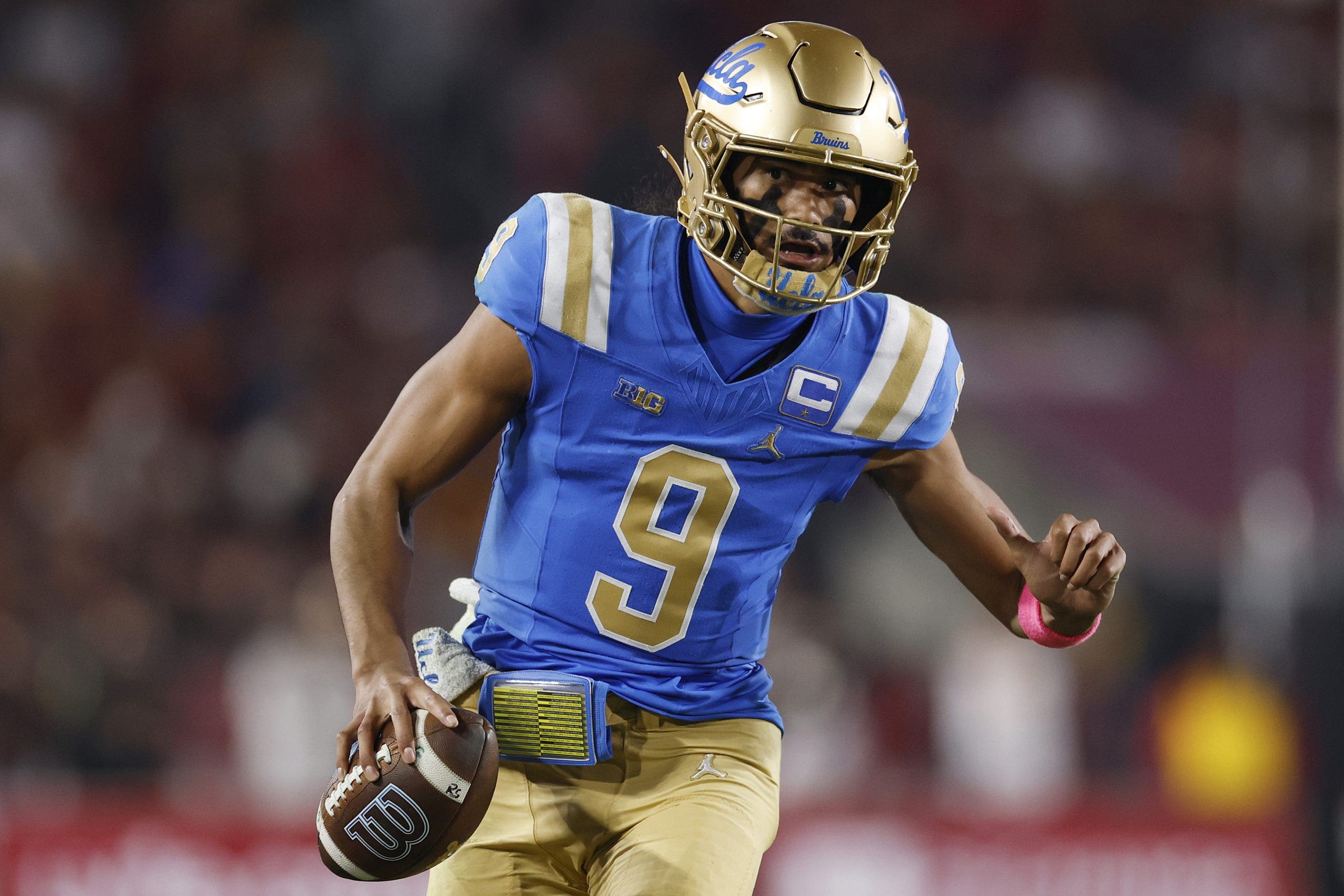
Nico Iamaleava of the UCLA Bruins runs for a first down against the USC Trojans. (Photo by Harry How/Getty Images)
Even though UCLA dropped five consecutive games to end the 2025 season with a thud, there is plenty of optimism surrounding the Bruins. UCLA landed one of the hottest names in coaching when it lured Bob Chesney, 48, away from James Madison, a program he led to the College Football Playoff last fall. Chesney posted an impressive 21-6 record with the Dukes after taking over for Curt Cignetti, who is now the head coach at Indiana. Those two winning seasons pushed Chesney’s streak to seven straight years above .500 overall and 15 out of 16 dating to his previous stints at Salve Regina, Assumption and Holy Cross.
Now, Chesney is working in the power conferences for the first time, taking over a program that is not without some talent. Former five-star quarterback Nico Iamaleava, a transfer from Tennessee, is back for another season in Westwood. Chesney added 41 new players via the transfer portal — including 10 from James Madison — to secure the Big Ten’s largest incoming class. The two highest-profile additions are former Oklahoma linebacker Sammy Omosigho (No. 115 transfer, No. 3 LB) and former Florida wide receiver Aidan Mizell (No. 143 transfer, No. 38 WR).
The Top 10
Minnesota entered its offseason on the upswing after defeating New Mexico in the Rate Bowl, handing head coach P.J. Fleck his seventh consecutive bowl victory. The win also gave Fleck a fifth season with eight or more wins in the last seven campaigns, evidence of an impressive coaching job at a school not known for its football prowess.
Such momentum manifested in the form of a high school recruiting class that finished No. 28 nationally and No. 8 in the Big Ten. By signing six blue-chip prospects, five of whom landed among the top 400 players nationally, Fleck laid the groundwork for the Gophers to secure their first top-30 recruiting class since 2008. The highest-rated player in the bunch is edge rusher Aaden Aytch (No. 181 overall, No. 22 edge), an Indiana native who chose Minnesota over additional scholarship offers from Iowa, Michigan State, Purdue and Kentucky, among others.
Now that Iowa has set a program record for most players selected in a single NFL Draft with seven, it’s worth reassessing just how good the Hawkeyes really were in 2025. Sure, head coach Kirk Ferentz’s team finished sixth in the Big Ten standings, sandwiched between Michigan and Washington, but its three conference losses came by just 12 combined points against three ranked opponents — one of which was eventual national champion Indiana. The Hawkeyes were a touchdown or two away from potentially reaching the College Football Playoff.
To replenish his roster, Ferentz assembled one of Iowa’s strongest high school recruiting classes in recent memory, a group that is ranked No. 26 nationally and includes eight four-star prospects. The name to remember might be four-star quarterback Tradon Bessinger, a Utah native who is the No. 11 signal-caller in the class. He is the second-best quarterback prospect to sign with Iowa in the recruiting rankings era, according to 247Sports, trailing only Jake Christensen in 2005.
One of the ways to gauge Illinois’ impressive trajectory under head coach Bret Bielema is through the recruiting rankings, where the Illini are surging into rarefied air. In 2020, the year before Bielema took over, Illinois’ high school recruiting class ranked 82nd nationally. Since then, Bielema has strung together the following finishes: 73rd in 2021; 46th in 2022; 37th in 2023; 49th in 2024; 46th in 2025 and 24th in 2026. This marks the program’s first foray into the top 30, where its only two spots behind Ole Miss and four spots behind Clemson, in 18 years.
To get there, Bielema landed five of the top 18 players from Illinois and supplemented them with blue-chip players from Florida, New Jersey and Missouri. The biggest question moving forward is whether quarterback Katin Houser, a transfer from East Carolina by way of Michigan State, can operate the offense as efficiently as predecessor Luke Altmyer did the past three seasons.
The stunning decision to fire head coach James Franklin last October gave way to a lengthy hiring process from athletic director Pat Kraft to identify the right successor. Ultimately, the Nittany Lions landed on a proven winner in Matt Campbell, 46, who oversaw eight winning seasons at Iowa State and another four at Toledo before that.
In an effort to turn over his new roster quickly, Campbell invested heavily in the transfer portal. His final tally of 38 signees was seventh-most in the country, according to 247Sports, and featured a number of familiar faces. Twenty-four former Iowa State players followed Campbell to Penn State, including veteran quarterback Rocco Becht, the No. 34 overall transfer and No. 10 signal-caller in the portal. Such aggressiveness was necessary in part because the Nittany Lions’ high school recruiting class splintered once Franklin was fired, with many of those players ultimately following him to Virginia Tech. Campbell is seeking to offset those losses by betting big on experience.

Washington QB Demond Williams Jr. points up at fans after throwing a touchdown during the first half of the LA Bowl Game. (Photo by Kevin Terrell/Getty Images)
There’s no chance the Huskies would rank this highly had star quarterback Demond Williams Jr., a potential Heisman Trophy candidate for the 2026 campaign, gone through with his decision to transfer over the winter. Williams, who threw for more than 3,000 yards and ran for more than 600 as a first-year starter last fall, announced his intention to enter the transfer portal in January but then reversed course two days later — after reports surfaced that Washington was prepared to take legal action to enforce his signed NIL agreement. Ultimately, head coach Jedd Fisch welcomed Williams back into the fold, setting the stage for what could be a special season.
Thanks to some exemplary player-acquisition efforts from Fisch and the Huskies’ staff, Williams will have more talent around him than ever before. Washington’s high school recruiting class finished 13th in the national rankings to set a new program record for the modern era. The Huskies signed 10 players rated among the top 300 overall prospects, headlined by five-star offensive tackle Kodi Greene (No. 25 overall, No. 3 OT) from powerhouse Mater Dei High School in California.
Surely this will be the year when head coach Lincoln Riley finally puts things together and takes USC to the College Football Playoff for the first time in school history, right? Riley has one of the country’s best returning quarterbacks in former UNLV transfer Jayden Maiava, now entering his second full season as the Trojans’ starter. He has what should be one of the league’s stronger running back tandems in Waymond Jordan (576 yards, 5 TDs) and King Miller (972 yards, 8 TDs). He has a flashy new defensive coordinator in former TCU head coach Gary Patterson, who guided the Horned Frogs to 181 wins from 2000-21. He has the No. 1 high school recruiting class in the country that features 14 signees rated among the top 200 players nationally. He has the No. 26 transfer portal class. He has a brand new, state-of-the-art practice facility slated to open this summer.
What more could a coach want in the modern era? The pressure is on Riley to get USC over the hump.
Messy and unsavory divorces from former coaches Jim Harbaugh and Sherrone Moore have given way to what the Wolverines hope will be a more controlled culture under Kyle Whittingham, the highly successful head coach from Utah. Whittingham posted eight 10-win seasons with the Utes between 2008-25, morphing the program into a model of consistency and respectability across multiple conferences. Now, Whittingham is working at one of college football’s blue bloods for the first time in his career, as the head coach or otherwise, and observers of the sport have wondered for years how his methods would fare in such an environment.
The primary order of business for Whittingham and offensive coordinator Jason Beck, who followed him from Utah, is to maximize the potential of former five-star quarterback Bryce Underwood following an inconsistent freshman campaign. If Underwood can raise his level of play — Michigan finished 107th nationally in passing offense last season — the Wolverines have enough talent to contend for the College Football Playoff.
With head coach Dan Lanning at the helm, Oregon has ascended to the sport’s upper echelon after winning 48 games over the last four seasons and reaching the College Football Playoff in consecutive years. Still, back-to-back landslide losses to eventual national champions Ohio State (41-21 in 2024) and Indiana (56-22 in 2025) began to sour an otherwise intoxicating blend. The narrative that the Ducks crumble when it matters most is something Lanning and his players must contend with until they dispel that notion on the field.
Even though Oregon lost both of its coordinators to head-coaching positions last winter — Will Stein to Kentucky; Tosh Lupoi to Cal — there is still plenty to like about the Ducks in 2026. They have a legitimate Heisman Trophy candidate in quarterback Dante Moore and one of the most explosive wide receiver corps in the country following the healthy return of Evan Stewart. The Ducks also have a defensive line that is loaded with NFL-caliber talent. Anything less than another CFP appearance will feel like unrealized potential.
Last year: 12-2 overall, 9-0 Big Ten
Postseason: 24-14 loss to No. 10 Miami in the CFP quarterfinals
More than a few eyebrows were raised when Ohio State head coach Ryan Day, fresh off winning the national championship, selected failed Detroit Lions head coach Matt Patricia as the replacement for defensive coordinator Jim Knowles. All Patricia did was organize one of the most statistically dominant defenses in recent memory as the Buckeyes finished atop the national rankings in scoring defense (9.3 points per game), total defense (219.1 yards per game) and opponent red zone scoring rate (66.7%).
So perhaps it should have been rather unsurprising when Day, whose offensive coordinator and longtime wide receivers coach, Brian Hartline, left to become the head coach at USF, turned his attention to another NFL name. Enter Arthur Smith, the former offensive coordinator of the Pittsburgh Steelers (2024-25) and former head coach of the Atlanta Falcons (2021-23). It falls on Smith to unlock the full potential of an offense that stumbled in its biggest moments against Indiana and Miami last season.
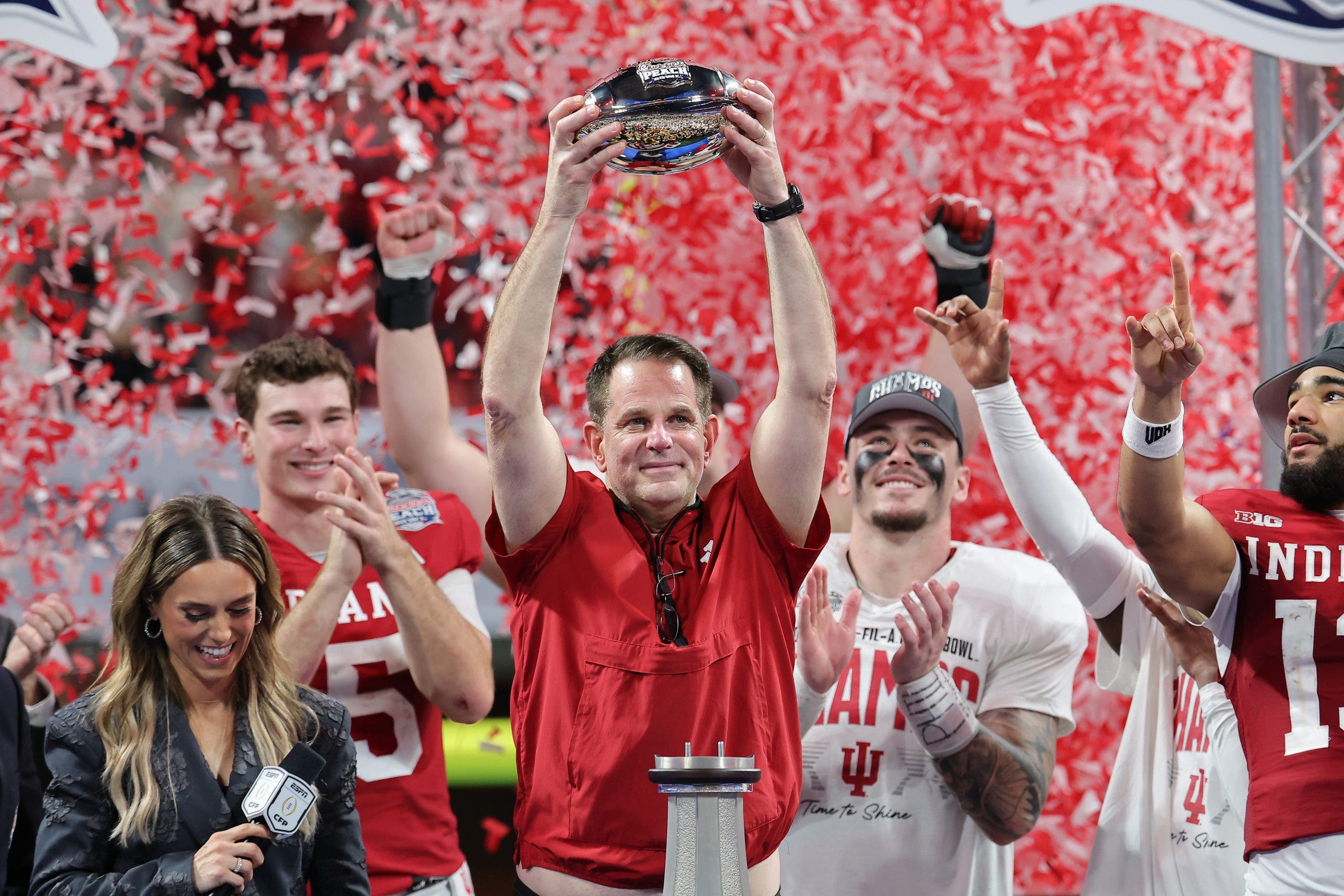
Indiana head coach Curt Cignetti hoists the George P. Crumbley Trophy after defeating the Oregon Ducks in the 2025 College Football Playoff semifinal. (Photo by Jonathan Bachman/Getty Images)
Time and again throughout Indiana’s fairytale run to the national title, head coach Curt Cignetti cited the continuity on his staff as one of the driving factors behind the program’s unparalleled turnaround the last two seasons. That is why, even after so many of the Hoosiers’ core players are now gone, including a school-record eight selections in the NFL Draft, so many people are still high on Indiana entering the 2026 campaign.
Cignetti managed to keep both offensive coordinator Mike Shanahan and defensive coordinator Bryant Haines, which represented a massive coup, even if that meant giving both coaches considerable raises amid widespread outside interest. The system they built across years of working together is what propelled the Hoosiers to previously unimaginable heights. So while the faces on the field will be different in 2026, the unimpeachable culture and schematics remain the same. For now, that’s enough to keep Indiana atop the Big Ten pecking order.