|
Only have a minute? Listen instead |
Near Business 83 and Broadway in McAllen, a food truck vendor served simmered charro beans to a couple sitting at one of the folding tables under the white canopy tent.
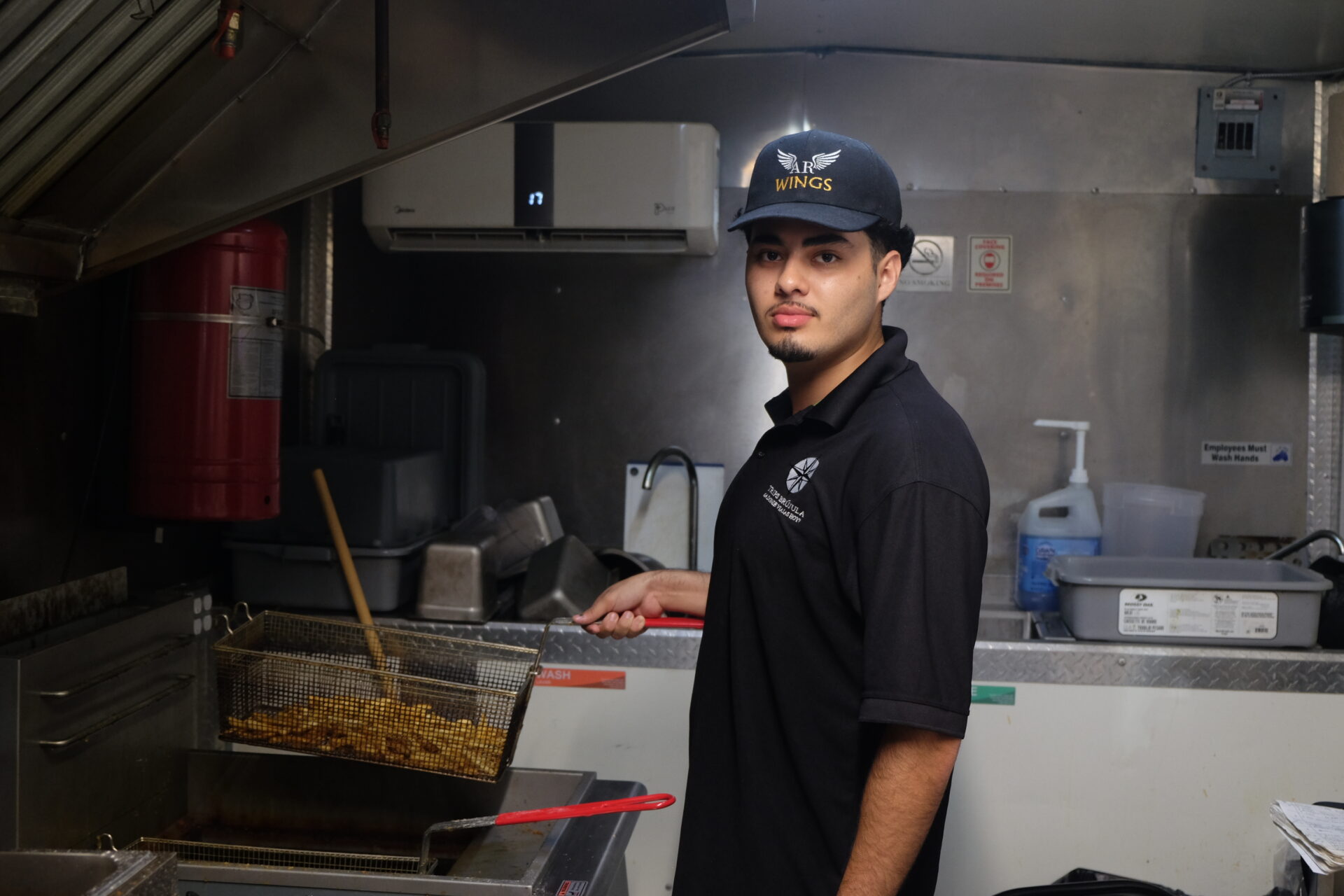
Across the lot, Argos Casas, 20, waits for someone to stop by at AR Wings. He opened his food truck in January with a friend Roberto Zuniga, 23. Casas said he’s hoping that business will get better in the summer.
Just getting through the paperwork of a food vendor permit took up a lot of his personal time, Casas said.
Texas mobile food vendors have long gone through city and county health departments to secure licenses, permits, inspections and so on.
But after the Texas legislature’s Food Truck Freedom Bill (SB 2844) goes into effect July 1, mobile food vendors will need to go through the Texas Department of State Health Services (DSHS) to apply for an annual license, according to Cameron County Health Administrator Esmeralda Guajardo.
The new system would be an opportunity for food truck vendors to travel across the state under one license, said Casas.
In the Rio Grande Valley, local officials are still gathering more information on what statewide licensure means for their respective jurisdictions.
DSHS plans to contract with Texas cities and counties to conduct health inspections, though some Valley officials are concerned that the contract’s proposed reimbursement value is not enough to make up for a loss in local funds and resources.

OLD PERMITS INVALID
The Food Truck Freedom Bill is meant to standardize regulations, reduce local permitting, and allow food trucks to operate across the state, Guajardo said while presenting to the Cameron County Commissioner’s Court during a regular meeting on May 5.
New food vendor rules are expected to go into effect May 31 and DSHS has a registration portal that will open June 1, Guajardo explained.
“Food vendors that are currently permitted will have to go and apply with the state,” she said, noting that the application would allow vendors to continue to operate until the state conducts inspections on the businesses.
On July 1, all mobile food vendors will be under DSHS licensing, she continued.
Any mobile food trucks’ permits with Cameron County, or any city or county, will no longer be valid, she said.
“One of the issues that we had is that we’re not getting a lot of information from the state,” Guajardo said during the meeting. She was part of an implementation work group with DSHS that shared information on the system’s plans, but “they weren’t putting anything in writing,” she said.
DSHS plans to subcontract with other health departments for health inspections, she stated, adding that Harlingen and South Padre Island submitted letters of intent to work with the state department. Neither city confirmed their intent to work with the state department.
Cameron County currently charges $150 for its annual permit and inspections. Hidalgo County charges $100 for permits, according to each county’s respective health department website.
Since a mobile food vendor currently pays the county and each city it works in for various permits and inspections, each jurisdiction makes money for its health department.
Under new statewide permitting rules, “a mobile food vendor will pay anywhere between $300 to $1,350 for an initial application and pre-license inspection and between $300 and $850 a year for license renewal,” said Guajardo.
Additional inspections from a contracted city or county will cost a mobile food vendor up to $500, according to DSHS proposed rules.
Health departments that contract with DSHS for inspections will be reimbursed between $250 to $400 per inspection, according to Guajardo.
DSHS has a list of contract obligations, including investigating complaints within three business days and ensuring personnel conducting the inspections meet specific training requirements, she said.
“I think the headache is gonna be short lived,” she said, noting she expects a lot of vendor complaints in the first year of the statewide license implementation.

COUNTY RESPONSES
DSHS’ contract requirements ask for health inspectors to meet qualifications that a lot of health department staff do not currently meet, said Guajardo.
“If the state health department wants to take over, let them do everything,” said Cameron County Pct. 3 Commissioner David A. Garza during the commissioner’s court meeting.
“It’s gonna take those folks that are having to do this work away from their current responsibilities, just compounding the process for us,” he said, adding that the contract is optional and not worth the money or time.
“They’re currently posting for registered sanitarians and we’re kind of scared we’re gonna lose ours,” she said. She stated that the county currently has one registered sanitarian.
With the new mobile food vendor rules, DSHS expects to spend up to $6.8 million per year, and make $17 million in revenue a year on the new permitting system, according to the department’s proposed rules.
Last fiscal year, Cameron County made $8,100 from mobile food unit inspections. “This includes 54 inspections at a rate of $150 for each,” Guajardo stated in an email later.
“I think it’s time to send the message to these folks that says ‘Hey, you want (us) to do this for you, pay us to do it.’ Otherwise hire your own people to get it done,” said Garza.
The commission motioned to deny an “interlocal cooperative contract” for health inspections with the state health department.
MyRGV.com reached out to Hidalgo County Health and Human Services about whether it planned to subcontract with the state health department, but did not receive a response.
Hidalgo County shared an infographic about supporting mobile food vendors through licensing changes. The document, shared in English and Spanish, advises vendors to “continue complying with all current Hidalgo County requirements” and to “monitor future updates from DSHS and Hidalgo County.”

CITIES GATHER INFO
In Hidalgo County, cities like McAllen are still waiting for more information.
“Entering into that contract is a decision that will ultimately be made by the city commission,” City Manager Isaac Tawil stated. He said that the commission would discuss the item soon. “Out of respect for their decision-making process, I must reserve further comment until after the meeting.”
In Cameron County’s city of South Padre Island, food truck operations have a controversial history, according to Pl. 2 City Councilmember Aarin Hartwell, referring to a lawsuit by the city claiming that their food truck rules were unconstitutional.
“Every city is gonna handle it differently,” said Hartwell. “In our city we had a food truck lawsuit on SPI and we won those cases.”
While Cameron County Health Administrator Guajardo said that SPI and Harlingen planned to contract with the DSHS for new statewide licensure, Hartwell stated that the SPI has not yet taken action on what implementation of rules would look like.
“I believe this law is being reviewed by the planning and zoning commission,” said SPI mayor Patrick McNulty. “They should be making (a) recommendation regarding the law and ordinance changes. I have no additional comments.”
When asked if Harlingen planned to go into contract with DSHS, officials said that if a decision is made to move forward, it will be presented to the city commission for review.
“Our Health Director has informed me that this contract is still under evaluation, and the city has not made a decision at this time,” said Harlingen Director of Communications and Media Rachel Saldana.
In Brownsville, officials chose not to go into contract with the state health department for many of the same reasons that Cameron County shared during its commissioners’ meeting, according to the city’s Director of Health, Wellness and Animal Services Arturo Rodriguez.
“We’re still trying to observe what the impact will be,” he said, adding that the city is working on a communication plan for food truck vendors to share at the end of the month.
“We need to let this play itself out a little more,” said Rodriguez.