|
Only have a minute? Listen instead |

HARLINGEN — It was a long war and a treacherous war fought by people who kept their slaves picking cotton long after they had been set free.
It is called the Civil War but there was nothing civil about it. More than half a million people died in this war between the northern states and the southern states. The motivations for this war were many, but the central issue was the releasing Africans from 400 years of slavery.
The United States implemented the Emancipation Proclamation on Jan. 1, 1863. However, the African American slaves in Texas did not learn of their liberation until June 19, 1865. That’s when Union soldiers arrived in Galveston and informed a group of “enslaved” people they were free, and in fact had been free for more than two years.
“Juneteenth was an opportunity for an enslaved people to experience what they hoped would be freedom,” said Naomi Mitchell Carrier, a San Benito native.
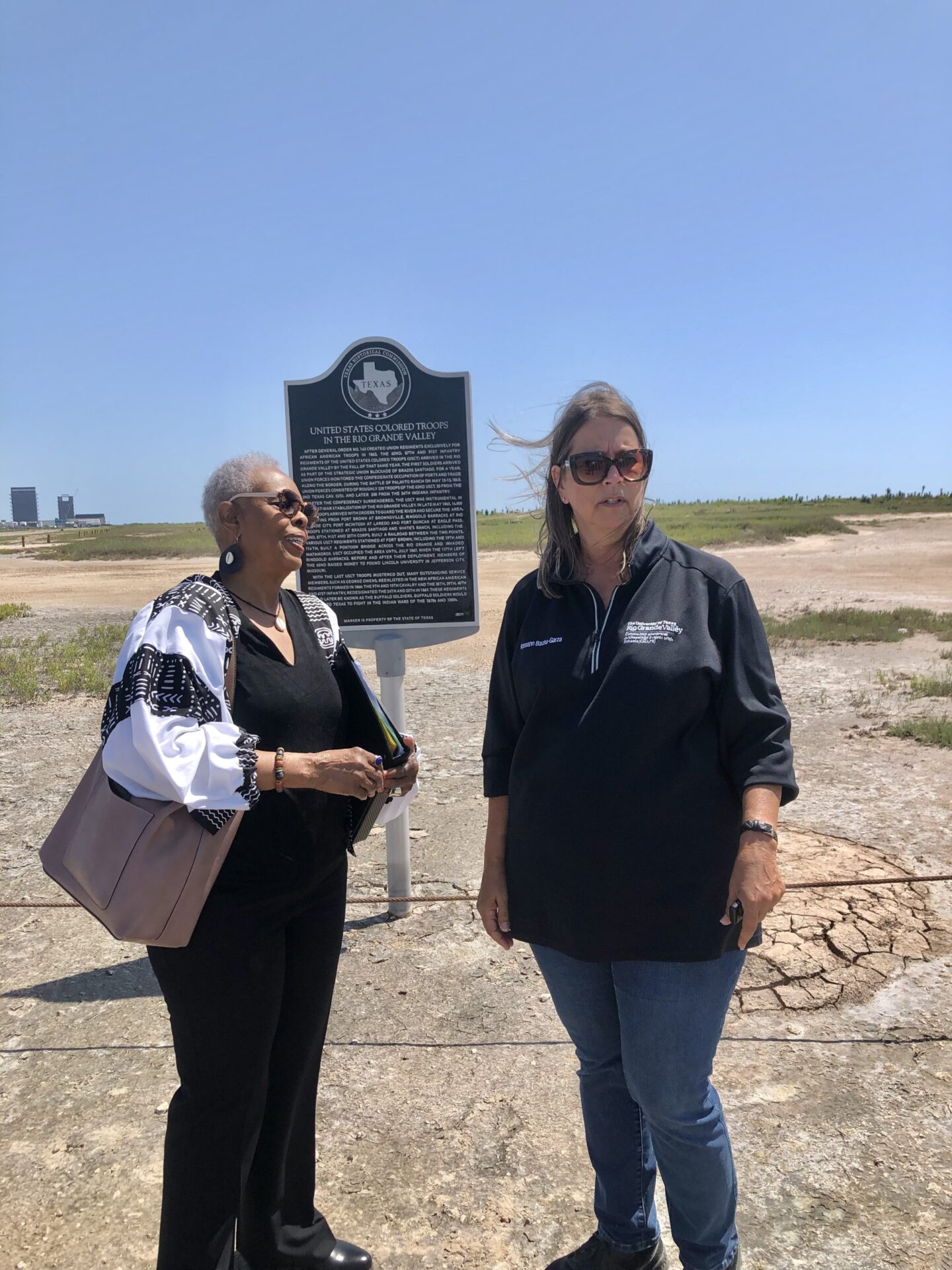
Carrier is the founder and CEO of the Texas Center for African American Living History which recently installed a marker called “The Undertold Story of the Last Battle of the Civil War Texas Historical Marker for United States Colored Troops in The Rio Grande Valley.” The marker is on Highway 4 with SpaceX in the background.
The marker recognizes the importance of the 16,000 soldiers of the United States Colored Troops who took part in the blockade of Brazos Santiago in Cameron County. At that time, Texas planters were sending armed wagon trains to deliver their cotton to Bagdad in the Mexican state of Tamaulipas where Confederate ships picked it up, writes Sandra Tumberlinson, treasurer of the San Benito Historical Society. The Union had created the blockade to prevent cotton and other goods from being picked up by Confederate ships, she says in an article about the marker.
“After the Confederacy surrendered, the USCT was instrumental in the post-war stabilization of the Rio Grande Valley,” Tumberlinson writes. “In late May 1865, 16,000 USCT troops arrived with orders to guard the river and secure the area.”
The proclamation delivered in 1865 in Galveston made Juneteenth a date of hope and then something else ….
“It was a time of hope and a time of despair,” Carrier said. “While it had promises of setting people free, it in fact wound up creating such a climate of animosity until thousands of people were actually murdered and so it did not fulfill its promise of emancipation. However, after the 13th, 14th, and 15th Amendments were passed, it did usher in a period of American history, particularly in the South, that was one of the most important periods of American history in terms of reconstruction.”
Ultimately, even those milestones did not offer a lasting deliverance, said longtime educator George McShan.
“From 1865 to 1877, Black people were free to vote, they had full privileges as white people who had enslaved them,” McShan said. “You had Black elected officials even in Congress, but after 1877 the white people came up with laws that were unequal to them.”
Jim Crow had arrived, with a list of laws that continued to restrict the movements and privileges they deserved. The promise of Juneteenth has been a war fought by thousands for many generations. It was considered a Texas celebration for many years, but in 2021 it has been a federal holiday commemorating the liberation and the struggle of all African Americans.