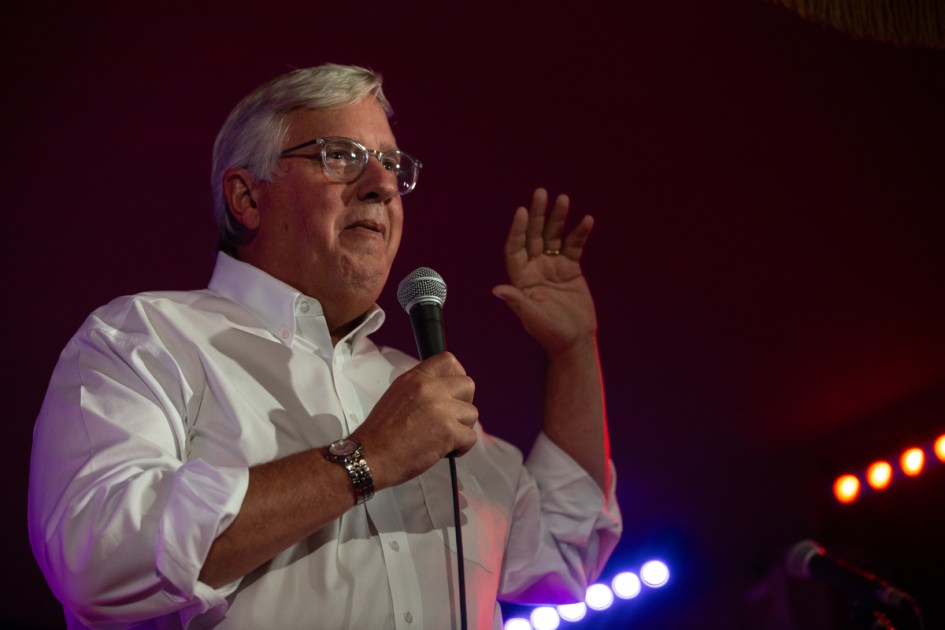

Mike Collier, the two-time Democratic nominee for lieutenant governor, has filed a lawsuit seeking to overturn Texas’ system for independent candidates to get on the ballot.
The federal lawsuit, filed in Austin last week, says that the bar for an independent candidate to get on the ballot is so high as to be insurmountable.
“No state in the nation requires independent candidates for statewide office to gather more signatures in less time than Texas, and no other state is even close,” the lawsuit says.
Collier is joined in the lawsuit by several notable political figures, including former U.S. Rep. and Dallas Mayor Steve Bartlett, former Tarrant County Judge Glen Whitley, former state Sen. Kel Seliger and Sarah Stogner, a West Texas district attorney.
Collier, an accountant and auditor, lost to Lt. Gov. Dan Patrick in 2018 and 2022. He announced last November that he would run again as an independent.
“Both parties are moving to the extremes, leaving those of us in the center without a voice,” he told The Texas Tribune this week. “The two-party system is failing us, and one thing I can do to help is normalize independents running.”
If Collier manages to get on the ballot — either by getting the required signatures, or if a court order lowers the bar — he will face Patrick, the longtime incumbent, and Austin state Rep. Vikki Goodwin, who defeated Houston union leader Marcos Vélez in a runoff in late May.
Background: Under Texas law, any political party that got at least 20% of the vote during the last election cycle nominates their candidates through primary elections, which the state pays for.
The hill is much higher for independent candidates, those not affiliated with any political party. They must submit a petition with the number of signatures equal to 1% of the total vote for governor in the preceding election — more than 81,000 to get on the 2026 ballot. Voting in either party’s primary makes you ineligible to sign an independent candidate’s petition.
All signatures must be submitted by 30 days after the primary runoff, but a candidate cannot start gathering signatures until after the primary is decided. In most cases, that gives them 113 days to collect signatures.
But Collier is trying to get on the ballot for lieutenant governor, so he could not start gathering signatures until after the Democratic runoff concluded in late May. He will have just 30 days to gather tens of thousands of signatures, a requirement he says is “so burdensome that no independent candidate for statewide office has ever qualified for the ballot in Texas” in a race with a runoff.
What Collier is saying: When he declared his intent to run as an independent, Collier didn’t fully understand the mountain he was going to have to climb.
“A more cautious person would have studied it more carefully, but I wasn’t going to let that decide whether I would try,” he said. “Even once I learned what it required, I wouldn’t have been motivated to file the lawsuit except that the runoff turned an already insurmountable challenge into the absurd.”
Collier estimates he would need 1,500 volunteers gathering several signatures an hour, which is a challenge since about two-thirds of the people he has encountered during the petition drives are disqualified because they voted in the primary. He sought bids for companies to help him gather the signatures — one came in at over $3.2 million, even before the timeline was cut short.
The timeline for gathering signatures has remained the same, even as the number of Texas voters — and thus, the signature count — has skyrocketed, Collier said. This has unconstitutionally kept him and other independent candidates off the ballot, and prevented voters who want to elect independent candidates from participating fully.
“The constitution says I can run for office and the Legislature says I can’t, so we’re going to let the courts decide,” he said.
What the Secretary of State says: In a statement, a spokesperson for the Secretary of State said they are not commenting on the lawsuit at this time.
This lawsuit is not the only challenge facing the agency recently. Earlier this month, Secretary of State Jane Nelson announced she would be stepping down in mid-July. Gov. Greg Abbott has not yet named her replacement. During her tenure, Nelson’s office complied with the U.S. Department of Justice’s request for access to the state’s full voter roll, one of 15 states to do so, and began using a federal database called Systematic Alien Verification for Entitlements, or SAVE, to verify the citizenship status of registered voters. Both actions generated legal challenges and blowback from election security experts and voting rights groups.
More recently, the agency found itself crossways with GOP leaders who want to close the primary elections to just registered voters of each party.
Source link