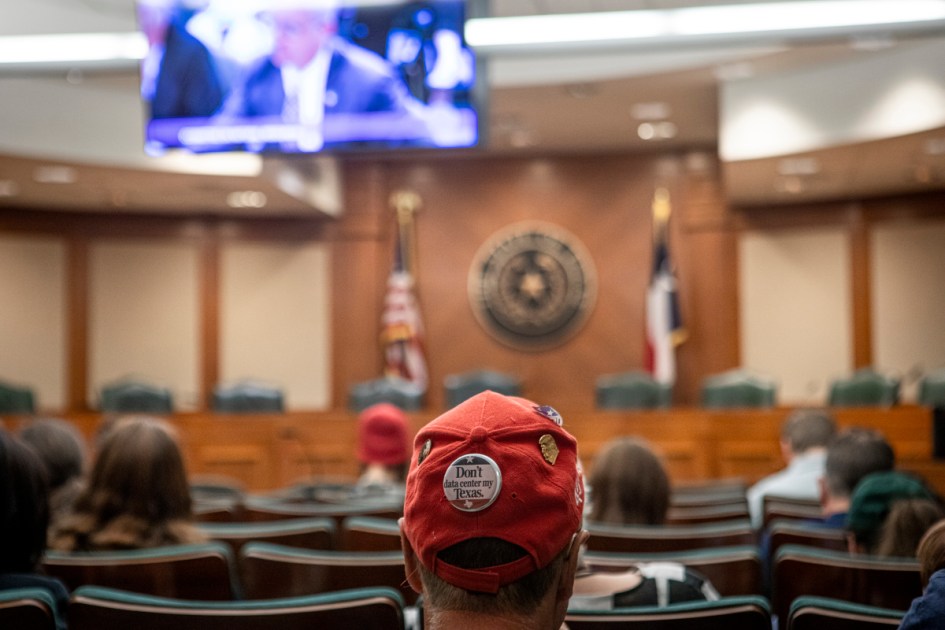

Data centers need a lot of water and energy. State officials want to know how much, and they hoped a survey sent to data center companies would give them the answers.
But at a legislative hearing Tuesday in Austin, they were told less than a third of the companies surveyed responded.
“Bad data, bad study,” said state Rep. Brad Buckley, R-Salado, a member of the House Natural Resources Committee.
Texans have been thirsty for information on how much water data centers in Texas use — and plan to use — as a rush of proposed new projects has flooded communities across the state. With more than 248 proposed data centers, Texas is challenging Virginia to become the No. 1 market for data centers in the U.S.
Communities and some state officials have aggressively pushed back against the growing industry. Their impact is being felt as Texas has shifted from aggressively courting data centers to tightening oversight — the latest move, by Gov. Greg Abbott, directs public utilities to ensure that the infrastructure costs required to serve data centers are not passed on to their customers.
Abbott has also issued recommendations for legislative action, including requiring data centers to use the most efficient, and more expensive, water recirculation systems to cool their servers.
Google recently announced their commitment to use 100% air‑cooled, closed‑loop cooling systems for new data centers. And the industry says its cooling technology is improving to require less water.
The water survey, developed by the Public Utility Commission of Texas in collaboration with the Texas Water Development Board, was a step by lawmakers to get more transparency on how data centers work. It’s intended to inform future water planning and help policymakers better understand the relationship between water use and energy demand at large industrial facilities.
It asked operators to provide information about water consumption, cooling systems, water sources, electricity demand and whether facilities are connected to the state’s electric grid or have their own on-site power source such as a gas-fired power plant.
The agency received responses from only 28 companies representing 92 facilities at various stages of development, according to Chris Brown, a program manager and economist at the PUC.
It’s unclear how many surveys the PUC sent out, but lawmakers noted that the 92 facilities represent only a small fraction of the state’s existing data centers.
Several legislators questioned whether the survey results would provide a reliable foundation for future planning. Buckley criticized the response rate, calling the participation level “pretty pathetic” and warning against making major policy decisions based on incomplete information.
“That’s just how science works,” Buckley said. “You either have enough data or you don’t.”
Lawmakers repeatedly pressed PUC staff for more details about the responses, including how many facilities were traditional data centers versus cryptocurrency mining operations and how many surveys were fully completed versus only partially completed. Those figures were not available during the hearing. Brown said the agency could get those soon to lawmakers.
“On transparency, this is a fast moving and highly competitive industry. Companies must protect proprietary, confidential, and competitive information,” said Dan Diorio, vice president of state policy with the industry group Data Center Coalition. He added that he’s working with the TWDB and the PUC to see how his coalition can help get more data centers to respond to the surveys.
He suggested that agencies could perhaps “aggregate and anonymize information to alleviate any confidentiality concerns moving forward.”
This isn’t the first time the state has received few responses to a survey. The Water Development Board has been sending mandatory water consumption surveys to data centers since 2023. The number of individually surveyed data centers has grown from 22 to 341.
Only one-third of data centers surveyed in 2024 responded and in 2025 only 17% responded, according to an agency official. The consequences for noncompliance are minimal — a Class C misdemeanor with a maximum fine of $500.
Unlike the TWDB surveys, the PUC survey is not mandatory, and agency officials said there is no incentive for data center operators to submit the requested information.
State Rep. Jeffrey Barry, R-Pearland, said lawmakers can’t rely on “sparse information” to make long-term policy decisions about increasingly scarce water resources.
“We see this pattern of continuing to use either, you know, half-baked information or old information to make futuristic determinations on where we’re moving forward, we need to be a little bit more consistent in the types of data,” Barry said.
Disclosure: Google has been a financial supporter of The Texas Tribune, a nonprofit, nonpartisan news organization that is funded in part by donations from members, foundations and corporate sponsors. Financial supporters play no role in the Tribune’s journalism. Find a complete list of them here.
Source link