
NEWS Staff Report
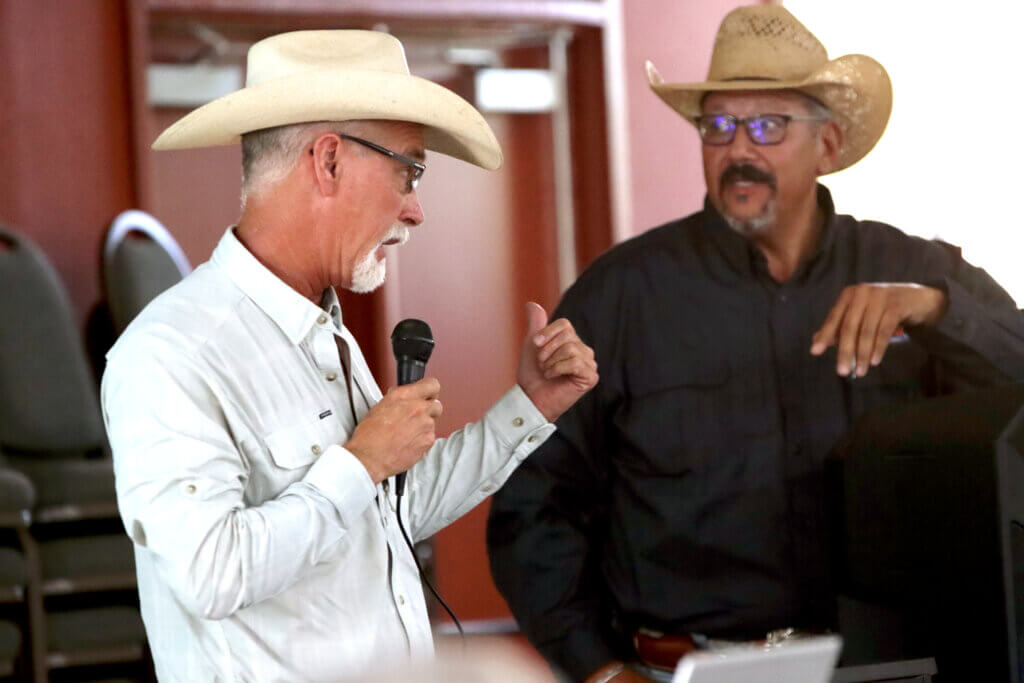
RIO HONDO, TX—Experts addressed an audience of more than 60 people, including many livestock producers, at an informative workshop on the New World Screwworm (NWS) held here Tuesday evening at the Civic Center.
The workshop lasted more than two hours, and while many in attendance expected a bleak outlook for the regional infestation of this flesh-eating parasite that riddles livestock and wildlife, experts drove home a message of hope through preventive measures and education.
Experts also reminded attendees that the NWS threatens all warm-blooded animals, including pets, wildlife such as deer and feral hogs, birds, and even humans, as well as livestock. While cases have been reported in Texas and New Mexico, none have been reported in Cameron County or its neighboring counties as of yet.
The speakers did concede, however, that there were possibly more cases of infection that have gone unnoticed and unreported.
The workshop aimed to help livestock producers, agricultural professionals, wildlife managers, and community members better understand the potential impact of the NWS and learn how to protect animals through awareness, preparedness, and early detection.
Guest speakers include Freddy Nieto, director of the Texas & Southwestern Cattle Raisers Association, and Eli Benavidez, region manager at the Texas Animal Health Commission. Attendees received two general continuing education units (CEUs).
According to Blair Fannin, media relations manager at Texas A&M AgriLife, the program’s primary goal was education and preparedness.
“The message right now is surveillance,” Fannin said. “Monitor herds daily for any unusual activity and report anything suspicious.”
NWS is a parasitic fly whose larvae feed on open wounds and can cause severe injury and death if not promptly detected and treated. Fannin said ranchers should pay particular attention to vulnerable areas, including newborn calves’ navels and any cuts, wounds, or lesions on livestock.
Officials are urging producers to watch for unusual animal behavior, non-healing wounds, or suspicious lesions. Fannin noted that game cameras can be useful for monitoring animal activity and for early detection of potential issues.
Although no preventive medication currently exists for NWS, early detection remains one of the most effective defenses. Producers are encouraged to inspect animals regularly and promptly report any concerns.
Anyone suspecting a screwworm infestation should contact their local veterinarian or the Texas Animal Health Commission at 1 (800) 550-8242. Wildlife concerns should be reported to the Texas Parks and Wildlife Department at (512) 389-4505.
In addition to the educational program, Texas A&M AgriLife Extension provides fact sheets and other resources covering the basics of New World Screwworm, wildlife impacts, and livestock management.
Several resources on the AgriLife Extension website are available in English and Spanish: https://agrilifeextension.tamu.edu/new-world-screwworm.
On June 3, 2026, the U.S. Department of Agriculture (USDA) confirmed the first case of NWS in the United States, identifying an infected calf in Zavala County, Texas.
Federal and state animal health officials responded to the detection by establishing an infested zone, conducting animal and fly surveillance, conducting epidemiological investigations, and implementing established response protocols to prevent further spread.
Although Zavala County is approximately 300 miles from Cameron County, county officials have been in contact with the appropriate state and federal agencies to ensure that local departments remain informed, prepared, and ready to assist with response efforts while protecting animals in the county’s care, according to a Cameron County press release.
Cameron County officials are also working to increase public awareness and to encourage livestock and pet owners, veterinarians, and animal caretakers to closely monitor animals for signs of infection and to immediately report any suspected cases.
The confirmation follows ongoing regional coordination among Rio Grande Valley county judges (Cameron, Hidalgo, Starr, and Willacy), state agencies, and animal industry partners.
At a regional press conference on May 18, 2026, local leaders discussed the potential threat posed by NWS and emphasized the importance of preparedness and public awareness.
If any member of the public suspects NWS in an animal, he or she is encouraged to immediately contact the Texas Animal Health Commission at 1 (800) 550-8242.
Current eradication efforts rely on releasing sterile male flies, a proven method that prevents reproduction and helps eliminate screwworm populations.
Currently, sterile flies from a reproduction facility in Panama are being released in South Texas. A large-scale sterile fly production facility is also under construction by the USDA in Edinburg, with a target completion date of November 2027.
For more information on NWS and best practices for monitoring, prevention, and treatment, visit the Texas Animal Health Commission’s New World Screwworm information page: https://www.tahc.texas.gov/emergency/nws.html
Free Inspector Training Launched
AS previously reported, Texas Governor Greg Abbott launched a free online course to increase the number of certified NWS inspectors statewide.
This course enables more Texans to inspect their animals and certify the documentation required to safely move them, which is critical to keeping cattle and livestock commerce running uninterrupted.
Developed by Texas A&M AgriLife Extension in partnership with USDA-APHIS, the Texas Animal Health Commission (TAHC), and the TPWD, the first-of-its-kind program launched two weeks ago Saturday.
The course is an online, modular program delivered via the AgriLife Learn platform.
It includes narrated modules, demonstration videos, and knowledge checks covering NWS biology and life cycle, surveillance and reporting, species-specific inspection and treatment protocols, the roles of state and federal agencies, and movement permitting requirements.
Those who meet TAHC eligibility standards and pass the final exam may apply to become a TAHC Certified NWS Inspector, authorized to issue official NWS Treatment/Movement Certificates for the lawful movement of livestock out of infested zones.
Phase one immediately opens eligibility to the following groups, in addition to existing authorized personnel, including thousands of Texas veterinarians: Licensed veterinarians (not already in the Authorized Personnel Program); veterinary technicians; Texas A&M AgriLife Extension agents and Disaster Assessment and Recovery agents; Texas Department of Agriculture inspectors; Texas Department of State Health Services Meat Safety inspectors; Texas Racing Commission inspectors; animal control officers; livestock deputies; and designated personnel from temporary livestock aggregation points.
Additional groups may be added in future phases as the program evolves. The course is also available to any Texan for educational use.
Livestock owners, managers, veterinarians, government personnel, and allied industry professionals are encouraged to enroll.
To access this free online course, register for an account, add the course to your cart, and then proceed to check out.
Speakers at Tuesday’s workshop emphasized that NWS is not a contagious disease and does not spread directly from one animal to another.
NWS is also not a food safety issue. Screwworms do not infest meat or other food products. The food supply remains safe, they stressed. The fly and/or larvae will also die if ingested.
Since the U.S. Department of Agriculture confirmed the first case of NWS in the United States, pet owners and shelters alike have expressed concern about what this might mean for their animals.
Because the larvae of the parasitic fly infest wounds and can create significant tissue damage if left untreated, veterinarians are encouraging shelters and pet owners, including those who work with colonies of stray or other unowned animals, to remain vigilant and stay informed, especially because NWS infestations can be easily prevented and treated.
Dr. Guilherme Verocai, an associate professor and director of the Parasitology Diagnostic Laboratory at the Texas A&M College of Veterinary Medicine & Biomedical Sciences, offers guidance for how owners can identify, prevent, and manage the parasite.
How New World Screwworm attacks animals
NWS, or Cochliomyia hominivorax, is a species of parasitic blow fly whose larvae are known for their screw-like shape. While the adult fly is relatively harmless, the danger comes when female flies lay eggs in open wounds.
“The female fly is attracted to wounds or lesions on an animal. It can be as small as a tiny scratch or a post-surgical wound,” Verocai said in press release from Texas A&M. “They will lay eggs around the edge of the wound, and, within 12-hours, the larvae will hatch from those eggs and begin feeding on live tissue.
“That’s really key with C. hominivorax,” he said. “Unlike other blow fly species, C. hominivorax requires live animals to survive.”
The adult fly thrives in warm climates, with activity typically occurring between 65 and 91 degrees Fahrenheit.
These flies, which Verocai describes as “strikingly metallic in color” — with metallic greens and blues and red eyes — should not be confused with their “first cousin,” Cochliomyia macellaria, another species of blow fly that is more common in the U.S., but which is typically harmless.
“Adult C. hominivorax are not going to be seen resting on the animals like horn flies or stable flies; they’re typically resting in forested areas,” Verocai said.
How fast it spreads and why it’s so dangerous, according to a Texas A&M press release.
Female C. hominivorax lays a couple of hundred eggs around an existing wound, and within 12 hours, depending on the temperature, the eggs will hatch. This can result in an infestation that can escalate quickly and become severe as the small larvae eat and grow larger.
“You’re not going to have just one or two larvae — it can be dozens or even hundreds feeding on live tissue,” Verocai said. “And it’s not a picky parasite; although it rarely infests poultry or birds, any warm-blooded mammal is quite suitable as a host, if given the opportunity.
“Screwworms can infest all warm-blooded animals, including dogs; cats; livestock; wildlife, including, rarely, birds; and even people,” he said. “In endemic areas cattle are most commonly affected, but dogs are usually the second most affected among domestic species.”
Stray or unowned dogs and cats are likely at higher risk of NWS infestation for several reasons, including being more prone to injuries and not having access to veterinary care and preventative medicines that may treat or prevent an infestation.
Because the parasite targets living flesh, it can cause extensive tissue damage and, if left untreated, may quickly become life-threatening, depending on the location and severity of the infestation.
As such, early detection is key for managing NWS infestations; pet owners should watch for: Visible larvae in a wound, Wounds that worsen quickly, A foul odor, often described as decaying tissue, swelling or irritation around a wound,
How to prevent and treat New World Screwworm
Preventing NWS infestation starts with routine care and awareness, which can include: checking pets daily for wounds or injuries; cleaning and treating wounds promptly; monitoring surgical wounds daily until they are completely healed; keeping pets up to date on veterinary care; and seeking veterinary attention for unusual wounds or odors.
“If you notice anything concerning, don’t wait — reach out to your local veterinarian,” Verocai said. “Early diagnosis, confirming, and treating as early as possible makes a big difference.”
Because this is not a disease — it is an insect infestation — the animal typically recovers when the insects are removed, especially if attention is given early.
It’s also important that owners keep their pets on routine parasite preventative medicines, some of which can be effective against screwworm larvae.
Since April, the U.S. Food and Drug Administration has issued conditional approval or an emergency use authorization for several antiparasitic products that prevent and treat NWS across multiple species.
Other New World Screwworm resources
There are many educational resources available through the Texas A&M AgriLife Extension Service, the Texas Animal Health Commission, and the U.S. Department of Agriculture, all of which provide practical guidance on identifying potential signs of screwworm infestation, monitoring wounds, and when to seek veterinary care.
“If you suspect New World Screwworm in your dogs or cats, do not wait,” Verocai said. “Immediately isolate suspected animals and contact either the Texas Animal Health Commission (1-800-550-8242) for livestock cases; Texas Parks and Wildlife (512-389-4505) for wildlife cases; or your local veterinarian for your pets or other small animals.”
More information on reporting cases and submitting samples to the appropriate authorities also is available through Texas A&M AgriLife.
Verocai emphasizes that while NWS is in the U.S., and may be here for a while, there’s no need for owners to panic.
Though these parasites cause serious issues, by continuing the habits that help protect your companion animals — including the regular use of parasite preventatives — and by staying vigilant and addressing wounds early, owners can rest assured that their pets will be safe from NWS.
Governor Abbott also announced this week the launch of an enhanced website that provides Texans with comprehensive information about the New World screwworm (NWS). Located on the Texas Division of Emergency Management’s Disaster Portal, Texans can visit screwworm.texas.gov to access a “one-stop shop” of information and resources from state agency partners engaged in NWS response.
“The New World screwworm poses a direct threat to Texas livestock, wildlife, and our rural economy,” said Governor Abbott. “This new website puts essential tools in the hands of our producers, veterinarians, and families. Screwworm.texas.gov delivers the facts, maps, identification methods, and certification resources Texans need to detect problems early and report cases without delay. Now every Texan has the information to act. Texas will protect our land, our animals, and our way of life from this pest.”
The new website serves as a central resource where Texans can access actionable and reliable multimedia information about NWS, including fact sheets, videos, and educational materials.
Texans can access numerous resources and tools through the web portal, such as background information, how to spot NWS, sample collection procedures, Texas Animal Health Commission (TAHC) NWS zone maps, the United States Department of Agriculture (USDA) case dashboard, links to best practices for livestock and wildlife, as well as details on registering for the new no-cost NWS Certified Inspector Training.
State and federal partners continue to work collaboratively to detect, control, and contain its spread as efficiently as possible. A key component of this effort is expanding public outreach and providing clear, accessible information to reduce risk.
Governor Abbott also directed the creation of the joint Texas NWS Response Team, bringing together state agencies, producers, veterinarians, wildlife experts, and federal partners.
He joined USDA Secretary Brooke Rollins to announce a $750 million investment in a new sterile fly production facility in Edinburg and to issue a statewide disaster declaration to mobilize resources and strengthen response efforts ahead of the first detection.
The Governor has also deployed all available state resources, activated the State Emergency Operations Center following the first confirmed NWS cases in Texas, joined Secretary Rollins and federal partners at the Knipling-Bushland U.S. Livestock Insects Research Laboratory in Kerrville for a briefing on the ongoing NWS response, and announced federal funding to strengthen NWS inspection capacity.
During Tuesday’s meeting, State Representative Janie Lopez of San Benito addressed the audience, saying that the state has been working diligently to address the matter and that her concern is not only for Valley producers but also for producers statewide and the state’s economy as it relates to the livestock and ranching industry.
Meanwhile, event co-organizer, rancher and Arroyo City resident EJ Sandoval said that his hope was that more of the Spanish-speaking producers who own smaller farms and ranches would attend and that he would continue to target those producers in future talks he plans to organize in adjacent communities. The evening prior, a similar event was held in Willacy County to stellar crowds.
