Subscribe to The Y’all — a weekly dispatch about the people, places and policies defining Texas, produced by Texas Tribune journalists living in communities across the state.
LUFKIN — Kaesha Avishai picked her corner of East Texas around five years ago. It was, for her, the ideal spot — close enough to town for shopping and doctor’s visits and far enough away to care for her cats and chickens in peace.
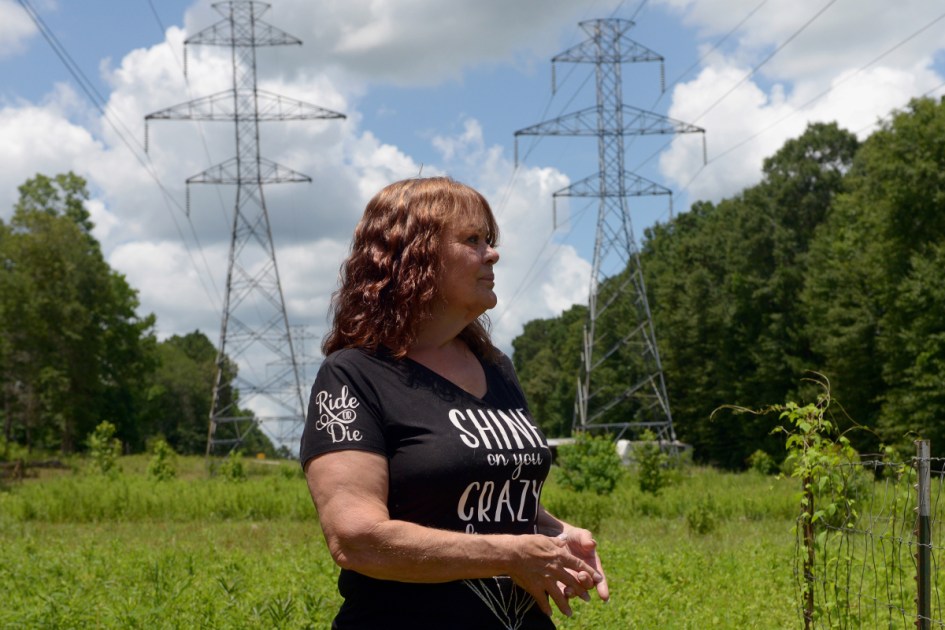
Then, men on four-wheelers began crossing her land. Pesticides and herbicides were sprayed along the edges of her property, killing every bit of life they touched. Helicopters and drones flew overhead. And one day, the buzzing powerlines on the easement through her property went quiet.
When she read in the paper that the land had been sold to Denver-based AmpZ Champion Data Center Holdings and its partner, Atlanta-based EPG Champion Development LLC, a renewable energy company, she wasn’t surprised in the least. And she was certainly angry.
“I can’t promise to keep the Second Commandment to love my neighbor if my neighbor is not human,” she said.
Due to the explosive use of artificial intelligence, data centers, many of which are used to power AI, are popping up across rural Texas and have attracted the attention — and scrutiny — of lawmakers and residents alike. Two data centers, including the one near Avishai, are planned for Angelina County. East Texas, in particular, has become a target for data center developers because of the available water and land.
Now East Texans, who moved to the region for peace and quiet, are faced with a form of economic growth they believe will take that away. If Angelina County is going to sign any agreements with developers, residents say they want guidelines in writing that ensure these data centers won’t disrupt their communities.

After more than a year of disruption, Avishai, a retired nurse, had had enough of the disruption to her land. She used ChatGPT to write a speech to the Angelina County Commissioners and attended their first meeting in early June alongside dozens of neighbors.
The irony of using ChatGPT — an artificial intelligence chatbot — wasn’t lost on her.
“You can use their weapons against them,” she said.
Data centers promise economic opportunities for communities fighting for growth and a stronger tax base. In communities like Lufkin, a project like this fits with the dozen or so companies that have sought tax abatement agreements with the city and county.
But in the face of community backlash, even Gov. Greg Abbott, who has built support based on his pro-business stance, has called for regulations and an outright ban on data centers in rural neighborhoods like Avishai’s.
She was disappointed when county officials said they couldn’t do much. Avishai, a born-again Christian, moved to Texas believing it was a stronghold of faith and peace. She believes the impact on Texas’ land imposed by data centers is a violation of that ideal.
“I would have thought — or hoped or prayed — that our representatives would have had a little more of that Christian backbone to stand against something that is so obviously evil,” Avishai said.
However, Lufkin Mayor Mark Hicks who has long-championed this project for its potential benefits to the county, has faith it will bring jobs and tax money to the county. And he hopes the companies building the center will make sure it is safe.
“I’m not going to say that there was not a data center built somewhere where promises were made and broken, or things didn’t pan out the way that they should have, or maybe these communities didn’t have the infrastructure to support the data center,” Hicks said. “But from what I have been told about the one here, I just don’t see an issue.”
East Texans are concerned
At a meeting in Angelina County one June evening, a room full of East Texans buzzed with the many possibilities of what the data center outside of Lufkin would mean for the region. Research they found, in the wake of few answers from the company itself, said data centers drank up tons of local water, caused electric bills to skyrocket and the hum led to health problems and stress.
That’s what brought Christina Perez, a Houston-based political activist, back to her family farm, which also neighbors the proposed data center.
“I really just want to make sure that we don’t see some big tech company from Denver — or any of these different places from out of state — come and take away our resources and turn our home into an industrial wasteland,” she said.
In 2025, data centers consumed an estimated 25 billion gallons of Texas’ water, representing less than 1% of the state’s total usage that year, according to the Houston Advanced Research Center, an independent nonprofit research organization focused on sustainability solutions. That number is projected to rise to 2.7% by 2030. Those numbers are based on the cooling systems and power generators that data centers currently use.
In the last two years, the Electric Reliability Council of Texas said 519 companies have asked to connect to the system. That would increase power demand by 438,595 megawatts — or, roughly, one-third of the power generation in America. These types of requests have been followed by rate increases across the rest of the country, according to the Environmental and Energy Study Institute.
A Time Magazine investigation found that the humming from bitcoin mining operations — which are similar to certain data centers — led to mysterious ailments in Granbury that doctors tied to stress from noise pollution.

“I don’t want to be by a data center,” Avishai said. “I don’t want to hear the buzz, the hum.”
Raine Cotton, managing partner for EPG Champion Development LLC and a representative of the project, said the company is open to working with the county and protecting the neighborhood. In fact, some of the concerns residents have expressed are being considered in the company’s plans.
For example, the proposed facility would use a closed-loop cooling system, meaning it would fill the system once with about 30,000 gallons of water and reuse it for up to 10 years instead of drawing in new water every day. Part of the 1,000 acres the company purchased would be used as a sound buffer zone to reduce the impact on nearby neighborhoods and also to preserve the natural wetlands that surround the site.
Cotton also said it would be no issue to provide regular reports to the county that address any environmental concerns, he said.
“There are more than 100 of them operating around Dallas, and oftentimes, you don’t even know they’re there,” Cotton said. “They look like a warehouse, sometimes there’s a facade on them. The community will benefit greatly from having that site cleaned and put in its place a state-of-the-art producing facility that will clearly be the No. 1 taxpayer in Angelina County.”
The data center would be built on 1,000 acres along State Highway 103 East at the site of a former papermill just outside of Lufkin. While the site is outside of the city proper, it is surrounded by small neighborhoods and homesteads like Perez’s and Avishai’s.
A town built on industry
The project could represent $1 billion in private capital investment, 30 full-time jobs and 500 construction jobs, according to Lufkin city officials.
Lufkin and Angelina County have long been friendly to economic development, especially smaller, diversified industrial operations that invest heavily in local land. Between 2018 and 2023, the city enticed half a dozen such companies to build in the city and its extra-jurisdictional territory through grants and tax abatements. Many of those agreements came through Keith Wright, the Angelina County Judge who was once Lufkin’s city manager.
This business-friendly mindset is not new. Lufkin has a long history as an industrial town. The city was built on major industries, like the papermill which once employed hundreds of people. It is the home of the oil pump that changed the game for the oil and gas industry in the 1950s, and community members still celebrate that legacy every Christmas.
Wright fully supported the data center until he learned more about the potential harm that comes with data centers. He said his goal is to establish a tax abatement agreement with AmpZ with some conditions that would make the company a better neighbor to Avishai and the community at large.
“They would have to ensure there’s no environmental impact to the county and that we’re protecting residents adjacent to this thing,” Wright said. “All of those are going to be conditions. But whether we can actually come to an agreement or not is going to be another question.”
Trying to be a good neighbor
Moving forward, residents want more information on the center and if they have the ability to stop this project if it fails to meet their expectations. Only one of those things will likely happen, however.
Aside from proposing a ban, Abbott released recommendations for industry regulations for lawmakers to consider in 2027, such as:
- Requiring new facilities to add power generation to the grid
- Mandating the use of “closed-loop” water systems
- Mandating reporting on electricity and water use
- Establishing standards that address community concerns
None of those recommendations give Texas counties the power to stop a project, which means residents won’t have that power either.
Cotton promised to hold town hall meetings in Angelina County in August or September to address residential questions and concerns. Up to this point, he hasn’t had all the answers and said he didn’t want to give them information that could change, he said.

“I know specifically in the Lufkin/Angelina County area there is a perception that perhaps we’re hiding, or not being transparent,” Cotton said. “That’s really not the case. We’re in the planning, engineering and regulatory environment right now.”
Momentum behind the grassroots organizations formed to address this center is not likely to slow, especially as AmpZ makes progress on the papermill. But, after town hall meetings and consultations with experts, East Texans will be turning their attention to Austin.
Avishai debates whether it’s worth continuing to invest in the flower farm she started this spring or if she should pack her animals up in her truck and leave. She sees the data center as an inevitability now that Texas has embraced them as part of its future industrial structure.
But it’s hard to let go of the home where she finally felt at peace.
“I would just like to stay here in my little cocoon by myself,” she said. “To take care of my animals and feed birds and la la around like Sleeping Beauty or something. But I’m afraid the giant has awakened, and the giant is coming.”
Disclosure: Houston Advanced Research Center has been a financial supporter of The Texas Tribune, a nonprofit, nonpartisan news organization that is funded in part by donations from members, foundations and corporate sponsors. Financial supporters play no role in The Texas Tribune’s journalism. Find a complete list of them here.
Source link