|
Only have a minute? Listen instead |

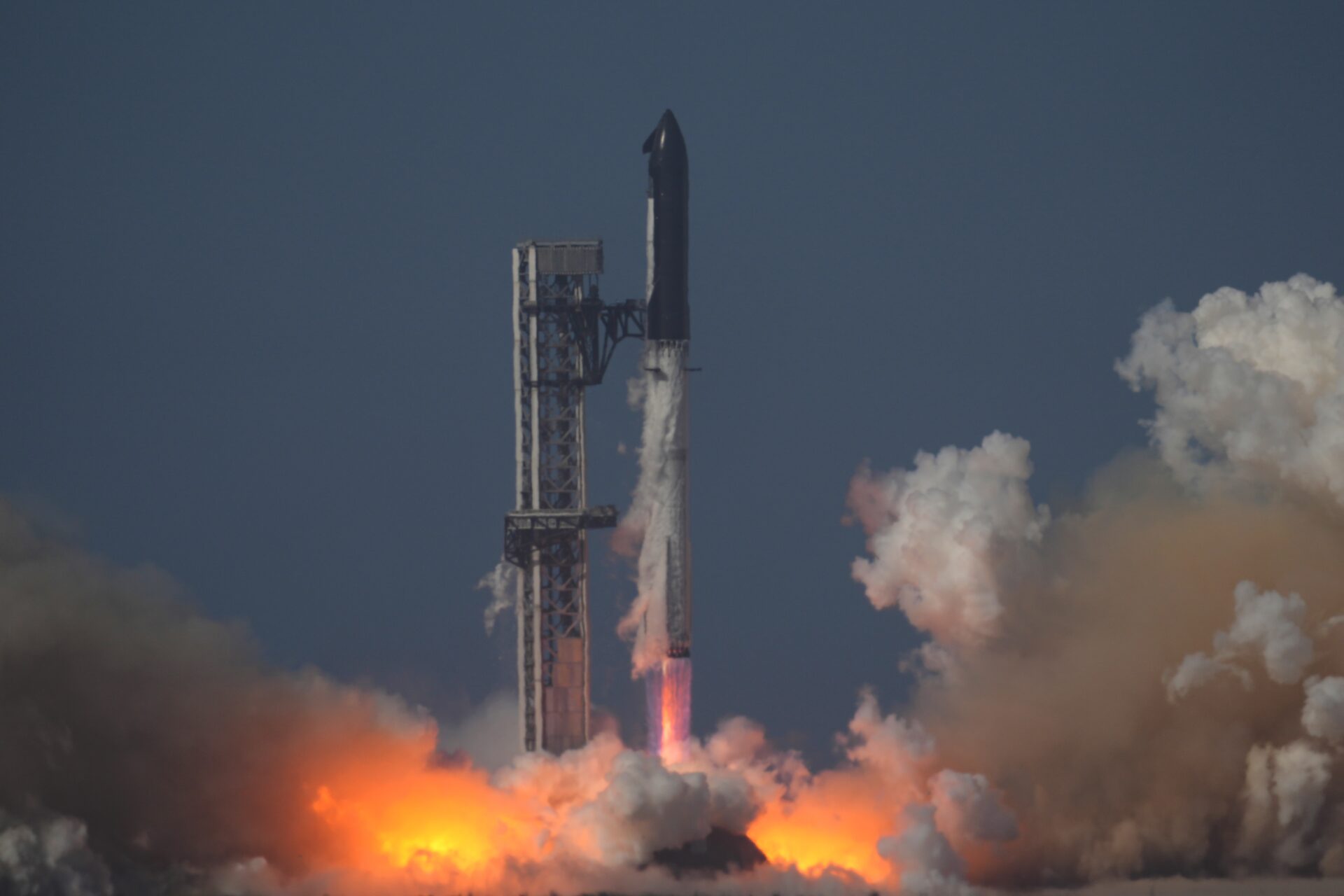
Starship S40 and Super Heavy booster B20 lifted off from SpaceX’s launch pad No. 2 at Boca Chica at 5:51 p.m. on Friday after scrubbing the launch twice, yesterday due to weather and on July 16 because some booster engines failed to light.
It was the 13th flight of Starship/Super Heavy and the second flight of the latest version (V3) of Starship, which has six engines, and the Super Heavy booster, fitted with 33. Starship/Super Heavy V3 is significantly redesigned, and larger and more powerful than the previous version, V2. Fully stacked, the V3 vehicles rise to more than 400 feet and are nearly 30 feet in diameter.
The stage-one booster and stage-two Starship separated a few minutes after launch as planned, with Super Heavy making a controlled landing offshore six minutes after liftoff and Starship on a suborbital trajectory to reentry and soft splashdown in the Indian Ocean near Australia.
With Friday’s landing of Super Heavy in the Gulf, SpaceX appears to have corrected the issues that caused the loss of booster B19 during Flight 12 on May 22. During that flight, Super Heavy lost some of its engines after separating from Starship and plummeted into the Gulf rather than touching down under power.

A mishap investigation mandated by the Federal Aviation Administration and conducted by SpaceX concluded that the incident was likely caused by heat damage to the booster’s propulsion system and “erroneous engine alarm system settings.” The investigation closed on July 13, clearing the way for Friday’s launch.
Flight 13’s mission goals were basically the same as Flight 12’s, with the exception of satellite deployment. This time Starship deployed 20 real Starlink V3 satellites as opposed to the mock-ups used in previous test flights.
SpaceX said that six of the satellites were fitted with cameras to scan Starship’s heat shield tiles and send the images to flight operators, to assist the continuing effort to find ways to analyze the ability of the heat shield to protect Starship during reentry, all leading up to an eventual attempt to land a Starship back at the launch pad to be reused.
Reusability of Starship and Super Heavy are key to the success of the development program, which otherwise would not be financially feasible. SpaceX has managed to “catch” boosters at the launch site, with Flights 5, 7 and 8, reusing two of them in subsequent launches. It has not yet been attempted with Starship.

Friday’s mission included a successful single Starship engine relight in space 39 minutes into the flight, a test abandoned during Flight 12 due to the loss of one of the ship’s engines during ascent.
According to the company’s website, a number of hardware and software modifications were done to fix problems that arose during Flight 12. For instance, due to slight differences in Starship’s engine startup (to initiate stage separation) the booster’s ensuing “directional flip” was off by about 90 degrees.
“After stage separation and the flip, the Super Heavy booster attempted its boost-back burn,” SpaceX said. “Five of its 33 engines experienced issues when attempting to re-light, causing the boost-back burn to end early.”
Without engine power, B39 fell into the Gulf from altitude at a high rate of speed.

“The startup sequence has been modified to be more robust to timing variability and more reliably flip in the desired direction, which is done to increase overall performance,” SpaceX said. “The Super Heavy on this upcoming flight has hardware modifications to improve re-light reliability along with updates to engine alarms and aborts to match the conditions seen in the multi-engine flight environment.”
As for “interconnected causes” behind the loss of one of Starship’s engines, which occurred about 40 seconds after stage separation on May 22, several “hardware and operational modifications” were performed to correct it for Friday’s flight, “with additional reliability improvements planned in upcoming versions of the Raptor engine.”
All mission objectives achieved, Flight 13 concluded at 6:56 p.m. with Starship lowering itself into the waves of the Indian Ocean under power. For the first time, after landing and falling over into the water, the ship did not explode. Instead, it floated on its side for at least several minutes according to livestream video, and was still floating, in no hurry to sink, when the video ended, orange flames playing around Starship’s singed fuselage.
Editor’s note: This story and headline have been updated with the full version.