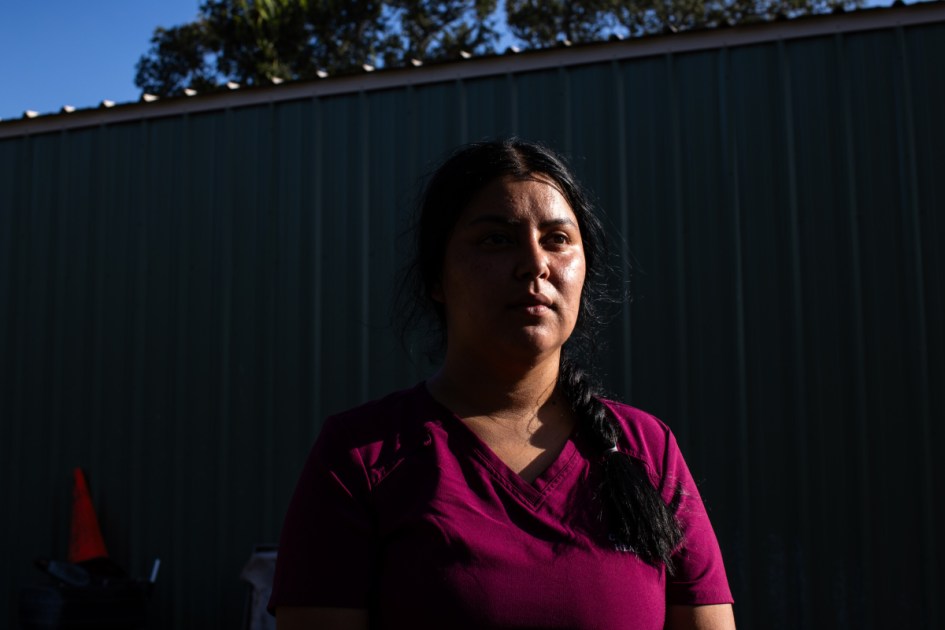
Growing up in Austin, all the kids in Itzayana Mondragón’s neighborhood looked pretty much like her — and spoke Spanish too.
Soon after Donald Trump won the presidency in 2016, Mondragón noticed that some of her friends had stopped attending class. She would learn later that those classmates were undocumented and had returned to their home countries — some out of fear, some against their will, as Trump delivered on his campaign promise to crack down on illegal immigration.
Mondragón’s parents sat her down to explain that they were undocumented — and so was she. The family had crossed the border from Mexico in 2000 when she was six months old.
“I didn’t know I was what people here call ‘illegal’ until high school, when the Trump administration came into office,” Mondragón said. “I did grow up with the fear of hearing my parents say, ‘What’s going to happen if they deport us?’ But it never crossed my mind to think, ‘You’re illegal.’ ”
As Trump’s first administration ramped up border enforcement and increased deportations, Mondragón, like many migrants who have long lived in the U.S., turned to an immigration program launched under President Barack Obama’s administration. The Deferred Action for Childhood Arrivals program offers legal protection and work permits to people who crossed the border as children and grew up without papers.
Trump tried to dismantle the program in his first term, but in 2020 the U.S. Supreme Court ruled 5-4 against him, arguing that the president’s attempt to shut down DACA was “arbitrary and capricious” and violated federal law. About 500,000 people in the U.S. are DACA recipients, meaning they can live and work here. About 80,000 of those people live in Texas.
Mondragón had applied in 2016 at her parents’ urging. In the 10 years that she’s had DACA status — allowing her to live and work in the U.S. — Mondragón became a nurse, a landowner and a mom. The 26-year-old has worked at a clinic for four years now, and two years ago, she and her husband, who works construction, bought a three-acre farm on the outskirts of Cedar Creek, half an hour from Austin — some grass, a green barn, a white wooden house.
As a side hustle, they raise dozens of animals: chickens, turkeys, ducks, sheep, geese. Their kids, 6 and 2 years old, help gather the eggs.
Now she’s afraid she could lose it all.
In Trump’s second term, DACA recipients’ renewal appointments are being routinely postponed, which leads to their status expiring, along with their work permits, which translates into people losing their jobs. Mondragón says one friend had to quit her job as a nurse when her DACA expired despite her renewal request.
Without DACA, they can become targets of U.S. Immigration and Customs Enforcement, which has recently arrested some recipients at the appointments to renew their status or at traffic stops, and deported them to countries they no longer know.
Mondragón was so afraid that she applied for her renewal in June, six months before it would expire.
“It is entirely possible that the administration is slowing down the renewals to go around the Supreme Court’s decision,” said Whitney Drake, managing attorney and co-legal director of American Gateways, a Texas-based nonprofit that provides legal services to low-income immigrant communities. “This administration has been very creative in the ways that it is attempting to dismantle the immigration system.”
Some Texas business owners say the administration’s DACA strategy has destabilized the labor force and hurt their business. A group of Republican construction business leaders from South Texas on Wednesday warned their own party that deporting workers will cost them votes in the November midterms.
Zach Kahler, spokesperson for U.S. Citizenship and Immigration Services, said the agency “is safeguarding the American people by more thoroughly screening and vetting all aliens.”
Three family members deported
Mondragón says she’s feeling the anxiety of watching people around her being swept up by ICE during Trump’s mass deportation push. She’s terrified, like her parents before her, that law enforcement agents could separate her from her children.
She said ICE arrested three of her brothers-in-law and deported two of them. They were undocumented. One lived at the farm and was pulled over for a broken light on his car, Mondragón said — 24 hours later he called home to tell them he was already in Mexico.
She said collecting her brothers-in-law’s belongings and vehicles to put them up for sale has become routine.
She’s seen ICE roaming Cedar Creek, pulling over her neighbors in the heavily Latino area.
“I get really bad PTSD and anxiety when I see a construction truck on the side of the road” with nobody in it, she said. “You can tell what happened.”

She said she witnessed state troopers drag a mother out of her car in the parking lot of the clinic where she works — Mondragón couldn’t stop staring from inside the building at the empty child’s seat in the back of the vehicle while they took the woman away. She said some of her co-workers went outside to translate for the woman as the troopers explained she had a warrant for missing an ICE check-in appointment.
“And I feel like that broke my heart, you know? I wish I could have done more,” she said. “I feel like I still haven’t recovered mentally from it.”
She said she’s seeing a therapist, taking pills, avoiding the news, crying alone, tending the farm and her kids to keep her mind busy. And praying.
“They don’t want you here, but they want your money”
At 12, Jesús Álvarez floated across the Rio Grande on a tire the coyote had inflated on the Mexican side of the river. He waited with his sister on U.S. soil, while the smuggler crossed back to get his parents. It was 2005.
Jesús’ brother had paved the way north. At 15, he left the family home in Iztapalapa, the most populous borough of Mexico City, saying he was chasing the American Dream. After six years of installing carpet, he’d saved enough to afford the fee to smuggle his family into Texas.
Álvarez arrived at a school where local kids bullied newcomers with foreign accents. He missed his country, his city, his grandparents. He learned English, but made friends with other children with foreign accents. In the summers, he worked with his dad and brother installing carpet.
After graduation, in 2012, he joined the carpet business and applied for DACA. He’s been renewing it every two years. It expired in April, even though he’d applied for the renewal appointment four months ahead, like he always does.
“I’ve spent my whole life here. Give me a chance to fix my status. I’m here paying taxes, being a good citizen,” he said. “But they don’t want you here — they want your money, they want you to work, they want to enslave you.”

Álvarez, now 34, moved into his parents’ home along with his wife and two kids last year around the time the mass deportation campaign took hold. They wanted to save money to buy their own place, but he said now they can’t move out — without DACA they can’t buy or rent a house in his name. Álvarez also can’t renew his driver’s license or do any kind of legal paperwork.
“Life here is just work and then home. And now there’s the fear of wondering whether today I’m going to make it back home to my family,” he said. “It’s something that wears you down — to go out into the street and see your own people running from the police as if they were animals.
“These people who say, ‘They’re stealing our jobs’ — come, come work and go head-to-head with us,” he added. “Why are you a criminal for trying to feed your family? Why are you a criminal for wanting to get ahead?”
“My home is in the U.S. now”
Unlike Mondragón, Diana Maldonado understood she was undocumented the moment she set foot in the U.S.
Her parents arrived earlier to establish themselves in Texas; Maldonado followed in 2001, when she was 11, traveling from her native Guanajuato, Mexico, with her uncle. She couldn’t wait to see her mom again.
The first time they tried to cross the Rio Grande, the Border Patrol found them with their clothes still wet, lying on the river bank, trying to hide under the night and the trees. Agents sent them back to Mexico the next day. On their second attempt, shortly after, they managed to get to Austin.
Maldonado applied for DACA in 2012, the year it was created, and found work cleaning houses. In 2024, she was able to travel to Mexico after obtaining a permit that allowed her to travel abroad and return without losing her DACA status.
“I thought I was going to feel happy returning to what I had once called my home — the place where I was born, where I grew up as a child,” she said. “But while I was there I realized that my home is in the U.S. now.”
Now 36, she has a 21-year-old son who’s attending college and a 16-year-old daughter. Maldonado said she applied for her DACA renewal in December because it usually takes three to four months to come through.
It expired in February as she waited.
She’s been nervously checking for updates online, but the government website just lists her application as “processing.”
“This is the first time since I’ve had DACA that I’ve felt undocumented,” she said.

Six months ago, around the same time her DACA expired, doctors found a tumor in Maldonado’s left ear that touched her brain. She stopped working and has lived off help from some of her cleaning clients.
She had surgery, lost hearing in the left ear and even though she still has follow-up checkups, the doctors have cleared her to work.
She’s just waiting for her DACA renewal.
She needs a paycheck again. Every time she drives, her kids worry a police officer will stop her. Every time she leaves her house — a cozy mobile home with a porch, flowers and a small patch of grass outside of Austin — she fears she may not come back.
She doesn’t want to feel far from home again.
Virgin of Guadalupe’s miracles
To honor those whom ICE tore from their lives, Mondragón built a little altar to the Virgin of Guadalupe at her farm. Before finishing it, she said she had an emotional breakdown — nothing was working, ICE was all around and she couldn’t even find a statue of the Virgin.
“Within an hour this random guy came honking,” she said. He sold Virgin figures. “I’d never seen him before. He came out of nowhere.” He was Mexican.
She finished the altar on a Sunday. The next day, her DACA renewal was approved and her parents’ visas, allowing them to live legally in the U.S. for three years and apply for residency, arrived after a two yearlong process. She said it must be the Virgin of Guadalupe, doing her thing.
But now, like other DACA recipients in Texas, she faces an additional threat: a federal court’s upcoming ruling in a lawsuit could ban them from working in the state and force them to move to other states to work legally.
The legal battle began in 2018, when Texas Attorney General Ken Paxton joined six other states to sue the Trump administration seeking to end the program, arguing that it was illegal and that providing social services to DACA recipients was financially harming the states.
If the suit is successful, that would mean Mondragón loses her job, the farm, the life. She’s arranged for her younger brother, a U.S. citizen, to keep the property in that event. Besides that, she doesn’t know what she’d do. Start from scratch in a different state? Try her luck in the country she left as a baby?
“I’m not from here or there,” she said. “The truth is, I’m not wanted here, but I don’t know any life in Mexico.”

Mondragón inherited her immigrant parents’ hard-working attitude and their fear about the future — the need to have a plan.
She dreams about going back to school, becoming Dr. Mondragón, someone able to explain in Spanish what her patients can’t understand in English.
Instead, she’s been feeding her emergency fund. Even with her DACA renewed, she doesn’t trust the law will protect her.
“I have to save money for my safety and my children’s safety,” she said. “What will happen if I’m deported? What will happen to my house? What will happen to my pets?”
She hopes to pass her parents’ spirit onto her children — minus the fear.
She looked up at her kids jumping on a trampoline with their father on the other side of the farm.
“I hope this family stays together.”
Source link