
By ALBERT VILLEGAS
Special to the NEWS
In planning their upcoming fiscal year budget, the San Benito Commissioners are considering not raising taxes while also giving city employees pay raises, creating more jobs, and being ultra-money-conscious by tackling more in-house projects than in previous years.
Discussion among commissioners and city staff in advance of the 2026 Ad Valorem property tax rate they will adopt next month considered a 1 percent reduction ($114,000 hit to the revenue stream), a 2 percent reduction ($185,000 hit to the revenue stream), and even a no-new-revenue rate (no changes).
Elected leaders may consider a tiered approach, adopting a 1 percent tax reduction this year and a 2 percent reduction next year.
This discussion took place during a second San Benito Commissioners’ budget workshop, held in conjunction with a “Let’s Taco ‘Bout the Budget” community session, where residents also shared thoughts and provided feedback on city streets, taxes, and public safety.
The San Benito Fire Department provided food to guests attending the July 28 budget workshop at the San Benito Community Center.
The fiscal year runs from Oct. 1 through Sept. 30.
MONEY MANAGEMENT DONE HERE
Pay raises and new jobs were among the proposals that elected leadership heard from city staff during the budget workshop.
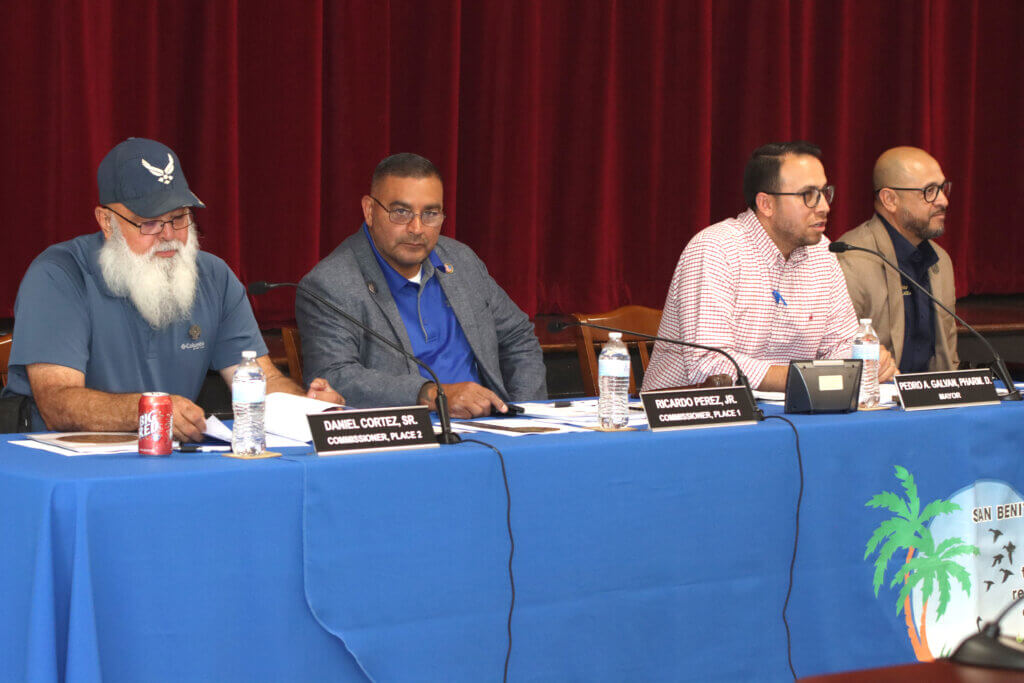
Since May, there’s been newly elected leadership, which includes four commissioners, one of whom is a mayor; there’s also an all-important interim city manager to lead city staff in the budget process.
Mayor Pete Galvan said that when he was elected five years ago as a commissioner, he remembers elected leaders operating with a $13 million budget. Now, as a first-time mayor two months into his tenure, he told three other new commissioners, including Ricardo Perez, Jr. (Place 1), Daniel Cortez, Sr. (Place 2), and Victor M. Gonzalez (Place 3), to be mindful of what is at stake.
“So you need to ask yourselves — what have I seen, what was the return, and what did I see differently in the city?” Mayor Galvan asked. “The staff has doubled. Does San Benito have a lot of overhead — possibly? Is the labor force growing? Are they paid more? And as elected leaders, you are in a unique position to balance 250 city employees and 24,000 residents.”
Interim City Manager Carlos Yerena replaced Fred Sandoval last month, who resigned after nearly three years at the helm.
Yerena leads the budget process on the city side and reminded the commissioners that they will abide by their requests.
He said city staff is working on introducing a budget with “conservative revenue forecasting.”
Yerena said the proposed budget targets “public safety and essential equipment.”
It includes a $1.9 million ladder truck that would be financed for the San Benito Fire Department.
Commissioners also listened to a hiring scenario for three new SBFD firefighters, funded by a grant that would cover 75 percent of their salaries in the first two years, 25 percent in the third year, with the city taking over in the fourth year and beyond.
Commissioners will also consider budgeting for a $215,000 asphalt recycler to help make city street improvements “more efficient,” as well as a mini excavator and an F-250 truck totaling around $145,00 for the Utilities Department, so a third group of future employees can handle in-house projects.
Per the proposed budget request, Yerena also asked the commissioners to consider hiring an IT technician and a grant coordinator to save the city money rather than contracting out.
He thinks the city could have more control over applying for more grants, since third parties already draw on city staff for information about needs.
He said that within a grant, a future internal staffer’s salary would surely be paid, and possibly leave funds to spend elsewhere for the city.
“Is this person going to sit back, get paid, and maybe, maybe not, get us a grant? That’s my concern,” Commissioner Gonzalez said. “We have to be mindful of our city tax dollars … I’ve lived in this city and have always been mindful of how it was spent, and I am a big critic of that.”
Mayor Galvan has experience in these matters and elaborated on one particular topic, the Community Development Block Grant, which has a citizens’ committee.
“The CDBG funds allow a percentage to be allocated to clerical and administrative duties. We had more than $60,000 in the last budget cycle that went to funding a grant coordinator, so, in a sense, you would have that person focus only on grant acquisitions and managing CDBG primarily, and then go out for more grants,” Mayor Galvan said.
PAY RAISES
Finance Director Stephanie Sarrionandia listened as Mayor Galvan acknowledged that the cost of living has risen during his five-year tenure on the commission. He also alluded to another water rate increase likely to occur in the fall.
He said a person can’t live on the current minimum wage.
Commission inquiries about budget dollars and positions—present and future—were directed not only to Yerena but also to Sarrionandia, who provided most of the budgetary details during the 90-minute workshop.
City Attorney Eric Flores also provided input.
Sarrionandia said from the first to second budget workshops, city staff has remained steadfast about “conservative revenue forecasting,” even if it includes a proposed 1 or 2 cent reduction in the city’s tax rate.
“We want to do as much as we can in-house, provide employees with the tools, and address our wear and tear; we want to carefully evaluate our expenditures by prioritizing where we need to invest our money,” she said. “We want to control our expenditures, review our agreements (with second parties), what we are paying monthly, and additional payments, and see about reducing them.”
The other portion of her presentation focused on city employees.
“Support for our employees. We are behind when we compare ourselves to other cities. Our employees are happy working here. We need to have employee investment,” Sarrionandia said.
She reported that some of the city employees are paid a minimum of $12.85 per hour, and proposed an increase of $1.15 to round it to $14 per hour, which would put them above the minimum wage rate. More than 40 city employees would be directly affected by this proposal.
“We are (also) proposing that you adopt a resolution on a pay scale — a compensation plan. This will establish fair and consistent pay rates,” Sarrionandia said. “We’ll be able to recruit and retain employees. We’ll keep salaries competitive.”
This would be contingent on an employee’s education as it relates to their city position.
It is also being proposed that new positions and new titles would have to be approved by elected leaders if a department head created such a post.
Attorney Flores asked the commissioners not to codify this specific compensation plan, but rather the process to “actually give it teeth,” so it could be implemented fiscal year to fiscal year.
An ordinance can’t be specific every time, he said.
“You adopt a compensation plan first (because) it gives you better guidance. It gives you better detail when you adopt a budget,” Flores said.
Commissioner Perez pleaded that training San Benito personnel would open the opportunity to keep an employee longer. “Training is the main thing if we hire them,” he said. “Customer service is also important.”
WATER AND SEWER
Yerena said some projects can’t be done in-house, for example, the construction of more lift stations, while maintaining and in some cases improving the 40 current station that four full-time employees operate. To meet the city’s growth, it was proposed to spend $500,000 this next year.
Yerena, however, would like for city employees to continue tackling sewer and water line work.
“With the addition of the equipment we are requesting for next year’s budget, we would be able to do a lot of the sewer and water line work in-house instead of contracting it out to third party companies,” Yerena said. “There would be significant savings conservatively about 50 percent) the city instead of paying out.”
With San Benito’s growth evident, the construction of another lift stations would be required, but city staff can’t do it because of “construction of a base, foundation, and electricity,” Yerena said.
TAX RATE
Sarrionandia provided the scenario of what a 1 and 2 percent reduction of taxes looks like.
Revenue impact is about $228,000 from a 2 percent tax reduction. That results in $40 yearly for a home valued at $100,000.
Revenue impact is about $114,000 from a 1 percent tax reduction. That results in $20 yearly for a home valued at $100,000.
Commissioner Gonzalez asked that city staff move cautiously.
“I don’t want to give (citizens) a 2 cent tax break now, only to have in three years we have to raise it to 5 cents,” he said.
Commissioner Gonzalez said citizens would quickly forget what was done in the past.
Mayor Galvan proposed an incremental tax cut.
TUESDAY’S MEETING
At Tuesday’s City Commissioners’ Meeting, after a long and contentious closed-door session to discuss the finalists for the open city manager position, the commission was split between interim City Manager Yerena and La Vernia city administrator Lindsey Wheeler.
The closed-door session lasted five hours, running into the following morning. The Mayor walked out of the meeting, calling his split commission “rogue.”
Discussion is set to resume at the next meeting, scheduled for August 10 at the San Benito Municipal Building on Sam Houston Blvd.
