|
Only have a minute? Listen instead |

RGV Desal has pitched itself as a potential solution to the Rio Grande Valley’s longstanding water woes.
This new resource, however, will be privately owned.
Cities and water districts throughout the region could eventually depend on the water produced at the $1 billion seawater desalination plant — water that will belong to a for-profit company.
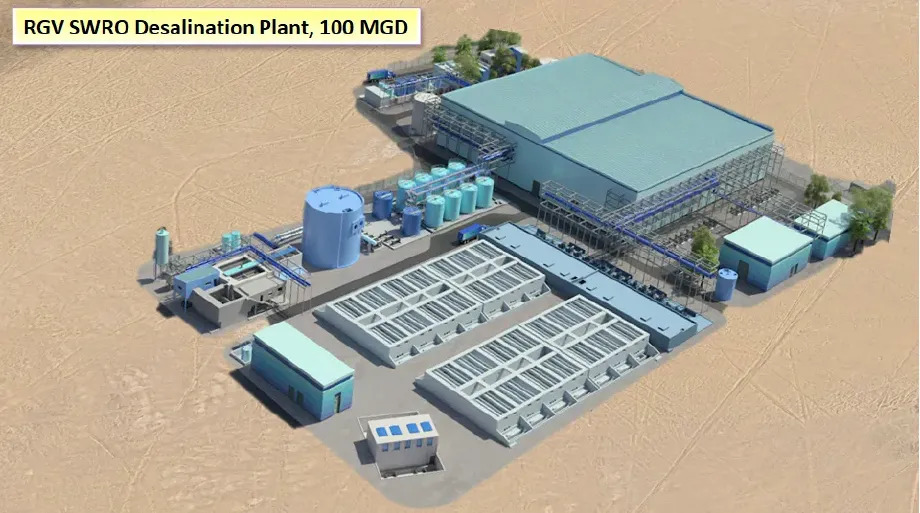
The desalination plant to be located on South Padre Island is a joint venture between US Desal and Israeli company IDE Technologies. Both will own the water produced, but the infrastructure for distribution will be a public affair. Additionally, water will be sold at a set price at the plant’s “fenceline” but the consumer’s distance from the plant will impact total cost.
The company’s preferred customers will be cities and water districts, as well as industrial companies, according to US Desal Board Director Doug Allison.
RGV Desal’s leadership board is composed of both US Desal and IDE Technologies board members. IDE Technologies will oversee construction with additional US Desal oversight, and are signed onto a 20- to 30-year contract, according to Allison.
RGV Desal will own the completed plant as well as the water it produces, and will control pricing, contracts, and potential expansion.
RGV Desal is a for-profit enterprise. It is privately financed with a limited number of investors, none of which are from the Valley, according to Allison. Some investors are within the state.
While at this time Allison could not disclose the identity or quantity of investors, he did say they range from smaller investors to private equity groups.
Allison said “lots of people” stand to profit if the plant proves successful, and cited the local communities as an example. He specified that they will benefit by “not running out of water.”
He added that he “does not know” what sort of return investors are expecting. He also does not know, at this time, how long the plant will need to operate before it is profitable.
When asked if there were any mechanisms or systems in place to ensure consumers are paying a fair price for water, Allison said the market, “like everything else in the world,” will dictate the price.
According to both Allison and Albert Escobedo, the project’s government affairs director, the water will initially cost the same for all consumers, but their distance from the plant will factor into the final price to cover needed distribution infrastructure.
The question today is how much public money will be required to make the privately produced water accessible throughout the Valley.
Allison argues that a privately funded facility is “more effective at controlling costs.”
“When you start having a public entity try to manage the development, the engineering, construction and delivery of the water, our experience has been that price starts getting out of control, and in our experience — has led to an unsuccessful project,” said Allison.

US Desal was founded by a group of attorneys and Port of Corpus Christi leadership after successfully securing permits for a desal project in Corpus Christi. However, according to reporting by the Texas Tribune, the project costs climbed to roughly $1.2 billion and was scrapped by the city council amid both cost and environmental concerns.
Allison says his experience showed him that public entities can lose control of construction costs, and adds that private financing allows RGV Desal to have more say-so. He says lower construction costs will translate to lower water costs, and also believes private operation will prove more efficient, as the same people who are designing the plant will be the same people operating it.
Escobedo adds that this is why they are pushing to get the plant built as soon as possible, to mitigate construction material costs as inflation continues to rise.
RGV Desal cannot begin signing customer contracts until it completes the permitting process, as it will determine the total cost of construction, which currently is approximately $1 billion, because the total cost of construction will factor into the price of the water.
However, according to Allison and Escobedo, there are a handful of entities who have already expressed interest, including the East Rio Hondo Water Supply Corporation, the North Alamo Water Supply Company, the Laguna Madre Water District, Brownsville PUB, and others who are currently protected by a non-disclosure agreement.
Allison says water consumers will have a “tremendous amount of influence” over the plant’s operations, but ultimately, control over contracts, pricing, and the water it produces will belong to RGV Desal.
The government plays its part through permitting and regulatory authority, and will potentially finance distribution infrastructure. At this time, it is not immediately clear how much that distribution infrastructure will actually cost as the project continues through the permitting process.
According to Escobedo, RGV Desal’s next step is to secure permits with the Texas Commission on Environmental Quality (TCEQ), and then possibly permitting with the Army Corps of Engineers. If the Army Corps of Engineers, or other agencies later in the process, deny or request amendment in the construction plans, then RGV Desal would have to start over at the beginning again, with TCEQ.
Allison says if the company were to eventually sell, existing water contracts would be “100% honored.” However, contract protections have yet to be seen, as no contracts currently exist.
Today, the land has been secured, engineering is underway, and permitting is the biggest hurdle. With no groundbreaking date, no customer contracts, and no set-in-stone construction plans, the project still doesn’t have the number that may ultimately determine everything — the cost of water.
“If the price is too much, people won’t buy it,” said Allison. “And if the price is too little, it will never get built.”