Subscribe to The Y’all — a weekly dispatch about the people, places and policies defining Texas, produced by Texas Tribune journalists living in communities across the state.
TEXARKANA — When Scott Norton became president of the TexAmericas Center, he hoped the industrial park would attract employers that would bring much-needed jobs to North East Texas.
Little did he know the industrial center would sit atop one of the country’s largest and richest lithium deposits, known as the Smackover Formation, and would also become a key location for mineral production in Texas.
“[Lithium production is] a great opportunity not just for the Department of War and Red River Army Depot, but in the entire region when it comes to capital investment and job creation,” Norton said.
Lithium production in East Texas could create high-paying jobs, support local businesses and encourage cities to improve East Texas infrastructure, such as roads or public utility services. But it could also leave landowners struggling with high property values and a community dealing with infrastructure that doesn’t keep pace with rapid growth, leading to a bust that the state has seen before with the oil and gas industry.
Economists at a Texarkana lithium symposium in July warned against vying for a boom, and encouraged leaders instead to seek slow, sustainable growth.

Now, however, local officials and state lawmakers must decide how to manage the industry to ensure that landowners’ rights are respected, that the extraction process remains safe and clean, and that producing this mineral in East Texas is worth the cost.
“We can learn from Arkansas and from some of these other places, but it has to make sense economically for companies,” said Brent Elliott, an economic geologist and mineral resource specialist with the Bureau of Economic Geology at the University of Texas. “They won’t do it if there’s not some kind of incentive or clarity on the landscape, like ownership, unitization and the production procedure. And then the economics of it at the end of it.”
Next year could prove to be a crucial year for this budding industry, if lawmakers make it a priority in the 2027 legislative session.
Who will manage lithium rules and regulations?
Lithium production is a national issue with wide-reaching implications. Landowners near production facilities have a stake in the game, as do producers such as EnergyX, ExxonMobil and Chevron, local officials and state and national lawmakers.
President Donald Trump and Texas’ congressional delegation are pushing to expand domestic mineral production and reduce the nation’s reliance on foreign countries for critical minerals. Right now, the Environmental Protection Agency oversees federal regulations on mineral extraction.
In Texas, lithium mining regulation is overseen by the Texas Railroad Commission, which also oversees the state’s oil and gas production, use and waste. The agency was given rule-making authority in 2023 and established some guidelines based on the oil and gas industry, and brine production.
Industry players would like to see some clarity on important issues, such as property tax values, royalties and brine injection regulations, either from the commission or from state lawmakers.
Researchers at the Bureau of Economic Geology at the University of Texas, including Elliott, plan to present lawmakers with findings on the industry, such as water rights and mineral royalties, by the end of the year to help lawmakers form decisions on this emerging industry.

“We’ll try to get to anyone who represents East Texas,” Elliott said. “Anyone who has jurisdiction over the Smackover or anybody who’s on the Natural Resources committees, both in the House and Senate, or the Energy Committees. Those folks would do well to understand the current landscape and the recommendations for making it better.”
This issue also touches on local economic development, which is why the Texarkana Chamber of Commerce hosted its first-ever lithium symposium, at which experts provided more insight on the industry to regional and state leaders. It even brought Arkansas Gov. Sarah Huckabee Sanders to Texas to open the symposium.
Lithium production in Arkansas has grown exponentially over the last few years as companies pull brine from the Smackover Formation, which spans from Florida to Central Texas. Because brine production was already common in Arkansas, lithium production rules and regulations were folded into an already established framework.
Arkansas’ regulations were cited in both the symposium and multiple independent interviews with the Texas Tribune as a solid source for Texas to base its own regulations on.
“They seem to be very happy with the structures in place in Arkansas, and would like to see more structures in the state of Texas,” said Robin Hickerson, president and CEO of the Texarkana Chamber of Commerce.
Economic implications
Texas’ reputation as a business-friendly state could encourage lithium producers to create high-paying jobs for out-of-work oil and gas workers since both industries require similar skillsets. It could also encourage tertiary development, such as retail, restaurants and hotels, in underdeveloped areas.
Before any of that happens, though, the industry needs to hammer out some much-needed details.
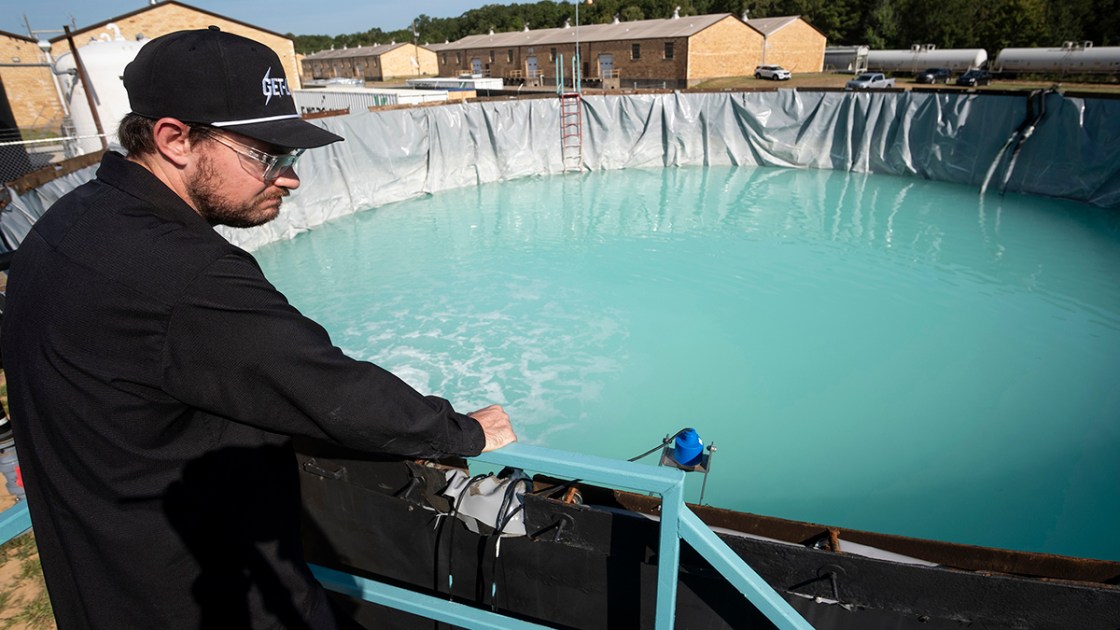
Bruce Cutright is the CEO of GeoFrame, an Austin company that wants to build the largest lithium production facility in the U.S. in Mount Vernon, a town about 60 miles north of Tyler. He has been working closely with community leaders in Franklin County to get the lithium project off the ground.
Cutright said the Legislature has several matters to settle next year, including the rights and responsibilities around minerals and brine, the water byproduct of drilling.
The key question lawmakers should ask when deciding water and mineral rights is why the brine is being extracted, said Chris Alex, vice president of U.S. Upstream Asset Development for EnergyX, which is developing a lithium production facility in Texarkana. Is the brine being brought to the surface as a byproduct of oil and gas production, or is it being extracted specifically to recover lithium through direct lithium extraction?
“The state has yet to clarify this in a ruling or statute,” he said.
If the brine is produced as a byproduct of oil and gas operations, Alex said it would belong to the exploration and production company. But if a company extracts the brine specifically to produce lithium, he said state law does not clearly establish who owns those mineral rights.
Other concerns center around the impact lithium production in the area would have on property taxes as well as who ultimately would see the financial gains from mineral production.
Cutright is concerned that, without clear guidance on how property taxes will be affected by lithium production, homeowners near his site may not be able to afford a significant increase in their property valuations.
“I wouldn’t want these beautiful fifth-generation ranches to suddenly be priced out of their property,” Cutright said.
Texas currently leaves it up to landowners and producers to hash out these decisions and they’re made as part of lease agreements, Alex said.
The Mineral Interest Pooling Act, which can dictate royalties for oil and gas rights, could also guide lawmakers, Elliott said.
Environmental implications
Most of the lithium produced around the globe is extracted from salty aquifers and stored in massive evaporation ponds in the arid countries of the Southern Hemisphere. The brine that is left is processed further for lithium extraction. The lithium carbonate, which is left after that extraction process, is then shipped to countries like China to be used in battery components for clean energy technology.
The whole process can take years and can be delayed by a rainier-than-average season. It requires significant amounts of water and has led to water scarcity in countries like Chile, which sits atop the largest known reserve of lithium in the world. And in some cases, the ground and surface water have been contaminated because of lithium extraction processes.

Lithium producers in East Texas, however, are eyeing an extraction process called Direct Lithium Extraction, or DLE, that more closely resembles oil and gas production. And it could work exceptionally well at extracting lithium from the brine in the Smackover Formation thousands of feet below East Texas.
For long-time environmental advocate Neil Carman, a volunteer and former Clean Air Director for the Lone Star chapter of the Sierra Club, the idea of lithium production in the state is a scary one. He worries that Texas’ emerging lithium industry won’t truly be regulated in a way that protects the community.
DLE poses similar risks as those of oil and gas production. If something fails in the infrastructure, it could leak into the potable groundwater resources East Texans are currently fighting to protect, and Texas doesn’t have the best reputation for cleaning up those messes, Carman said.
He’d like to see the state outline reporting requirements for operations and a detailed plan for if something goes wrong.
Elliott sees DLE as something akin to what Texas has already done for years with the oil and gas industry. The Railroad Commission already has rules in place for brine production overall, which includes lithium.
Alex of EnergyX believes brine extraction is regulated similar to oil and gas in some ways, but with more stringent requirements in others. EnergyX maintains a strict emergency action plan with the county and has secured its site beyond Railroad Commission requirements, he said.


Cutright is happy with the state’s framework, but he’d like to see the Railroad Commission update its rules regarding reinjection. As it stands, brine pumped from the ground must be reinjected into the same formation. This will dilute the lithium brine source over time, meaning eventually the lithium extractors will have to find a new place to pump, Cutright said.
“There needs to be sort of a side decision loop in the permitting process that asks if there are other, more appropriate zones to inject the spent brine back into the subsurface,” Cutright said.
What comes next
Arkansas is using much of its framework and infrastructure from bromine production, a mineral that can be extracted from brine, which is why some experts have encouraged Texas to see what its northern neighbor is doing.
But Texas is in a position that could set the stage for real industry growth and development that even Arkansas doesn’t have, Elliott said.
“We have the advantage of developing infrastructure that would be better suited for future development without having the previous stuff,” said Elliott.
It could take some time, though. Lithium may have been a priority for lawmakers going into 2027 before state residents began to worry about data centers. Now that data centers and most especially, water and energy usage, are top of mind for many voters, Elliott said he isn’t sure how this new industry will be perceived.
“It was probably higher on the priority list before,” he said. “The data center issues have really kind of moved to the forefront. I don’t know if that’s a good thing or a bad thing for lithium.”
Meanwhile, in East Texas, companies are setting up test sites and figuring out exactly what the deep-water aquifer has to offer. Texarkana is bracing for investment, as are communities across the region.
GeoFrame’s ground breaking was pushed back from its original goal of 2026 due to financing and project changes, but Cutright is excited for its launch.
The site would produce more than 83,000 metric tons — about the weight of 16,000 large elephants — of battery-grade lithium carbonate annually. This would put a sizable dent in the U.S. domestic needs, if successful.
“Texas is blessed with some of the highest lithium concentrations in the Smackover Formation,” he said. “The part of Texas where we’re working, Franklin County, and that area — that’s really the bullseye for the highest concentrations.”

Source link