|
Only have a minute? Listen instead |
BROWNSVILLE — City commissioners voted unanimously late Saturday night to voluntarily disannex more than 444 acres of land at the request of SpaceX after a tense, six-hour special meeting. At stake was a $220 million agreement with the trillion-dollar aerospace company that city leaders say will secure Brownsville’s ability to supply water to its residents for generations.
The evening highlighted the lopsided power dynamics between the city and SpaceX, with a representative from SpaceX straightforwardly telling commissioners that the company would only provide money to the water infrastructure projects if commissioners passed an ordinance formalizing the disannexation the same night.
Following the meeting, Mayor John Cowen Jr. told the Herald that the decision weighed heavily on commissioners. He said the mood during the two executive sessions of the night was intense, with many in the room sharing concern that the process played out during special meetings.
Ultimately, he said commissioners could not pass up the opportunity to secure the city’s water supply and “sustainability as a city for generations to come.”
“We put the residents first tonight,” he told the Herald. “We look at this as a very historic moment for the city. Water is a huge issue in South Texas and around the state, and this decision today will ensure that Brownsville be a place for future generations to live, and for our continued growth as a city.”
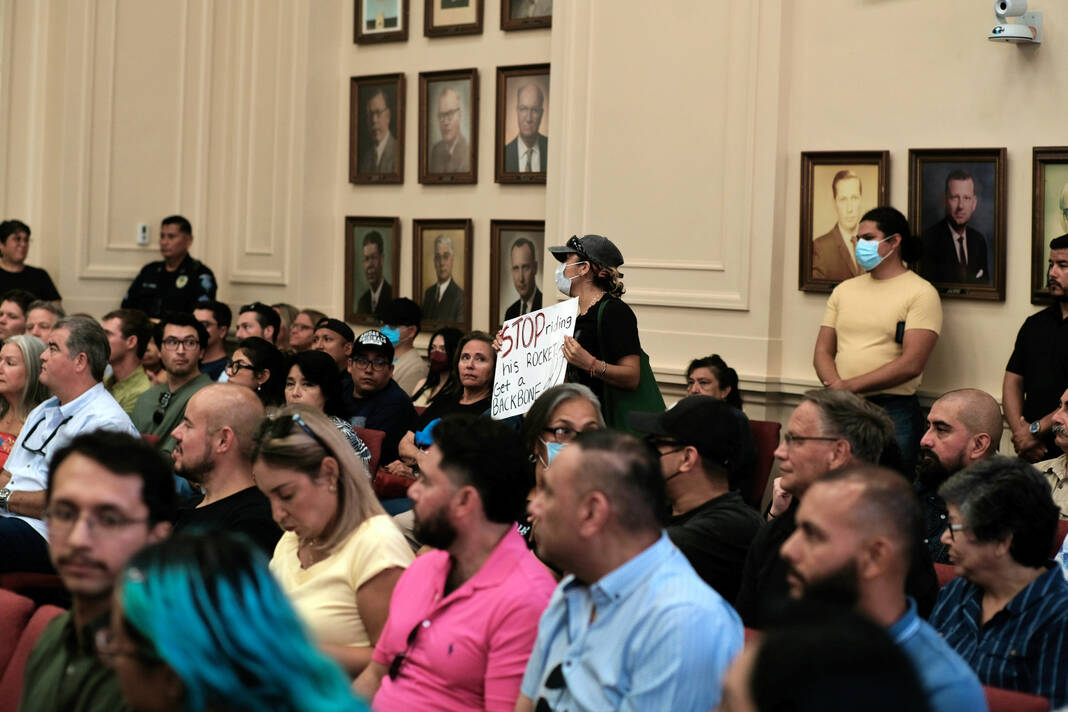
Commissioners heard from dozens of speakers during the public comment portion, both for and against the agreement and disannexation. Supporters extolled SpaceX’s economic contributions to the region while opponents expressed concern over environmental damage caused by the company and what some called bully tactics to push the disannexation forward.
“Why are we rushing this? Why are we here on a Saturday?” said one resident. “Why can’t we know what they’re going to do with the land? They say Starbase is a company town, but I fear we are becoming one, too.”
During the public comment portion, Greater Brownsville Economic Development Corp. President and CEO Gilberto Salinas said that “as one of our premiere corporate citizens,” a SpaceX partnership would reduce costs and share risk on the projects.

“This is how well-balanced super cities are built,” he said. “It will benefit every resident by expanding our capacity for water as well as sustainability for our water resources.”
People in the city commission chamber clapped, booed and jeered during public comments, and officials called several times for attendees to maintain decorum. Attendees were removed throughout the meeting for being disruptive or speaking during the hearing portion of the meeting.
Joseph Hollmann, board president of the Southmost Regional Water Authority, said the funding would give life to two projects that would transform the city’s water supply. The larger of the projects would increase the water authority’s production capacity to filter brackish water from about 7.5 million to an eventual 20 million gallons per day, Hollmann told the Herald.
The second project, which is in its research phase, would help the Brownsville Public Utilities Board develop the best way to transform sewage water that’s treated at its facilities back into potable water. That would add another 8 million gallons per day to the city’s production capacity, Hollmann said.
SpaceX also outraged critics with its speed-running of the agreement, which Cowen said was brought to the city about a week-and-a-half before the night’s votes. The public got its first presentation on Project Quantum, the city’s name for the infrastructure funding agreement with SpaceX, just a couple hours before the commission’s votes.
Commissioners approved a first reading of the ordinance during a special meeting at noon on Aug 21. The Brownsville Public Utilities Board considered its agreement with SpaceX for the first time on Thursday night and met again to vote to approve it on Friday. Adding to the tension were technical difficulties some experienced trying to access the meeting virtually to give public comment.
Facing a Catch-22, commissioners could have either approved the ordinance and risked losing the trust of those who see SpaceX as having undue influence over the city; or not approve it and lose a once-in-a-lifetime windfall that could future-proof its water supply.
Staff and commissioners highlighted the difficulty of securing funding for water projects at a time when drought has put the future of the city’s water supply in a precarious position. The Texas Water Development Board has $1 billion in project grants to disperse each year but receives $50 billion worth of proposals, officials said.

District 3 Commissioner Gustavo De León summed up their conundrum.
“We’ll be heroes today and zeros later because we didn’t do anything,” De León said during the meeting. “We’re a long way off from being able to do something like this. It’s our top priority to make sure we have enough water for the citizens.”
During a meeting that had been characterized by high emotion, with those in opposition at times angry and pleading with the commission to turn down the disannexation, SpaceX Vice President of Starship Legal and Regulatory Sheila McCorkle dispassionately and succinctly confirmed that the $220 million for critical water projects would be off the table unless commissioners voted for disannexation that night.
At-Large “A” Commissioner Tino Villarreal Jr. asked McCorkle why SpaceX was in a rush to see the disannexation ordinance passed.
“It’s no secret SpaceX has grand ambitions,” McCorkle replied, listing off projects like its work to make reusable rockets and execute manned missions to the surface of Mars. “These are really hard engineering projects, with millions of engineering hours, and so we like to do things as quickly as possible. We think this is a really good opportunity for Brownsville.”
Villarreal asked if she would be willing to sign the funding agreement before the disannexation was passed.
“No, they’re together,” McCorkle said.
Villarreal later asked whether the deal would be off the table if commissioners took another 72 hours to consider the agreement and disannexation.

“Yes, sir,” McCorkle replied. “I appreciate it’s a rush, but it’s the reality.”
Cowen acknowledged that SpaceX’s aggressive timeframe put them in a difficult situation. Officials pointed out during the meeting that if commissioners chose not to approve the disannexation, SpaceX could choose to go through the court system to push the disannexation through and leave the city with nothing to show for it.
“This is bigger than all of us,” Cowen said. “This is about future generations being able to really survive here in Brownsville. We altered our normal process to be able to ensure the viability of our community. We typically would host these hearings in a regular meeting, but we had to alter the timing because that’s the only way that we can do this.”
McCorkle told commissioners that SpaceX was in the process of closing on the purchase of the disannexed area from a private land owner.
The votes come a few days before the commission is set to decide on Tuesday whether to adopt a moratorium on data centers in the city.
Residents trickled out of the chamber as the evening dragged on.
After commissioners went into their second executive session, one man left in frustration and on his way out said to McCorkle, “I sincerely hope you go to Mars.”