
The Philadelphia Eagles are struggling like never before with QB Jalen Hurts. The Denver Broncos’ offense isn’t any better. Former blue-chip wide receiver prospect Marvin Harrison Jr. has a new team. The New York Jets have a new star defender.
Each week, I dive into the All-22 coaches’ film before offering a few insights to watch. Here are four developments that could be long-term storylines involving some of the best teams and players in the NFL.
1.

It is rare for a Super Bowl MVP to land on the hot seat shortly after feeling the confetti fall on his shoulders, but Philly natives are growing restless after watching the Eagles’ offense sputter and stall again under Jalen Hurts.
The perennial title contenders are sitting at 2-3, with an offense that ranks near the bottom of the league in most major statistical categories. The Eagles’ anemic running game is accompanied by a scattershot aerial attack that doesn’t appear to have any rhyme or reason under new offensive coordinator Sean Mannion.
To be fair, the Eagles are dealing with numerous personnel issues, from injuries (Saquon Barkley and DeVonta Smith) to departures (A.J. Brown, Lane Johnson, Cam Jurgens) that have wrecked an offensive lineup built to overwhelm opponents with superior talent. Now, Hurts is overseeing a patchwork offense that lacks the star power to roll over opponents, while being asked to do more in a traditional scheme that wants him to operate like a pass-first point guard instead of a playmaker who scores in multiple ways.
Without an elite wideout on the perimeter, Hurts is expected to get it done with a wide receiver-by-committee approach that features a borderline WR1 (Smith) and a collection of B-list pass catchers (Hollywood Brown, Dontavyion Wicks, Makai Lemon, and Darius Cooper) who don’t scare opposing defensive coordinators or defenders with their individual or collective talents.
Although some Eagles’ supporters might dispute that sentiment based on the first-round pedigrees of Brown and Lemon, neither has made an impact in Philly that demands attention from their opponents thus far. Until they are able to spark the offense with splash plays, the Eagles will rely heavily on Smith and Dallas Goedert as Wicks makes key contributions in a supporting role.
While the Eagles have succeeded without a marquee pass-catcher in the past (see: 2017), the lack of five-star perimeter talents puts more pressure on the offensive line and running game to produce results to help the quarterback find positive plays down the field. Barkley has been a non-factor this season due to injuries limiting the bulk of his work to two games (Washington and Chicago). Despite averaging 5.1 yards per carry in those contests, his absence and the losses of Tank Bigsby and Will Shipley have forced the Eagles into a one-dimensional attack that was doomed from the start.
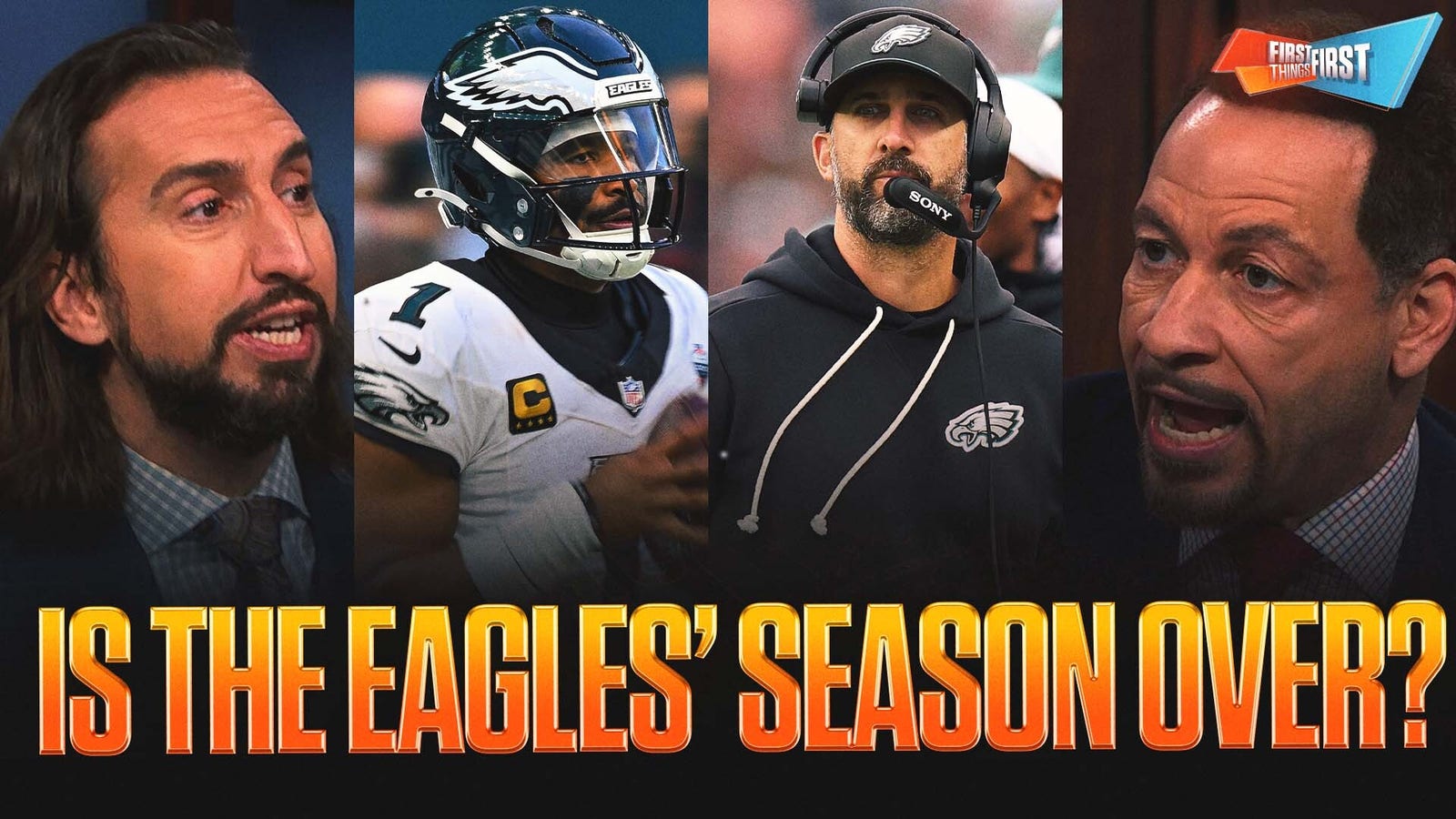
Eagles ‘should consider trading their stars’, Who’s to blame for the Commanders’ OT mishap? | FTF
In that past, the Eagles’ stellar offensive line could mask their playmakers’ woes because they could dominate the line of scrimmage and allow marginal backs to churn out yards between the tackles. However, the loss of respected offensive line coach Jeff Stoutland and the aforementioned departures of Jurgens and Johnson, leaves the Eagles searching for an identity within the trenches with a bunch of newcomers trying to figure it out in a new system.
Speaking of schematics, the addition of Mannion as the offensive coordinator also appears to be a poor fit based on his preferred system and Hurts’ abilities. Mannion, of course, is the fifth OC head coach Nick Sirianni has hired in his six-year joint tenure with Hurts. While the Sean McVay/Matt LaFleur disciple brings over Xs and Os that have helped several quarterbacks flourish in the pocket, Mannion’s traditional dropbacks and play-action concepts from shotgun and under center are a far cry from the RPO (run-pass option) concepts that helped turn Hurts into an unstoppable force as the Eagles’ QB1.
Although the franchise quarterback should be able to adapt and adjust to a new playbook as an experienced starter with a 59-28 career record, the tactics don’t mesh well with his talent, so his 2026 struggles are not surprising.
Watching the Eagles’ operation in Week 5, the disconnect between Hurts and the rest of the offense is startling. From the stagnant ground attack due to lackluster runners plunging into clogged holes, to the “dink-and-dunk” throws to covered receivers, the Eagles’ lack the personnel and playbook to challenge heavyweight opponents right now. Perhaps more time on task and the return of their frontline stars can help revive Philly into a title contender, but the offense’s struggles are destined to continue until Hurts is put in an offense that leans more into his playmaking rather than exposes his flaws as a passer.
2.

After watching his offense sputter under new offensive coordinator Davis Webb, Broncos head coach Sean Payton snatched the call sheet from the former NFL journeyman QB to help Bo Nix and Co. find the balance and rhythm that has been missing in 2026.
Despite promising to stay out of the way of the first-time playcaller, Payton stepped in to keep the Broncos from missing a potential Super Bowl run while Davis finishes his on-the-job training. With the Broncos ranking 26th in scoring offense and Nix playing the worst ball of his career, the offensive wizard needed to take the call sheet back to help a promising young quarterback rediscover the magic that helped him lead 10 game-winning drives over his first two seasons, while completing 64.8% of his passes with a 54:23 touchdown-to-interception ratio.
Most importantly, Nix led the Broncos to back-to-back playoff appearances and last season’s AFC Championship Game thanks to his steady play under Payton. Part of his success as a young QB can be attributed to Payton’s conservative approach, which eased the pressure on the former first-rounder. The offense blended a movement-based passing game with a diverse running game to keep opponents from attacking Nix with exotic pressures from every angle.
Although the Broncos lacked a premier running back in the backfield, their rotation forced opponents to prepare for a creative running game that featured role-playing specialists (Javonte Williams, Jaleel McLaughlin, J.K. Dobbins and R.J. Harvey) anchoring a mid-ranking running game that was just good enough to keep opponents from loading up against an efficient aerial attack.
Stretch zone runs and complementary bootlegs, plus the inside run and various RPO combinations, allowed Nix to maximize his playmaking potential as an athletic passer with plus-running skills. Nix’s impromptu scrambles and occasional designed runs added another dimension to the offense as Payton sought to build a ball-control unit that complemented a disruptive defense.
In Week 5, the Broncos returned to a complementary game, with Payton balancing the call log to feature a 50-50 run-pass ratio. The Broncos ran 29 times and passed 27, while capitalizing on the prime scoring opportunities the defense created. Although the stat sheet was far from impressive, with the team amassing just 224 net yards and Nix finishing with the second-lowest passing output of his career (123 yards), the offense’s flow matched his strengths as a “game manager” with a keen understanding of how to play winning football (avoiding sacks and turnovers) for a playoff contender.
While Payton must find more ways to incorporate wideouts Jaylen Waddle and Courtland Sutton into the game plan to increase the offense’s explosive potential, he must do it while rebuilding Nix’s confidence with high-completion throws and “chain-moving” plays that keep the offense on schedule. With Nix also thriving in “tempo” situations at the end of games, the Broncos could mix in some no-huddle to help the young quarterback face more vanilla defensive looks that allow him to operate in attack mode from the pocket.
After taking back the call sheet to help his franchise quarterback and offense get back on track, Payton must continue to take bold measures to get the Broncos back to playing the efficient brand of ball that has made them title contenders under his direction.
3.

Is one’s trash another’s treasure? That’s what the Texans are betting on after acquiring once-ballyhooed Ohio State standout Marvin Harrison Jr. and reuniting him with quarterback C.J. Stroud.
Although the football world has seemingly soured on MHJ after posting 1,578 receiving yards and 13 touchdowns in 33 career games, the third-year pro needed a winning organization with a demanding culture to get back on track after an up-and-down journey with the Cardinals. The Texans’ impressive track record of turning top picks into stars (see: Stroud, OLB Will Anderson and CB Derek Stingley) bodes well for the 6-foot-3, 220-pound Harrison, who flashed elite receiving skills before falling out of favor amid a slump that exposed his flaws as a playmaker.
Harrison’s inability to separate against bump-and-run and tight coverage led to too many 50-50 balls for a big-bodied pass catcher expected to anchor the passing game like Larry Fitzgerald once did in Arizona. With MHJ’s effort and concentration waning near the end of his tenure, the Texans are hoping a change of scenery, a new scheme and better connection with his quarterback will help the super-sized pass-catcher regain his swagger as a high-end WR2 for an offense that desperately needs a reliable threat opposite Pro Bowler Nico Collins.
Studying the All-22 coaches’ footage from MHJ’s rookie season shows he entered the league with the tools to be a designated playmaker in an offense built around his game. In the second game of his career, he totaled 130 receiving yards and a pair of scores on just four catches against the Los Angeles Rams.
The tape reveals a sticky-fingered receiver with outstanding balance, body control, and awareness. As a natural pass-catcher with strong hands, Harrison can climb the ladder on boundary alley-oops or post up smaller defenders on curls and in-breaking routes between the hashes. He also flashes enough speed and quickness to beat squatting defenders on vertical routes that accompany play-action or misdirection fakes in the backfield.
For a Texans squad that needs a dependable weapon with big-play potential, Harrison’s revival could resurrect the team’s playoff hopes and ignite an offense that has been looking for a spark plug on the perimeter.
4.
If the 2026 regular season ended today, Jets defensive end David Bailey should be the undisputed choice as the NFL’s Defensive Rookie of the Year. The No. 2 overall pick has dominated as expected as a speed-rushing phenom with exceptional first-step quickness and closing burst.
Through five games, Bailey has recorded five sacks, including a hat trick against the Cleveland Browns that showcased his speed, quickness and burst around the corner. The 6-foot-3, 251-pounder posted a jaw-dropping 40-yard dash time (4.50) prior to the draft, and his explosive quickness shows up repeatedly as he blows past blockers on simple speed-rushing moves.
In studying each of Bailey’s three sacks against Cleveland, the rookie standout showed he can mix force with finesse to keep blockers guessing on the edges. On his first sack, Bailey attacked rookie offensive tackle Spencer Fano with a two-handed bull rush and dog-walked the blocker into Deshaun Watson’s lap. The explosive move exploited the blocker’s fear of his speed by running through him as he waited for a “dip-and-rip” off the edge.
Bailey’s second sack came from a cleverly designed blitz from a “Double Mug” (six-man front with linebackers walked up on each side of the center) front that sent Bailey off the edge, with Jarvis Brownlee shooting inside through the B-gap (space between the right tackle and right guard), creating a two-on-one matchup against OT Tytus Howard on the edge. With the veteran opting to protect the inside gap because of the quarterback’s proximity, Bailey waltzed in for an easy quarterback takedown.
With the Browns unsure how the rookie would attack, given his diverse repertoire of pass-rush moves, the hat trick on his patented “dip-and-rip” rush shouldn’t surprise anyone who studied his game at Stanford and Texas Tech. Bailey exploded off the edge facing OT Dawand Jones, and the veteran couldn’t kick-step quick enough to stay in front of the hard-charging pass-rusher.
As Jets coach Aaron Glenn continues to find fun and creative ways to deploy Bailey as a designated pass-rusher with elite playmaking skills, the football world can expect to see the rookie continually making splash plays.