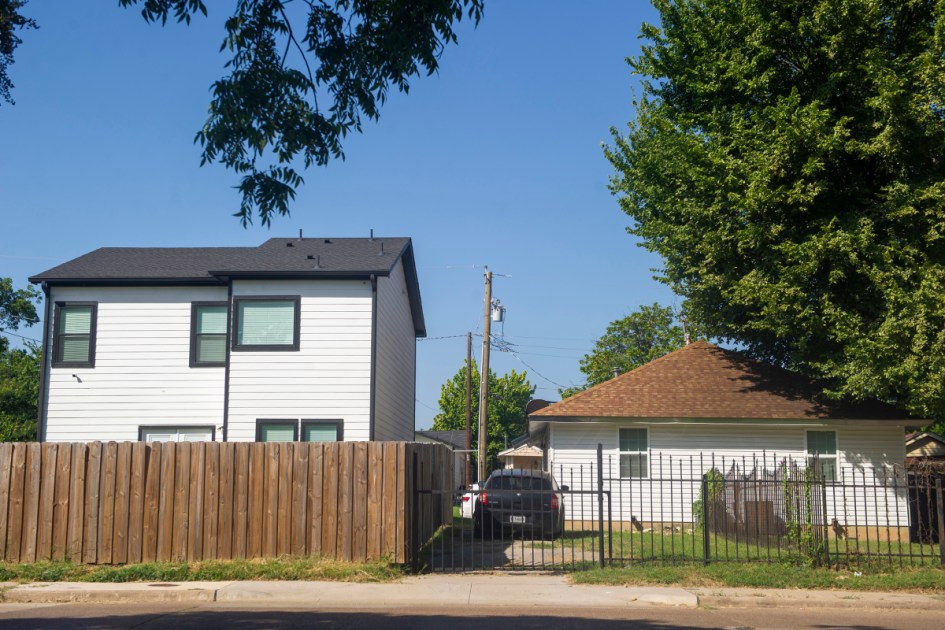

DALLAS — When the Margaret Hunt Hill Bridge opened more than a decade ago, it connected downtown Dallas to West Dallas, one of the poorest parts of the city. With the new bridge came a spike of new development interest in the predominantly Hispanic neighborhood, once largely cut off from the city’s urban core.
As that newfound interest mounted, so did property tax bills. As homeowners in the neighborhood increasingly worried about their climbing tax bills, community advocates came to a realization: many hadn’t claimed a benefit that might have helped keep those bills in check.
That benefit: the homestead exemption, which shaves at least $140,000 off the value that school districts tax and triggers more property tax savings if cities and counties offer their own exemptions.
The exemption results in potentially thousands of dollars saved in taxes annually while unlocking a number of other benefits intended to keep bills from rising too quickly.
Without claiming the exemption, many West Dallas homeowners risked being priced out of the neighborhood and displaced, said Johana Miranda, who runs the Homestead Preservation Center at the Wesley-Rankin Community Center, a nonprofit in West Dallas.
“It comes down to being able to afford another year of taxes,” Miranda said. “It does make a huge impact on the decision of staying or having to leave.”
West Dallas homeowners aren’t alone in potentially missing out. As homeowners receive their tax bills this month, hundreds of thousands of Texas homeowners who may be eligible for the homestead exemption aren’t claiming the benefit, policy experts and appraisal districts told The Texas Tribune.
In Dallas County, that estimate was 57,000 households — who have left nearly $310 million on the table by not claiming the exemption, according to research by the Child Poverty Action Lab, a Dallas-based nonprofit. In Travis and Bexar counties, roughly 60,000 homeowners in each county may unduly be going without the exemption, appraisal districts told the Tribune. Some 113,000 Harris County homeowners could be eligible but aren’t claiming the exemption, the appraisal district said.
That’s about 1 in 5 households in Travis County who might be eligible but don’t have the exemption, and roughly 1 in 10 in the others. Appraisal districts don’t have a precise number because of several factors, including the fact that appraisal districts don’t directly identify who’s eligible, just who might be.
Without a homestead exemption, the owner of a median priced home in Dallas County could expect to pay $7,062 in property taxes last year, according to another report from the University of Texas at Austin School of Law’s Housing Policy Clinic and the Child Poverty Action Lab. With a homestead exemption, they would have paid $4,573 — resulting in 35% savings on their tax bill. An older homeowner’s bill would have come out to $1,872, thanks to additional breaks for homeowners over the age of 65.
Homeowners don’t automatically receive the break and not everyone knows about the exemption, policy experts, nonprofit workers and appraisal district officials said.
To get the exemption, homeowners have to fill out an application, prove they own the home and that it is their primary residence, among other requirements. But the process can be complicated, especially for those who encounter language barriers or face other complications when proving they own their home. That’s especially true for first-time buyers or heirs who inherit their homes who are not using a lender or real estate agent to complete the process, said Heather Way, who heads the Housing Policy Clinic.
“How are you supposed to even know that this exemption exists if your real estate agent or mortgage broker hasn’t told you about the exemption?” Way said.
Disparities in who claims their homestead exemption falls along racial and wealth lines. Homeowners in Hispanic and Black neighborhoods in Dallas County claim the exemption at lower rates than those in predominantly white and Asian neighborhoods, the Child Poverty Action Lab said. A similar disparity exists between poorer and wealthier neighborhoods, researchers found.
Local governments, appraisal districts and nonprofits have combed through records to try to reach individual homeowners to implore them to claim the break. State lawmakers have chipped away at barriers to getting the homestead exemption, but policy experts have suggested a litany of ways that lawmakers could still act.
At the same time, the number of homeowners who have claimed the exemption has grown, said state Sen. Paul Bettencourt, a Houston Republican who authored measures in recent years to increase the exemption amount offered by school districts. The comptroller’s office reports some 6.28 million Texas homeowners had an exemption in 2025, which Bettencourt says is 580,000 more than two years prior.
Bettencourt acknowledged an education gap around the homestead exemption but said it’s unlikely that all eligible homeowners will ever claim it, though he wants them to. The main way the state could increase awareness of the homestead exemption is to keep increasing it, he argued.
“The higher the homestead exemption, the more likely people are to notice it,” Bettencourt said.
What’s behind the gap
In Dallas County, Child Poverty Action Lab researchers found that homeowners in wealthier neighborhoods claim the homestead exemption at higher rates than those in poorer neighborhoods. Of the 57,000 estimated Dallas County properties that could be eligible for the break, some 40,000 properties sit in low-income areas.
In Travis County, there are gaps in poorer places like Del Valle and Manor than in wealthier neighborhoods like Hyde Park or Westlake, said Cynthia Martinez, chief strategy officer at the Travis Central Appraisal District.
“People with means are more likely to know what a homestead exemption is right off the bat,” Martinez said.
One possible explanation for the disparity: wealthier people often employ property tax consultants who can inform them about the homestead exemption and help them apply for it, said Ashley Flores, senior director at Child Poverty Action Lab. But hiring a tax consultant may be too expensive for lower-income homeowners, she said.
Applying by oneself can be difficult. It’s not always easy to find the homestead exemption application on an appraisal district’s website and it contains jargon that might be intimidating for a homeowner to fill out. Many appraisal districts allow homeowners to apply online, but others may not.
Language barriers persist. Not every appraisal district provides the application in Spanish. The Texas comptroller’s office provides an application in Spanish, but even when there is a translation, property tax jargon can be tough to understand, Miranda said.
“I’ve encountered a lot of clients that obviously speak Spanish, but they wouldn’t understand the questions that were being stated or asked,” Miranda said.
Even when a home is someone’s primary residence, homeowners sometimes have a hard time proving it. They might inherit the home from a family member and do not have their name on the deed because they didn’t use a lender or a real estate agent to make the ownership transfer formal. Heirs can claim the homestead exemption if they’re not on the deed, but may need additional documents like a death certificate or a recent utility bill to prove they live there.
That kind of proof isn’t always readily available, Miranda said.
Older homeowners who haven’t claimed their exemption may face other hurdles. To get a homestead exemption, homeowners must have an up-to-date driver’s license or state identification. But older Texans may have stopped driving long ago and allowed their driver’s license to expire.
That reality became apparent when appraisal districts began sending letters to homeowners confirming their exemption eligibility, a requirement under a state law passed in 2023.
“We had a lot of adults calling on behalf of their parents, saying, ‘You sent my mom or dad this letter, and they live in their home, but they don’t have a license or ID anymore. What are we supposed to do?’” Martinez said.
In West Dallas, Miranda said she has driven people to the DMV to obtain IDs to help them remain eligible.
Homeowners who are undocumented, meanwhile, are completely boxed out from getting a homestead exemption. It’s illegal for them to obtain a driver’s license that would enable them to claim a homestead exemption.
It’s unclear how many homes that might be eligible for a homestead exemption are owned by undocumented immigrants.
Missing out
Low-income Dallas County households who haven’t claimed their exemption would see an average savings of $5,000 if they did, including possible refunds, according to the Child Poverty Action Lab. For a household with two adults and two children, that’s equal to the cost of about five months’ worth of food or three months of healthcare expenses.
“There’s only a couple things that homeowners can do to realize lower housing costs, and one of those is claiming the homestead exemption,” said Joey Blatt, director of the Child Poverty Action Lab’s Housing Impact arm. “So it’s really a primary way for homeowners to realize more affordable housing.”
Other tax benefits kick in with the homestead exemption on school district taxes.
For one, properties with the homestead exemption also benefit from the state’s 10% appraisal cap, which limits how fast a home’s taxable value can rise each year. But the cap doesn’t necessarily limit how much a tax bill can grow because it doesn’t prevent local governments raising tax rates.
Homeowners who qualify for a homestead exemption get deductions from any jurisdiction that offers an exemption. For example, in addition to the school district’s, homeowners could get additional exemptions from a city, county, community college or hospital district.
There are additional benefits for older homeowners. Homeowners age 65 and or have a qualifying disability receive an additional $60,000 exemption on top of the $140,000 exemption they receive from school districts. Their school tax bill freezes the moment they turn 65 or whenever they claim the exemption. Often on fixed incomes, older Texans get the option to pay their property taxes in installments. They may also get additional tax breaks from local school districts if those districts offer additional breaks.
How to close the gap
State law requires appraisal districts to proactively identify and notify homeowners who may be eligible for the exemption but haven’t claimed it. Appraisal districts must send homeowners letters explaining that they may qualify for the exemption.
Even so, appraisal districts can only do so much when the onus of claiming the homestead exemption ultimately falls on the homeowner. The Bexar Central Appraisal District sent notices to nearly 82,000 homeowners officials believed were eligible in January, appraisal district spokesperson Jennifer Rodriguez said. By October, roughly a quarter of them had claimed the exemption, she said.
It’s possible some homeowners think the notice is junk mail — that a homestead exemption sounds too good to be true.
“The amount of junk and spam, especially in neighborhoods where people are hungry for homes, it becomes really challenging to know what’s real and what’s not,” Breen said.
In the meantime, some cities, nonprofits and appraisal districts have tried other ways to help people claim their homestead exemption.
The Travis Central Appraisal District puts on workshops and informational sessions and sends officials to community events to help people claim their exemption, Martinez said. In some cases, district employees show at homeowners’ doorsteps to inform them they could be eligible. The district is also encouraging lenders and real estate agents to inform homebuyers about the exemption, she said.
Several ideas could close the gap, including improving Spanish-language materials and increasing local and state resources to boost outreach, experts say.
Now, the process of applying for a homestead exemption is spread across 253 appraisal districts. The state could centralize the process through one online application portal managed by the Texas Comptroller’s office, Way said.
“Right now, you have each appraisal district paying for its own [application process], contracting out with third-party software vendors,” Way said. “It’s so inefficient.”
Instead of requiring homeowners to provide a copy of their ID to apply, the Legislature could require the Texas Department of Public Safety to allow appraisal districts access to the agency’s real-time data showing driver’s licenses and state IDs. State law already requires DPS to provide some license and ID information to appraisal districts, but doesn’t require the agency to give appraisal districts real-time access. Doing so would streamline the application process while ensuring that only qualified homeowners are getting the benefit while allowing appraisal districts to precisely target eligible homeowners, Way and Martinez said.
It’s not likely lawmakers would automatically give new homeowners a new homestead exemption when they first buy their home instead of making them apply. Bettencourt dismissed the idea of automatic enrollment and using DPS data, citing concerns about accuracy of the data and potential fraud, though he said he’s potentially open to smaller changes.
There’s only so much the state can do to help or convince people to apply for the exemption, he said.
“At some point in time, it becomes pushing on a rope of human nature,” Bettencourt said.
Source link