In Washington, D.C., on the night of Nov. 18, 2018, the lights started to go out for Gonzaga College High School’s football team.
The Eagles, who’d trailed 20-0 in the first quarter, fought their way back into the conference championship game against rival DeMatha Catholic. A touchdown gave them a lead with 29 seconds left … but then they allowed an 80-plus yard kickoff-return score with 15 seconds remaining.
Gonzaga trailed 43-40. No timeouts left.
“We claw our way back into a winning position,” John Marshall, a Gonzaga receiver at the time, told me, “and then we’re kind of just like, ‘wow.’ A lot of defeat sets in on the sidelines.”
But with just 10 seconds left for the offense, Caleb Williams still saw opportunity. Between the time DeMatha scored and when his offense took the field, the sophomore quarterback — playing through a fractured ankle suffered on Gonzaga’s previous possession — exhorted the offensive line:
“I need you guys to block for me.”
“I need a chance to get it down there.”
He went over to the wide receivers:
“There’s still a lot of time left.”
“We can make a play.”
Williams completed a deep out on the first play, leading his receiver out of bounds just inside the 50 to stop the clock at four seconds. Then he connected on a 53-yard Hail Mary heave to Marshall in the end zone as time expired, putting Gonzaga on the winning side of one of the greatest high school football games of all time.
“I think he’s always known, I guess internally, that he has been special,” Marshall, who played college football at Navy, told me. “Understanding that, ‘I am special. I have these abilities, but I’m not gonna let it derail me from achieving more.’”
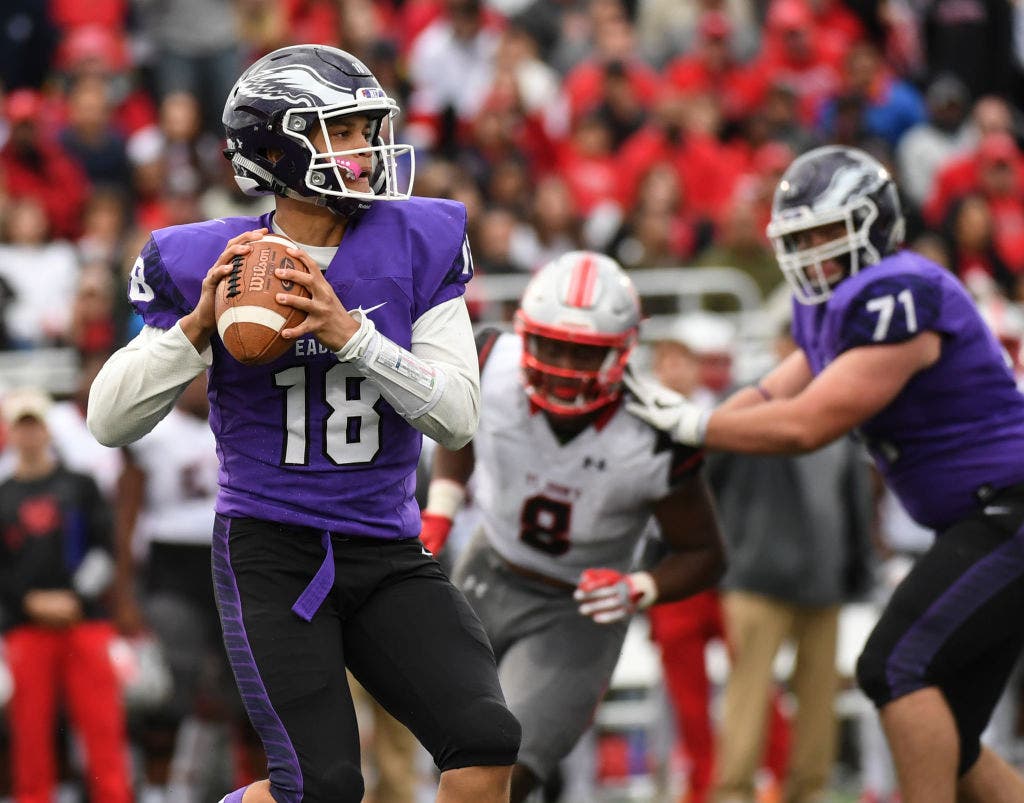
Caleb Williams’ “Iceman” roots started in high school as the quarterback of the Gonzaga College Eagles in Washington, D.C. (Photo by Toni L. Sandys/The Washington Post via Getty Images)
This is the Caleb Williams that the NFL now knows.
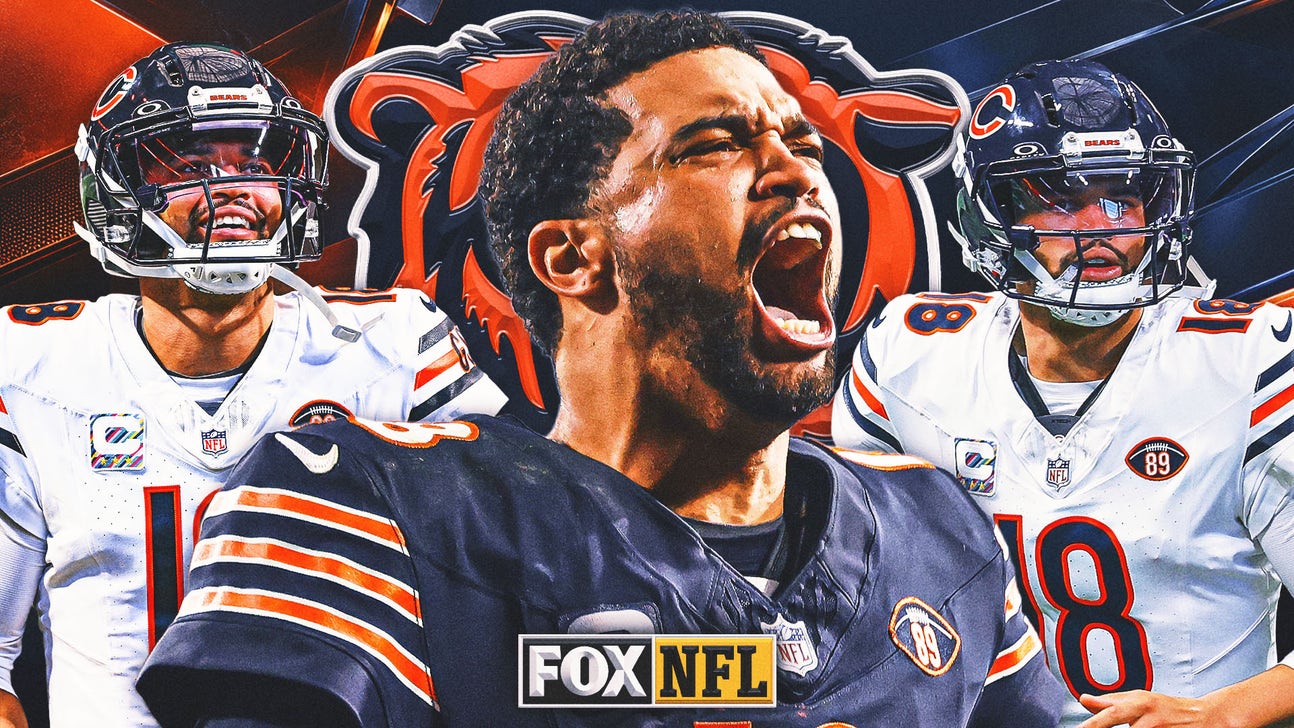
The “Iceman,” who’s ascending into superstardom in Year 3 with the Chicago Bears, is arguably the NFL’s most clutch performer. In 2025, Williams engineered seven comeback victories in which the Bears trailed in the final two minutes of regulation, including the playoffs, the most in a season by any quarterback under the age of 25 in league history.
“I feel more comfortable in those moments,” the Bears quarterback said last year. “I think my heart rate drops. Everything kind of settles in. It’s gotta-have-it moments. I think I’ve done a good job with that over my career in those gotta-have-it moments.”
This year, the Bears haven’t yet needed WIlliams’ heroics late in games. What we’ve seen, primarily, are the major leaps he’s made playing on schedule under head coach and playcaller Ben Johnson.
But he’s still lethal down the stretch. In his first primetime showdown of the season, the Bears’ 30-24 victory over the New England Patriots on Thursday Night Football last week, Williams completed more than 76.4% of his passes and led two scoring drives in the second half of the one-score victory.
“I love just where he is mindset-wise right now,” Johnson said of his QB last week. “No one’s more critical of him than himself at this point. … He’s the first one to say it and we go through it and [detail] where [he] can improve while still highlighting the improvements we’ve already made along the way.”

Under the tutelage of Ben Johnson, Williams is becoming an elite NFL quarterback. (Photo by Michael Reaves/Getty Images)
Williams’ next challenge: Mike Macdonald’s vaunted Super Bowl defense, as the Bears (5-2) travel to Seattle to face the Seahawks (4-3) on Monday Night Football in a matchup of NFC heavyweights.
Williams’ former coaches and teammates shared what makes the quarterback uniquely capable of rising to the occasion in high-stakes scenarios.
Former USC offensive coordinator and O-line coach Josh Henson sat in on Williams’ meetings with head coach Lincoln Riley and assistant Luke Huard, whose responsibilities were more directly tied to the quarterback.
There were always mountains of film to watch. They talked through plays and coaching situations. Game knowledge was shared. These meetings were pushed, in part, by Williams. They didn’t force him to stay. He wanted to stick around until he felt he had all the answers he needed.
That also meant randomly walking into Henson’s office, peppering him with questions:
“Coach, can you teach me this protection you were talking to the offensive line about the other day?”
“Can you teach me why you guys ID the front like this in the run game?”

Williams was a sponge in meetings with USC coach Lincoln Riley and his staff. (Photo by Brian Rothmuller/Icon Sportswire via Getty Images)
“That type of curiosity and wanting to know all there is to know about football … really served him well to be able to go make those plays in those [clutch] moments,” Henson, now Purdue’s OC and tight ends coach, told me.
So much so that those around him grew numb to it. Williams regularly did the spectacular in practices and games.
At the start of his junior season in high school, Gonzaga hosted national powerhouse American Heritage School (Plantation, Fla.). The visitors were befuddled at the crowd’s “Merry Christmas!” chants after taking a 7-0 and later a 14-7 lead. They thought the home-team fans were crazy. The reality is that they just knew what was coming. They wanted to congratulate the opponent on tasting what it felt like to be up.
Williams led a 26-0 unanswered run by Gonzaga for the victory.
“The dude is almost like a Jedi,” Randy Trivers, Williams’ coach at Gonzaga, told me. “He’s The One. He’s like Neo from ‘The Matrix.’
“It’s an ordinary thing for Caleb to do extraordinary things.”
As a true freshman at Oklahoma, in his first extended action as a college football player, Williams replaced starter Spencer Rattler in the second quarter and led the Sooners on a 21-point comeback and the game-winning drive to beat Texas 55-48 in the 2021 Red River Rivalry game.

Williams entered the 2021 Red River Rivalry game against Texas in the second quarter and led a 21-point comeback for Oklahoma. (Photo by Tim Warner/Getty Images)
“I think people deep down, at the end of the day, they can say what they want, but people either don’t love those moments and don’t relish them, or they do,” Lincoln Riley, who coached Williams at USC and Oklahoma, told me. “And I think he has always relished those moments, wanted to be in them, and is willing to pull the trigger and be willing to kind of put himself out there to make the play, knowing that sometimes it’s going to happen and that’s great. And sometimes you’re not going to make it, right?
“There’s going to be failure associated with that, too, and you can’t be scared of that failure. And I don’t think he ever has.”
USC pass-catchers would do extra conditioning to prepare themselves for whatever Williams might do during a game — or even in practice. In a third-down period in one USC practice, Williams got pressure from the right side, rolled left and instinctually switched hands to rip a left-handed pass, hitting a receiver over the middle.
Receivers knew a routine dig route could turn into a 60-plus yard explosive play in a scramble drill. His offensive linemen knew to block for four to six seconds rather than three or four.
“You never saw what was happening,” Rams offensive lineman Justin Dedich, who blocked for Williams at USC, told me, speaking from the OL perspective. “You just knew something great was about to happen.”

Offensive lineman Justin Dedich (No. 57) knew to hold his blocks for Williams, always expecting the unexpected. (Photo by Keith Birmingham/MediaNews Group/Pasadena Star-News via Getty Images)
Williams’ offensive coordinator at Gonzaga, Danny Schaechter, would always end his play calls to the quarterback with a similar message: “Stay on the beach.” It was a reminder to remain even-keeled. There might be big waves and storms in the game action. But on the beach, we’re good. We’re enjoying this. All is calm.
“I’ll still message him before games and stuff,” Schaechter told me. “Like, ‘Hey, man, have fun. Stay on the beach.’”
Even without the reminders, that’s how Williams operated. He’s always had a stoic demeanor in high-stakes moments, according to former coaches and teammates. He treated practices like games. He took pride in how he went through his reads, how he’d look off defensive backs. He didn’t want to waste energy on anything except what was in front of him.
“He would always tell us, ‘Everybody breathe. Take a deep breath,’” former USC wide receiver Brenden Rice told me.
Williams wanted the whole game on his shoulders, badly.
Texans Pro Bowl safety Calen Bullock remembers Williams’ first day at USC in 2022. The two went out to eat with a couple teammates. They sat in the car, talking and getting to know each other.
Williams’ message to the group:
I’m going to go win the Heisman.
“He said it, and he went out and did it,” Bullock told me. “I will always remember that.”
To understand Williams, Riley explained, you must know how long he’s been intentionally designing his life.
“He decided a long time ago, he and his family, that this is what he wanted to do for a living,” the USC coach told me. “And so everything they’ve done has been to try to position himself to be able to do it, and with the belief that he was going to be able to do it. And so I think a lot of his preparation started years and years and years ago, and it’s kind of been just a big, constant, steady build-up to these moments now.”
That belief became fuel for others.
“No question, it affects how you call a game or some of the decisions that you make in a game, knowing that you have a guy that is capable of, and is not going to be scared of, those types of moments,” Riley told me. “I’m sure Ben [Johnson] would say the same thing right now. It’s a huge advantage feeling like that. … If we can just get the ball and in this type of situation with the game in reach, we like our chances.”
In May, Gonzaga College High School unveiled a statue of a rising Eagle on campus. Inscribed at the bottom: “11.18.18,” commemorating Williams’ last-second Hail Mary that won the school the conference championship that year. It’s meant to serve as encouragement for future generations of Gonzaga students.
For the football world, it’s also a permanent reminder of what Williams is capable of at any moment.