|
Only have a minute? Listen instead |

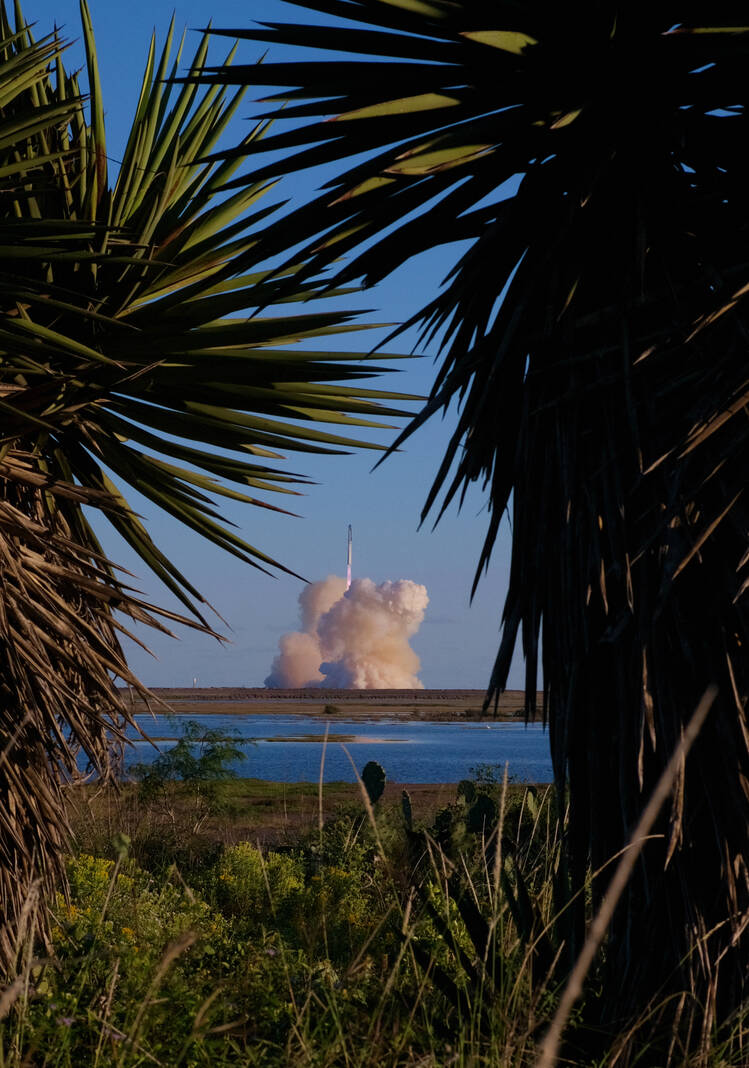
After more than 22 hours in low-Earth orbit, Starship S34 returned to the Boca Chica launch site where it had lifted off late Friday afternoon.
The vehicle was caught by the launch tower’s giant mechanized pincers as it descended toward the launch pad under power.
It was SpaceX’s first attempt to “catch” a Starship at the launch tower, nicknamed “Mechazilla,” a maneuver that SpaceX has accomplished three times before with the much larger Super Heavy booster.
On Friday, a planned attempt to catch Super Heavy B22 was aborted after the vehicle’s guidance and navigation system detected that the booster “was not in the place that it was supposed to be to proceed with a catch, did an automated abort and then headed out to that offshore splashdown location,” about 6 minutes after liftoff, according to SpaceX spokesman Dan Huot.
Mechazilla catches Starship! Congratulations to the entire SpaceX team on this incredible achievement! pic.twitter.com/YJzmGUZb2B
— SpaceX (@SpaceX) November 14, 2026
But the Starship catch on Saturday worked.
“Mechazilla has grabbed the Starship,” Huot said at 3:24 p.m., 22 hours and 32 minutes after Friday’s launch. “We have been waiting to hear that for a long time.”
“If successful, this will mark the first full recovery of an orbital launch system and a breakthrough moment in making Starship a reliable, rapidly reusable rocket,” the company had said in anticipation of Flight 15.
“Starship will only execute a return to launch site if the flight control team has ensured that the vehicle systems critical for reentry maneuvers and final landing burn and tower approach are healthy.”
Retrieval and reusability of spacecraft are key to the company’s goals of dramatically reducing the cost of transporting payloads — and eventually humans — via Starship.
Once Starship reached orbit on Friday, it successfully deployed 26 Version 3 Starlink satellites, another facet of the mission.
NASA awarded SpaceX a $4.4 billion contract (the initial $2.9 billion contract in 2021) to develop Starship as the Human Landing System that would return astronauts to the moon for the first time since 1972, though Starship development delays caused NASA to reconfigure its moon program, dubbed “Artemis,” and also contract with SpaceX competitor Blue Origin, a rocket company owned by Jeff Bezos.
NASA in February announced that Artemis III, initially intended as the mission to land astronauts on the moon, had been redefined to involve “testing of systems and operational capabilities in low Earth orbit to prepare for an Artemis IV landing in 2028.”
A key mission goal will be “rendezvous and docking with one or both commercial landers from SpaceX and Blue Origin,” NASA said.