Subscribe to The Y’all — a weekly dispatch about the people, places and policies defining Texas, produced by Texas Tribune journalists living in communities across the state.
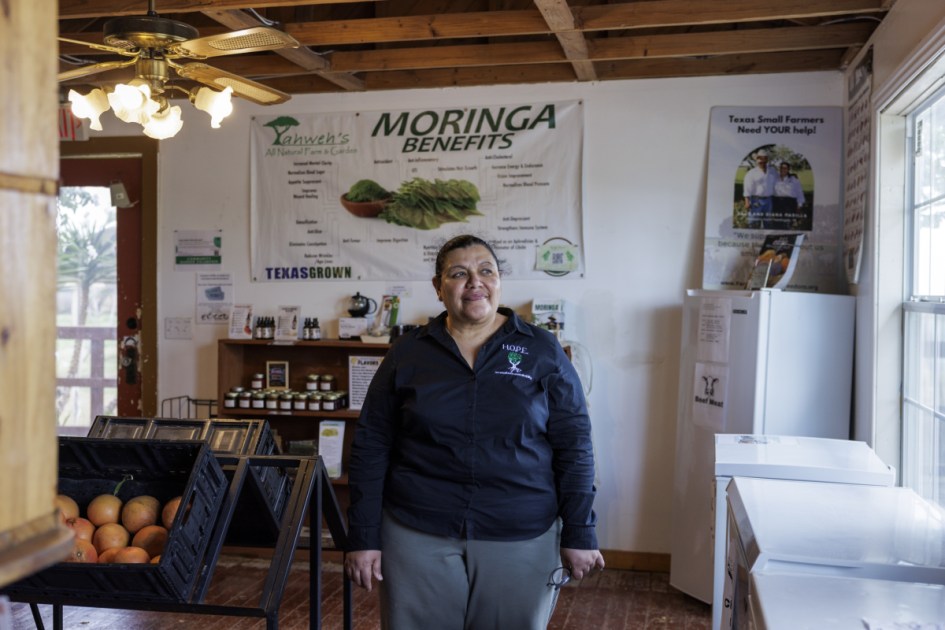
HARLINGEN — For more than a decade, Diana Padilla has been teaching Texans in the Rio Grande Valley how to farm.
For four hours on Sundays, she and her husband, Saul Padilla, would help their student farmers at a community garden the couple had set up on their farm by preparing the soil for them, teaching them how to use the space, and telling them what would be good to plant and what wouldn’t be.
“We were mostly there for, like, pep talk,” Padilla said.
The idea for the community garden came from their weekends spent at the farmer’s market where some people couldn’t afford their organic vegetables. If the people couldn’t afford them, Padilla thought, maybe she could teach them how to grow their own. .
Her mission dramatically expanded when, in the summer of 2023, she learned she had been awarded a federal grant to teach the rest of the state how to till the land.
Her nonprofit, HOPE for Small Farm Sustainability, had received $7.5 million to educate Texans interested in farming. As part of the grant, Padilla could hire educators in other regions outside the Valley and purchase land to harvest.
Her first hire lived about 500 miles away in Kaufman County, near Dallas.
Padilla was on the cusp of hiring three more people in Central Texas. But his plans to expand came to a sudden halt last month when the U.S. Department of Agriculture notified her that the government was terminating the grant as part of President Donald Trump’s pledge to eliminate Diversity, Equity and Inclusion programs.
“It was heartbreaking,” Padilla said.
In a March 23 letter, the USDA said it canceled the grant following a review of the Increasing Land, Capital, and Market Access Program, which was started during the Biden administration. The USDA alleged that the program was “rife with DEI preferences” and an example of wasteful spending.
Padilla vowed to appeal the decision. She said there was nothing about her program — which is open to anyone interested in learning about farming — that explicitly focused on DEI. She was adamant her organization would debunk allegations of wasteful spending.
Now, HOPE has a slim window to convince the federal government to restore funding. If Padilla cannot, at risk are her efforts to empower would-be farmers amid a dramatic trend of farm loss across Texas, and to ensure the agriculture economy persists outside of big farming.
“We are going to appeal, but we’re going to need everybody’s support,” Padilla said. “We have an obligation to safeguard our food system for the future of Texas.”
One-on-one training
Jamie Cumming had been teaching local residents in Kaufman County about gardening and foraging. She ran a small homestead academy she led from her home and small farm.
As a struggling small farmer with six children, she couldn’t afford to teach all the skills she wanted to pass on for free, so she was excited to learn about HOPE and that it was looking to hire educators across the state to teach aspiring farmers what they needed to know to build a sustainable farm. She took the job in October 2024 and has held workshops a few times a month that are open to anyone who wants to learn how to farm, along with classes at the community garden.
But because of the USDA’s decision to pull the grant, the programming and Cumming’s job in Kaufman County ended.
“It’s a big disappointment, because it was going so well,” Cumming said.
HOPE had paid for equipment such as a tiller, drip line, landscape fabric and seeds. It’s also paid for water, a classroom and educational guest speakers.
About 27 people had been assigned a plot of land in Kaufman County that the county is allowing them to use. The aspiring farmers ranged from young families to a 78-year-old woman who farmed when she was younger.
Cumming said she didn’t collect demographic data from the people who attended her workshops. She estimated she had about four Black or Hispanic participants among the 27 farmers.
What most had in common was that they had full-time jobs and were trying to learn how to farm during their free time. Part of their education included learning about the right season for certain plants to grow, how to irrigate, how to identify plants, and how to mix seed-starting soil.
“That one-on-one training has really been a blessing for so many who are trying “to do this,” Cumming said. “We need to help that and let that flourish.”
Funding for the USDA’s Increasing Land program came from the American Rescue Plan Act, a Biden-era COVID-19 relief bill, to improve access to land. However, the agency, which is now under the Trump administration’s leadership, concluded that the grant awards did little to improve land access.
“Under the guise of increasing land access for producers, the Increasing Land, Capital, and Market Access Program included no minimum requirement for direct producer support,” the USDA said in a statement to The Texas Tribune. “Instead, the program permitted the abuse of federal funds, including expenditures on the purchasing of a barbeque smoker, construction of a gazebo, massages, and for one awardee, a $20,000 budget for ink pens alone.”
The agency did not respond to questions specifically about HOPE and its activities.
Padilla insists she spent the money correctly. Of the $7.5 million grant, HOPE had spent less than 10%. Most of the $700,000 that has been spent was used for equipment and education for farmers.
The majority of the grant funds, 59%, were budgeted to purchase additional land, but none of those transactions had been completed.
Padilla said HOPE had identified and was close to purchasing four properties in Central Texas — close to Houston, San Antonio, and Austin — for people in those areas who were interested in farming. The land would have been used for community farming that early-stage farmers could share and continue learning.
Losing farm land
Padilla and her husband started their own farm, Yahweh’s All Natural Farm and Garden, in 2008. Her husband is the farmer and she is the entrepreneur and, together, they made a business of his passion.
It took a lot of hard work, knowing how to grow and knowing how to market their products.
She knew if early-stage farmers weren’t persistent, they would likely quit, so they set out to teach people how to do that with the help of other USDA grants.
They started their first community gardens on their 75-acre farm where aspiring farmers could learn from the couple. Then in 2014, they officially launched HOPE.
Padilla’s effort to increase the number of farmers faces staggering odds. In the 25 years between 1997 and 2022, Texas lost more than 3.7 million acres of working land, according to data from Texas A&M Natural Resources Institute. Working land is privately-owned farms and ranches that produce food and provide wildlife habitat. Of those, 1.8 million acres were lost in the final five years.
Within that same 25-year period, the Rio Grande Valley, where Padilla is based, lost 751,000 acres of farmland.
Small family farms are the most prevalent type of farm. In 2024, they made up 86% of all farms in the U.S. That’s down from 2021, when they made up 89%.
Salomon Torres, projects and grants adviser for HOPE, said the loss of farmland is a disturbing trend. It contributes to illiteracy among the general public about where their food comes from, among other consequences.
“Agriculture has always been a contributor to a local economy, as far as jobs, as far as keeping land productive,” Torres said. “If land becomes completely urban, it’s going to desensitize people about the source of their food.”

The accessibility of land for locally-sourced food is considered significant for people’s health but also for their well-being, said Judith McGeary, executive director of Farm and Ranch Freedom Alliance.
“I think it’s a threat to national security,” McGeary said. “Because when we cannot raise food in this country, we are reliant on imports, which we already are, to a great extent — far more than most people realize.”
The loss of small farmers was not due to a lack of interest, McGeary said. There has been a growing interest in farming among young people, but what is less discussed, she said, is how often those young farmers fail because of the lack of land, infrastructure and hands-on support.
“Very smart, talented, motivated people often cannot make a go of it,” she said. “And that’s not just a problem for them, it’s a loss for all of us.”
Advocates for small farmers in Texas say educational programs like the one HOPE was providing are needed across the state.
P. Wade Ross, director of the Texas Small Farmers and Ranchers Community Based Organization, said the fundamental issue is that many government bureaucrats don’t know the farming landscape. They make decisions like cutting off funding for HOPE, not realizing the consequences.
“Why do you need to do that when this is a program that’s helping you achieve all the initiatives that you say are your initiatives?” Ross said.
“What happens a lot of times is people who are the decision-makers get so caught up in what they don’t want,” he said“and they don’t realize they’re cutting their arm off to get rid of what they don’t want.”
Reporting in the Rio Grande Valley is supported in part by the Methodist Healthcare Ministries of South Texas, Inc.
Source link