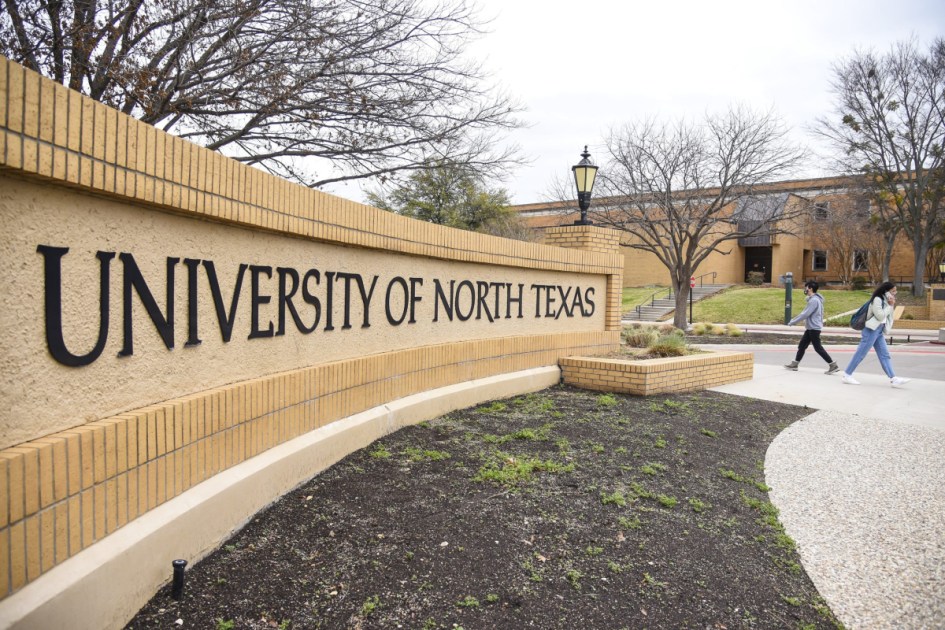

University of North Texas approved buyouts for 40 faculty members, a move officials say will soon save up to $4.7 million.
But that only covers a fraction of UNT’s projected $45 million budget shortfall that’s driven largely by declining international student enrollment and reduced state funding. Julie Elliot Payne, UNT’s assistant vice president of communications, said deans and division leaders are still weighing other potential cuts, though broad layoffs across the Denton school aren’t expected.
Records obtained through a public information request by The Texas Tribune show 44 professors, tenured administrators and other long-term instructors applied for buyouts during the application window that closed April 10. The records show four were denied because they did not meet eligibility requirements.
The College of Liberal Arts and Social Sciences had the most buyouts at 15, including six in English, three in economics and three in media arts.
Some of those departments are also affected by UNT’s academic program changes: English is absorbing the creative writing master’s program and losing the American studies minor, while media arts is losing a master’s program and an undergraduate certificate.
Two linguistics faculty members are among those leaving through buyouts as UNT is phasing out linguistics degrees and merging the department with World Languages, Literatures and Cultures.
The records do not identify faculty by name nor show whether they taught in a degree, minor or certificate program slated for elimination.
The College of Engineering had the second-highest number of buyouts with six, followed by the College of Information and the College of Public Affairs and Health Sciences with four each, and the College of Music with three.
To be eligible, the employees must have worked at UNT for at least 15 continuous years. Tenured faculty, administrators who also hold tenure, and some non-tenure-track faculty could seek the buyouts.
Tenured faculty and administrators taking the buyout will receive one year of base pay, while non-tenure track employees will receive six months. They must leave UNT by Aug. 31, and the university must pay them by Oct. 15, after the next fiscal year begins.
UNT officials said another round of buyouts is not planned and that some positions could be refilled if they advance the university’s strategic plan.
For journalism professor Tracy Everbach, who has taught at UNT for 22 years, the buyout offered a way out of a university she said has become increasingly hostile to academic freedom and faculty input.
Everbach said her concerns compounded over time — beginning with what she described as UNT’s overcompliance with the state’s ban on diversity, equity and inclusion efforts at public colleges in 2023, continuing with the recent removal of artwork from campus exhibits, and culminating with the AI-assisted syllabus review that she said flagged her “Race and Gender in the Media” class.
Finally, the university’s announcement that it would cut or consolidate more than 70 degrees, minors and certificates reinforced her decision to leave. Faculty critics say those changes happened without meaningful input.
Everbach said she has taught “Race and Gender in the Media” nearly every fall and spring semester since 2009. The class, which enrolls about 95 students and is required for journalism majors, examines how people from different groups are represented in the media and teaches critical thinking, she said.
She informed students this week that she was leaving.
“They were very dismayed to hear that,” Everbach said. “They felt like that was one of the most important classes they had taken as college students.”
UNT has blamed the shortfall on a 45% drop in international graduate student enrollment and reduced state funding tied to enrollment. International students typically pay higher out-of-state tuition, so losing them can create a larger budget hole than losing the same number of Texas students.
To close the gap, university officials moved to cut or consolidate academic programs, left some positions vacant, offered buyouts and shifted more than 40 courses to a format in which students watch lectures online and meet in person for smaller groups, a model aimed at teaching more students without hiring more faculty.
The move to cut programs was not made lightly, UNT president Harrison Keller and Michael McPherson, provost and vice president for academic affairs, wrote in a March letter to university staff.
“While these decisions are painful, they are part of a broader effort to position UNT for greater long-term stability in an increasingly dynamic time for higher education,” the leaders wrote.
UNT is not alone in facing budget pressure as international enrollment has fallen amid heightened federal scrutiny and travel restrictions.
Since June, the University of Texas at Arlington has notified 49 employees they are being laid off, according to the Fort Worth Report. UT-Arlington saw a 30% drop in international graduate students in the fall.
The Texas Tribune partners with Open Campus on higher education coverage.
Source link