By Javier Gonzalez
Special to the PRESS
Another spring bird migration has come and gone with the southern winds. Exhausted, but happy, birders finally get to rest after the intense birding frenzy. But the birds keep making their way, as our area is mostly just a halfway point. The native gardens are quieter now, but we are satisfied, and we are left with a reminder of how fleeting it all is and how valuable these coastal migration stopover sites really are. Migration, especially spring migration (March – May), is when one can appropriately gauge the value of native habitat along the Texas Gulf Coast. Millions of trans-gulf migratory songbirds on a big rush to northern breeding sites lift off from the Yucatan Peninsula and gamble with southern winds to take a shortcut across the open waters of the Gulf of Mexico to the Texas coast. All of them risk their lives on this leap of faith as zugunruhe spurs their bravery. The strong and lucky ones will make it across, and for many, the first sight of land will be South Padre Island.
Our goal here at the South Padre Island Birding Nature Center and Alligator Sanctuary is to ensure these tired and hungry arrivals have the food, water, and shelter they need to refill their energy tanks to go the distance, so that they bypass danger and arrive at their destinations as quickly as possible.
Last spring, the migration winds were heavily in the birds’ favor, and most flew right over the island and made it far inland, but this spring, they had it a bit tougher as strong late-season cold fronts and storms made passage tricky for them, especially in April and early May. Migration activity in March was practically non-existent on SPI as south winds kept migration flowing. It hadn’t rained in months, and we were under a severe drought. The trees looked like they were struggling. I worried about them. Many plants looked almost dead, and the Mulberry trees hardly bore fruit, but that all changed in April. We had a cold front and rain almost every weekend in the month! The first big migratory bird wave dropped on the island after a cold front on April 5th, Easter Sunday. Gratefully, many birders were able to enjoy the birds the next day, as they had the day off from work! Excitement grew as the first rarity of the season was spotted at our Songbird Alley’s water feature. A bright male Golden-winged Warbler, a species of conservation concern suffering from declining populations, attracted all the birders on the island to our site! This species regularly migrates through our area, but I had personally missed it the last two years! I was so very pleased to see it again and to know our native plant habitats are helping a species in need.
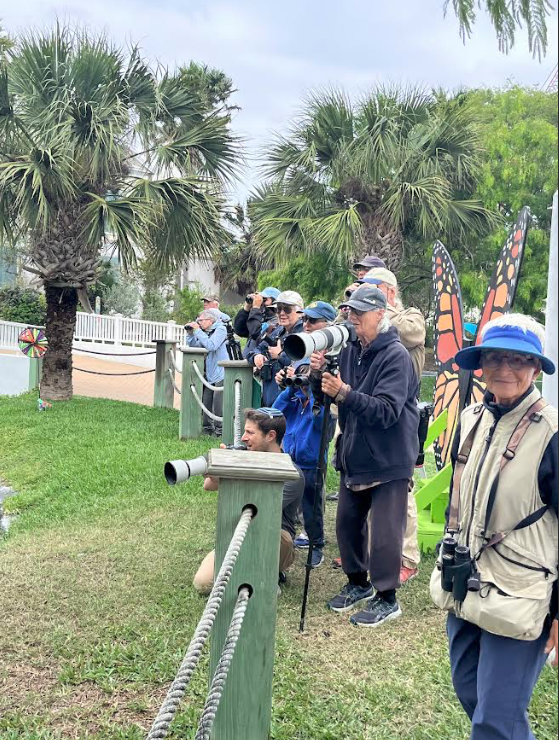
But that was just the beginning; the real action came just a couple of weeks later. A strong cold front with rain hit on the morning of Sunday, April 19th, and by the afternoon, it was obvious that we were experiencing a “fallout”! We literally could see the migratory birds falling out of the cold gray skies and into our habitats. Streams and streams of them! The wind settled overnight, and we woke up Monday morning to the sounds of hundreds of birds in our gardens! We estimated more than 300 individual migratory songbirds in the gardens surrounding the visitor center. Ruby-throated Hummingbirds buzzed at every flower, desperately seeking energy! Some birds were so exhausted that you had to watch your step to make sure you wouldn’t step on one. They barely made the crossing. Nineteen warbler species were recorded. Bright red and black, Scarlet Tanagers seemed to be everywhere you looked, Gray Catbirds flushed from every nook, flocks of Indigo and Painted Buntings gathered to eat grass seed along the fencelines, and a couple of bright male Cerulean Warblers, another threatened species, wowed the crowds. Birders stood in total awe at the spectacle unfolding around them. It was one of those special days at the birding center! Most of the birds moved on later that night, but many remained and rested through the week.
Migration kept steady through April, but another surprisingly hard northerner hit the first weekend in May. It unfortunately struck the birds by surprise as well, as beachgoers reported dead birds washing up on shore in the following days. Many lucky birds did reach our sanctuary. This time, the gardens were full of late-season migrants. The species that nest in the Boreal Forest of Canada! My favorite Magnolia Warblers “Maggies”, Chestnut-sided Warblers, and fiery American Redstarts were aplenty! The birds arrived just in time for our annual Great Texas Birding Classic day with the Lower Laguna Madre Young Birders Club! The club members were excited about the many “lifers”; bird species that they had never seen before in their lives! It was the first spring migration some of them had ever witnessed, and the sights were memorable. Migration is tough, but we hope these birding experiences create lasting impressions in the young minds of our club members, help them realize the importance of conservation, and inspire them to care for nature.
Most birders tapped out by mid-May, but the migration continued through the end of the month. This is the second spring that I have monitored the number of individual migratory birds utilizing the native gardens we have grown with the help of community volunteers and staff. Last spring, I counted 481 individuals; this spring, we counted 914 individuals, comprised of 104 songbird species! I was surprised by the number because our year total for 2025 was 1,045 individuals in our gardens! I’m even positive that I’ve undercounted, and I think I’m safe to say that we had more than 1,000 individual birds in the gardens this spring alone! Habitats on the island were exceedingly important this season. We saw an incredible number of birds, and along with them came the birders! Seasons like this inspire us to keep creating and preserving habitats on South Padre Island.