By SANDRA TUMBERLINSON
San Benito Historical Society
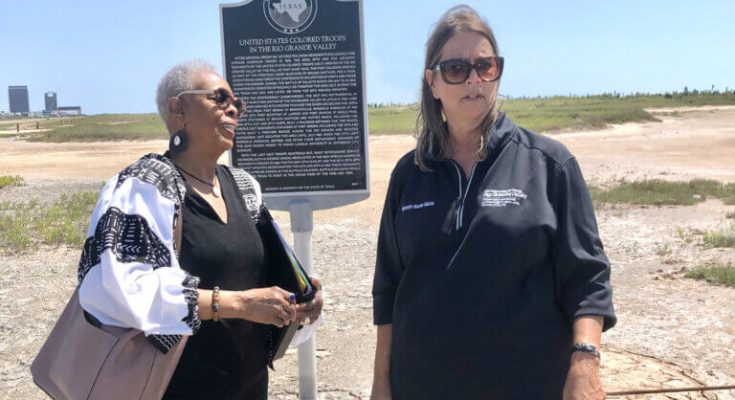
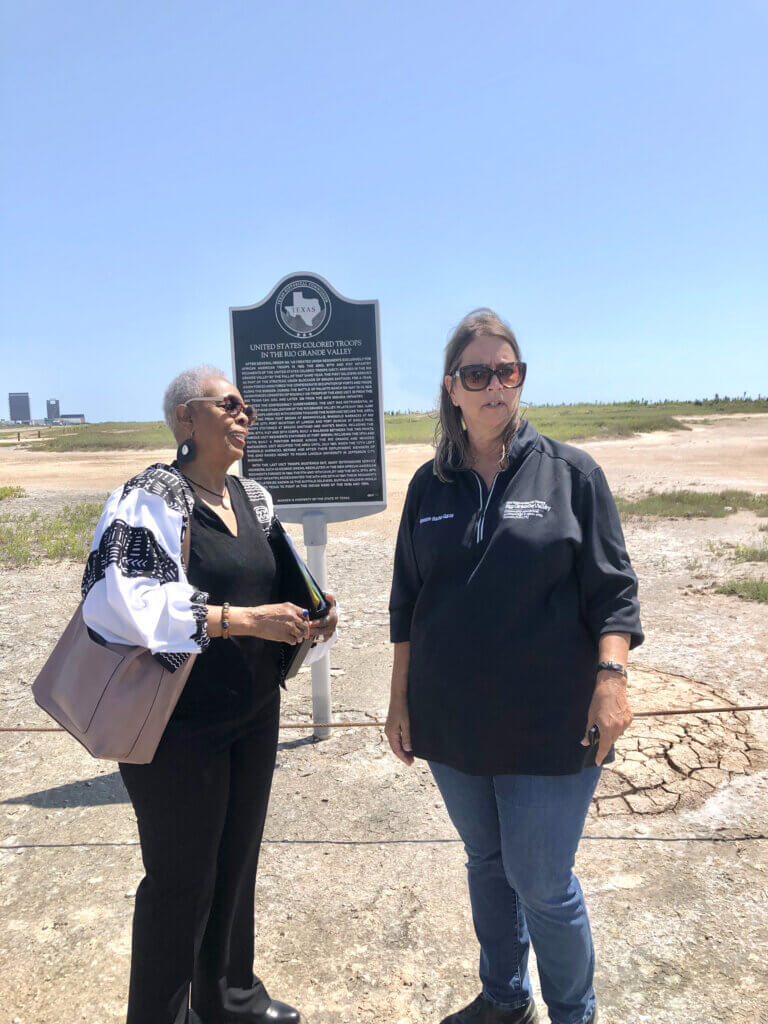
On a windy, sunny South Texas day, the under-told story of the last Civil War Battle in Texas, as commemorated by the Texas Historical Marker for the “United States Colored Troops In The Rio Grande Valley,” was dedicated on Hwy. 4, in the shadows of SpaceX, by Naomi Mitchell Carrier, the application author for the Texas Center for African American Living History (TCAALH) and a San Benito native.
She was joined by Wilson Bourgeious, Cameron County Historical Commission Chair; Stephen Cure, Texas Historical Commission Military Historian; and Roseann Bacha-Garza, anthropology professor at the University of Texas Rio Grande Valley, who also serves as the Program Manager of the Community Historical Archaeology Project with Schools (CHAPS), along with local historians.
Carrier congratulated those who worked on the installation of the historical marker, saying, “Ten years ago, in September 2015, I journeyed to this Rio Grande Valley, the place of my birth, to witness the Rio Grande Valley Civil War Trail.”
She added, “Having studied the Civil War for 55 years, in this, the 160th Anniversary of the Emancipation Proclamation (2025), I am so happy to come before you to pay homage and to commemorate the United States Colored Troops. To them, whose courage and bravery helped free my ancestors from slavery, I give honor, because without them, there would have been no Union Victory.”
She continued her speech by explaining the past.
“Cotton changed the course of America’s economic and racial future because of two simultaneous events: the mass production of textiles and the mass production of cotton. The cotton economy controlled the destiny of enslaved Africans,” Carrier explained.
Carrier recalled, “There were 5000 slaves in Texas by the time of the Texas Revolution in 1836.”
By the time of annexation, a decade later in 1845, there were 30,000. By 1860, 15 years later, the census recorded 182,566 slaves — over 30% of the state’s total population.
American cotton production soared from 156,000 bales in 1800 to more than 4,000,000 bales in 1860. The cotton economy controlled the destiny of enslaved Africans.
In Texas, The Port of Galveston was the largest cotton port in the world. Some plantations earned as much as $5,000 per day.
In 1848, Brazoria County produced more than five million pounds of sugar and 10 million pounds of cotton. Before the US Civil War, 80% of the world’s cotton was produced in the United States.
Texas became well known for its production of “King Cotton,” making it the largest producer of cotton in the Southern USA.
By 1860, enslaved labor produced over two billion pounds of cotton each year. About 75% of the cotton grown in the United States was sold overseas.”
“Cotton was the South’s economic backbone. When the southern states seceded from the United States to form the Confederate States of America in 1861, they used cotton to provide revenue for its government, arms for its military, and the economic power for diplomatic strategy,” Carrier explained.
On April 19, 1861, the Union established a blockade along the Southern shores that limited, but had not completely stopped, Southern commerce.
Texas planters armed wagon trains to deliver their cotton to Bagdad, Mexico, where awaiting, were ships loaded with ammunition and supplies for the Confederacy.”
“Meanwhile, the war raged on. Union regiments exclusively for African American troops named the United States Colored Troops (USCT) were created in 1863 and were involved in the Union blockade of Brazos Santiago.
After the Confederacy surrendered, the USCT was instrumental in the post-war stabilization of the Rio Grande Valley.
In late May 1865, 16,000 USCT troops arrived with orders to guard the river and secure the area, operating from Fort Brown at Brownsville, Ringgold Barracks at Rio Grande City, Fort McIntosh at Laredo and Fort Duncan at Eagle Pass.
USCT occupied the area until July 1867, when the 117th left Ringgold Barracks. Before and after their deployment, members of the 62nd raised money to found Lincoln University in Jefferson City, Missouri.
Carrier concluded, “With the installation of this Under-told Stories Texas Historical Marker, we salute the more than 16,000 United States Colored Troops who participated in the stabilization of the Rio Grande Valley following the Civil War.
These young Black men upheld the changing of the guard in the United States of America from a country invested in slavery to a democracy where all men, women, and children are created equal. The Rio Grande Valley Civil War Trail is a significant monument to the unfettered access to freedom and equality.”
The inscription on the “United States Colored Troops in the Rio Grande Valley” historical marker reads as follows:
After General Order No. 143 created Union regiments exclusively for African American troops in 1863, the 62nd, 87th and 91st Infantry regiments of the United States Colored Troops (USCT) arrived in the Rio Grande Valley by the fall of that same year.
The first troops arrived as part of the strategic Union Blockade of Brazos Santiago. For a year, Union forces monitored the Confederate occupation of forts and trade along the border.
During the Battle of Palmito Ranch on May 12-13, 1865, Union Forces consisted of roughly 250 troops of the 62nd USCT, 50 from the 2nd Texas Cav. (US), and later, 200 from the 34th Indiana Infantry.
After the Confederacy surrendered, the USCT was instrumental in the post-war stabilization of the Rio Grande Valley.
In late May 1865, 16,000 USCT troops arrived with orders to guard the river and secure the area, operating from Fort Brown at Brownsville, Ringgold Barracks at Rio Grande City, Fort McIntosh at Laredo, and Fort Duncan at Eagle Pass.
Troops stationed at Brazos Santiago and White’s Ranch, including the 62nd, 87th, 91st, and 25th Corps, built a railroad between the two points.
Various USCT regiments stationed at Fort Brown, including the 19th and 114th, built a pontoon bridge across the Rio Grande and invaded Matamoros.
USCT occupied the area until July 1867, when the 117th left Ringgold Barracks.
Before and after their deployment, members of the 62nd raised money to found Lincoln University in Jefferson City, Missouri.
With the last USCT troops mustered out, many outstanding service members, such as George Owens, re-enlisted in the new African American regiments formed in 1866: The 9th and 10th Cavalry and the 38th, 39th, 40th, and 41st Infantry, re-designated the 24th and 25th in 1869.
These regiments would later be known as the “Buffalo Soldiers.” Buffalo Soldiers would return to Texas to fight in the Indian Wars of the 1870s and 1880s.
Carrier authored the narrative for two pieces of legislation: H.C.R. 245 for Recognition of the Underground Railroad from Texas to Mexico and H.R. 434 for the Emancipation National Historic Trail; and two Texas Historical Markers 1) Marshall and Malinda Mitchell, 2) United States Colored Troops Last Battle of the Civil War.
The marker is located on Richardson Ave., south of Hwy 4, past Palmito Hill Battlefield (the last battle of the Civil War) Rd., just before the entrance to SpaceX.