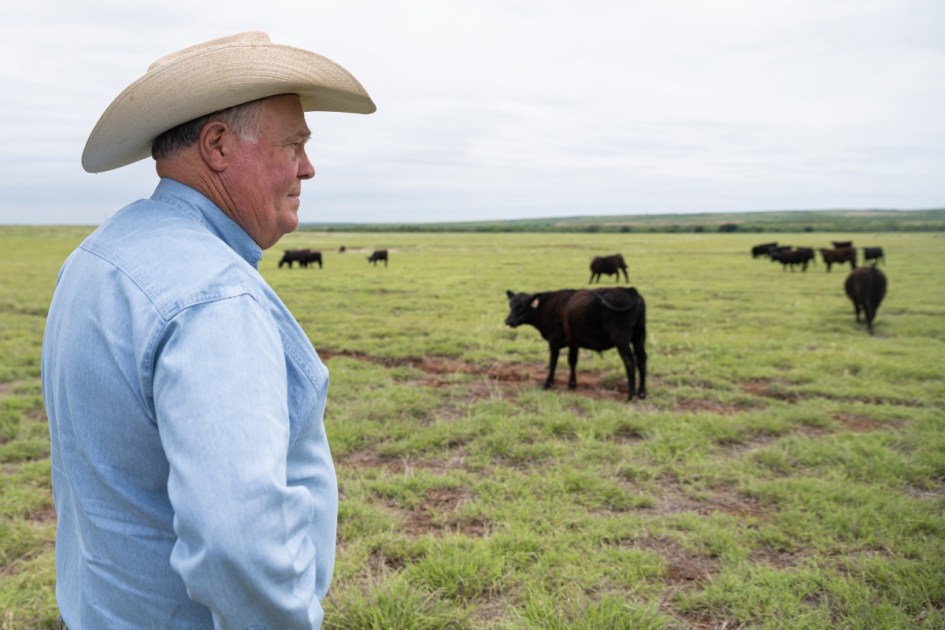
James Henderson was a teenager in 1971 when he had to treat animals for a type of white maggot that ate livestock from the inside out — the New World screwworm.
“It’s a horrible parasite, and it will eat that flesh very quickly,” said Henderson, who operates the Bradley 3 Ranch near Memphis in the Texas Panhandle. “From the time that adult fly lays its eggs until you have an animal that probably needs to be destroyed can be as little as 72 hours.”
Henderson, like most Texas ranchers, has faced one battle after another in an industry already full of challenges. The return of the screwworm is the latest blow.
As inflation eats into Texas ranchers’ wallets, widespread drought and wildfires are making it even more difficult to grow a U.S. herd that has already shrunk to its smallest size in more than 70 years. President Donald Trump’s trade war in 2024 further inflamed the industry’s problems. The reduced supply of cattle is straining every link in the supply chain, making it more expensive for meatpacking plants to operate and passing those costs onto retail consumers and restaurants who are also struggling with higher prices.
According to the Consumer Price Index Report for May, beef prices nationally rose 12.9% in the past year. Texas’ beef cattle industry contributed about $7.2 billion annually to the state’s gross domestic product from 2018 to 2021, according to a study by Texas A&M ArgriLife.
“It’s a tough time for many ranchers out there,” said David Ortega, a professor in food economics and policy at Michigan State University. “Then you have this latest factor. The cost of trying to contain and prevent the spread of this, it’s just another layer.”
Ortega says screwworm is creating uncertainty in the industry and for consumers. U.S. Agriculture Secretary Brooke Rollins said recently the screwworm outbreak could continue for a few more months. The construction on the sterile fly facility — the tool most think is the solution to the outbreak — won’t be completed until November 2027.
“It just takes time,” Henderson said. “We can only ramp up so fast to get things done.”

As screwworm spread north, it has slowed growth in the cattle population, first by pinching off cattle imports from Mexico in November 2024, and now, domestic ranchers are slowing operations as they meticulously check their herds for infection, Ortega said.
Ranchers are taking more care in certain tasks, like branding, dehorning and castration, because they don’t want to create more opportunities for screwworm flies to lay eggs in open wounds.
This latest snag at the top of the supply chain could slow ranchers’ recovery from drought and wildfire and trickle down through the rest of an already strained industry.
“It’s really been this perfect storm of factors that have impacted the beef industry in the past few years,” Ortega said. “And it’s really driven prices to record highs.”
Culling Texas’ herd
The Texas Panhandle is one of the biggest cattle-producing regions in the country and the state, raking in $6 billion annually and growing 85% of the state’s beef. If the 26-county area was its own state, it would rank in the top three for beef production.
Still, the region has been hit hard over the years. A series of devastating wildfires — including the Smokehouse Creek fire in 2024 that became the state’s biggest wildfire ever — has set back cattle ranchers. The fires killed more than 15,000 head of cattle, including pregnant cows, in a week.

To top it off, inflation has made the business more unpredictable. Sure, beef prices are at a record high. However, Henderson said, ranchers aren’t making record profits.
The cows are being bred bigger, which means ranchers are putting in more money to maintain their cattle. From feed to fertilizer, and even the cost of fuel and veterinarian services, are higher. In the cow-calf sector of the industry in particular, Henderson said they’re possibly just now profitable again after the last few years of struggles.
“Virtually anything and everything ranchers touch has gone up in cost,” Henderson said. “So yes, we are getting record prices for cattle. But we’ve also got record costs.”
Henderson doesn’t think the screwworm will reach the Panhandle. If it does, however, it would reduce herds even more. He remembers when the screwworm first appeared in the U.S., and the delays it caused for regular cattle operations.
Since ranchers have to avoid creating unnecessary open wounds during an outbreak, they wait until the winter to perform certain tasks on cattle, such as branding and castration. The screwworm can’t survive cold temperatures, Henderson said.
“You’re pretty well forced to do those things when those flies are not around,” Henderson said.

And with more job loss in the industry, Henderson said there isn’t enough manpower to even manage a large-scale screwworm outbreak.
“There’s not enough labor, not enough horses, not enough food to manage it,” Henderson said. “We’re not accustomed to having to come up with the labor that it takes to manage some of these big ranches, and to do that if we get a major outbreak.”
On top of having to potentially wait to do their work, Texas ranchers also have to worry about a tough summer of drought. Last week, nearly 50% of the state was experiencing some level of drought conditions — compared to 36% this time last year. The lack of moisture makes it harder for cattle to graze and forage for food.
Domestic producers had 86.2 million head of cattle at the start of this year, according to the U.S. Department of Agriculture, the lowest number since 1951.
Meat packer: “We’re all at negative margins”
Trevor Caviness, 51, is the third generation in his family to run Caviness Beef Packers. The industry is facing its longest downturn since before Caviness’ grandfather founded the beef packing company in 1962, Caviness said.
The Panhandle-based beef packing company now has the capacity to slaughter, process and pack roughly 2,900 head of cattle each day but is currently operating at about 75% to 80% capacity due to the shortage of cattle, Caviness said.
“There’s more beef plants with shackle space than there are livestock,” Caviness said. “You need to be running at something like 80% to break even.”
Caviness Beef Packers procures livestock from within a 600-mile radius surrounding its Hereford beef harvesting plant, which includes cattle from much of the southwest and The Plains states.
In 2021, it was roughly $1.70 per pound for a live steer. Today, a steer costs Caviness’s company 50% more — $2.55 per pound. A typical beef steer ready for harvest weighs about 1,450 pounds, according to the University of Nebraska at Lincoln.
The only way to fix the high prices is to increase the size of the U.S. herd, Caviness said. He pays the high price of steers because he considers it a necessary part of supporting cattle ranchers.
But combined with his own overhead increasing due to tariffs and inflation, Caviness said he is operating at a loss.
“The rancher needs high prices, especially in these inflationary times,” Caviness said. “But on the flip side, because of our capacity issues as an industry, we’re not able to sell the meat on the other side at a break even or a positive margin. We’re all at negative margins.”
The company also operates a ground beef and pattie facility, which primarily uses U.S. grown lean beef. Because the U.S. herd does not produce enough lean meat to satiate Americans’ demand for hamburger meat, the company also imports lean beef from overseas, Caviness said.
Parts of the beef carcass not in demand in the U.S., like organ meat and hides, are exported abroad.
Parts of this balancing act to maximize the value of a steer have faced headwinds in recent years, Caviness said.
The trade war sparked by President Donald Trump’s tariff policy briefly led to a 40% tariff on beef imported from Brazil for months in 2025, raising costs to produce ground beef and patties. That tariff was removed in late 2025 to lower grocery prices.
However, the trade war has created ripple effects.
Caviness said exports are down 17% this year industry-wide, decreasing the company’s ability to maximize the value of a carcass.
While cattle prices continue to climb, both meat packers and retailers face increasing overhead costs as inflation grows the cost of shipping and labor.
“Things come and go, and there are cycles in a commodity business, but this is the most severe negative cycle for the longest duration probably since the 50s,” Caviness said. “The industry has got to consolidate. There will need to be changes made, or changes will be forced to reduce capacity in the industry.”

Further consolidation in the meat packing industry may not be looked upon kindly by state and federal regulators, who have directed much of the blame for high beef prices at the industry.
In November, Trump announced the U.S. Department of Justice had launched an antitrust probe of the “Big Four” meat packing companies: JBS, Cargill, Tyson Foods, and National Beef. The companies control about 80% of the meat packing market in the U.S., which Trump argued gives the companies the market power to drive down prices paid to cattle ranchers while increasing costs on beef consumers.
On May 15, Attorney General Ken Paxton announced he was launching his own investigation of the Big Four in conjunction with the Trump administration.
Ortega, the Michigan State food economist, said the Big Four could not be responsible for the increasing costs of beef over the past year because they have held the same market share for decades. While the companies’ market power does allow them to exert price controls, that has been baked into the market for far longer than the recent inflationary period, Ortega said.
Caviness noted that in January, Tyson Foods closed a beef processing plant in Nebraska due to its losses, eliminating 3,200 jobs. And on Friday, JBS announced it was closing a plant in Pennsylvania.
“The Big Four are having the largest losses in history, just like the medium processors like us, just like the smaller processors,” Caviness said. “We’re all in the same boat. We are all paying more for livestock than we can sell the meat for.”
Barbecue restaurants: No more fat to trim
The market for beef has so broken down that it is no longer affordable to produce a Texas delicacy: brisket.
Across two Austin-based barbecue locations, The County Line cooks and serves 5 million pounds of beef each year, owner and founder Skeeter Miller said. The centerpiece of his menu, like most barbecue restaurants in Texas, is sliced brisket. Over the course of 51 years in business, Miller believes he has perfected the process.
“It’s not an easy business, but it’s fulfilling,” Miller said.

Cooking and selling brisket, however, is no longer affordable amid high prices, Miller said.
The process begins when a truck load of raw brisket slabs arrives in crates, at least four to a crate and dozens of crates at a time. Ten pounds of raw brisket costs the restaurant about $54, up significantly since last year, Miller said.
Before the restaurant closes each night, the head smoker will prepare and begin to smoke the slabs of beef overnight so they are ready by lunchtime the following day.
While the raw brisket itself has become more expensive, rapidly rising energy, property tax and labor costs are increasing the cost of preparing the brisket, as well. Miller said he values his employees and has an average employee tenure of 37 years among his cooks and management — there’s not much overhead left to trim.
“They’re handling solid gold in the back,” Miller said. “I want to make sure everyone stays around for as long as they have.”
As the costs to prepare brisket rise, those costs are being passed on to the customer. A typical order of a half pound of brisket now costs about $16 at County Line, up “at least $5” from last year, Miller said.
“I’m going to hold the line as long as I can before I change the menu,” Miller said, noting he’s lost about 6% of his customers since prices began rising.
But even with those high prices, Miller said he is no longer turning a profit on a 10-pound slab of brisket.
A year ago, Miller was making about 4% to 5% profit on brisket, enough to pay his staff, keep the lights on at his restaurants and still make some money. But now, that margin is about 2%, well below the bottom line needed to cover the costs of cooking it.

Emily Williams Knight, president and CEO of the Texas Restaurant Association, said her organization has seen an acceleration of closures among Texas barbecue restaurants over the past year due to the same problem Miller is experiencing. The price for brisket has reached the point that restaurant owners can no longer increase it without losing out on customers, she said.
“Where I sit today, traffic is declining, sales are up, but that’s largely due to price increasing,” “Before we had … confirmed cases of screwworm, we were looking at 2028 for any type of cost relief.”
Now that screwworm has arrived in Texas, Williams Knight said a decrease in the price of beef faces an uncertain timeline.
“I was more optimistic a couple of months ago, but I’m more cautious now just because of the number of uncontrolables impacting restaurants.”
Miller said he believes he will be able to survive the downturn, largely thanks to his loyal customer base, built over 51 years in business, and efforts to increase profits on other parts of the menu, like sides, pork and smoked turkey.
“I don’t think I could do it starting out today,” Miller said. “Just the cost, the permitting and all of the things that you have to do, it’s a hard time right now.”

Disclosure: Texas A&M AgriLife and Texas Restaurant Association have been financial supporters of The Texas Tribune, a nonprofit, nonpartisan news organization that is funded in part by donations from members, foundations and corporate sponsors. Financial supporters play no role in the Tribune’s journalism. Find a complete list of them here.
Source link