
This coverage is made possible through Votebeat, a nonpartisan news organization covering local election administration and voting access. Sign up for Votebeat Texas’ free newsletters here.
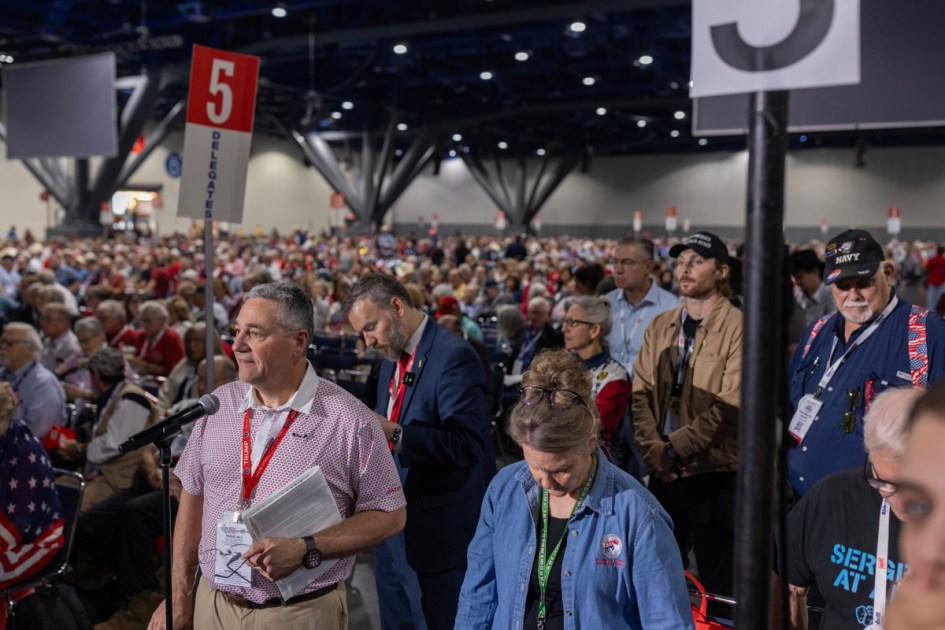
During the Texas Republican Convention last week, Gov. Greg Abbott publicly backed a push to close primaries and require voters to register with a party.
“We are going to make clear that in the future, only Republicans vote in Republican primaries,” he said Friday, addressing the convention in Houston.
After an unsuccessful legislative push last year to close the primary elections, when voters choose a party’s nominees for the November general elections, state Republicans sued to make it happen. That litigation is still pending in federal court, but Abbott wants state lawmakers to try again. Lawmakers “can and should be more responsive to Republicans than a judge may be,” Abbott told the Texas Scorecard, a conservative news outlet.
During the convention, Abbott noted that closing the primary will require a “thoughtful process” laying out “how we’re going to make sure we get all Republicans registered to vote and identified as Republicans.” Abbott’s comments were received with cheers and applause. The party also made closing the primaries one of its top legislative priorities for next year’s legislative session.
Here’s what you need to know about the GOP’s push to close the primaries:
When did the recent push to close Texas primaries begin?
For years, Republicans in Texas have made closing primaries a top legislative priority, but haven’t gotten anywhere. The push intensified in 2024 when two incumbent state representatives viewed as moderates, former House Speaker Dade Phelan and Gary VanDeaver, held off challengers in their primary races by fewer than 800 votes.
Some Republican leaders claimed Phelan and VanDeaver only won because they’d received votes from Democratic- and independent-leaning voters — which is allowed under the state’s open primary system that doesn’t require party registration and allows any voter to cast a ballot in whichever primary they want.
That same year, more than 70% of voters in the Republican primary supported a nonbinding proposition calling for closed primaries.
How do primaries work in Texas?
Texas’ open primary system has been in use since the early 1990s, when the state moved away from using party conventions to nominate candidates.
Eligible voters in Texas do not have to select a party affiliation when registering to vote, and may choose to vote in any one party’s primary during a given election cycle.
Unlike most other states, where county and state officials are responsible for managing the primary election, Texas gives the political parties a lot of authority. On primary Election Day, the parties have discretion to choose where and how voters cast ballots and how the votes are counted. The state then reimburses them for many expenses and administrative costs.
Why did closing the primaries become such a hot topic?
The issue heated up last fall, when the Texas Republican Party sued Texas Secretary of State Jane Nelson, a Republican, arguing that the state’s open primary system is a violation of their freedom of association rights under the First Amendment. Then, Texas Attorney General Ken Paxton sided with the GOP in asking a federal judge to strike down parts of the election code that allow for open primaries. Paxton’s office gave Nelson less than an hour’s notice of his filing.
Nelson, who earlier this month announced she’d be stepping down as secretary of state, opposed Paxton’s motion and argued that it’s up to the state Legislature to make changes to election law. This sparked backlash among some Republicans, and scattered calls on social media for Abbott to fire her.
The lawsuit is still pending in federal court.
What would it actually take to close the primaries?
The law would have to change. Republican lawmakers’ proposals to close the primaries haven’t been successful so far, but Abbott’s recently declared support could push the proposal forward during next year’s legislative session.
Alternatively, the federal judge presiding over the GOP’s lawsuit could also at some point rule the current state law unconstitutional, which would also force a change.
What would closing the primaries in Texas mean for voters?
Administratively, changing the state’s current system could be complicated because the state’s more than 18 million registered voters have never had to declare a party affiliation. And the state’s voter registration system is not designed to accommodate that.
In its lawsuit, the GOP suggested that if the judge were to rule in their favor, the party could maintain its own voter registration lists, “develop its own verification procedures,” and work with county election officials to provide them with access to the GOP’s system. Under that model, Democrats would presumably need to take similar action.
But the change could also require administrative action by the state. Election policy experts are wondering whether switching to closed primaries would mean requiring all voters to re-register with a party affiliation. That could be a big lift not just for voters but for the state, which would have to redesign its forms and software to allow for voters to list a party affiliation. It’s not yet clear how long that would take and how much it could cost.
Natalia Contreras covers election administration and voting access for Votebeat in partnership with the Texas Tribune. Natalia is based in Corpus Christi. Contact her at ncontreras@votebeat.org.
Disclosure: Texas Secretary of State has been a financial supporter of The Texas Tribune, a nonprofit, nonpartisan news organization that is funded in part by donations from members, foundations and corporate sponsors. Financial supporters play no role in the Tribune’s journalism. Find a complete list of them here.
Source link