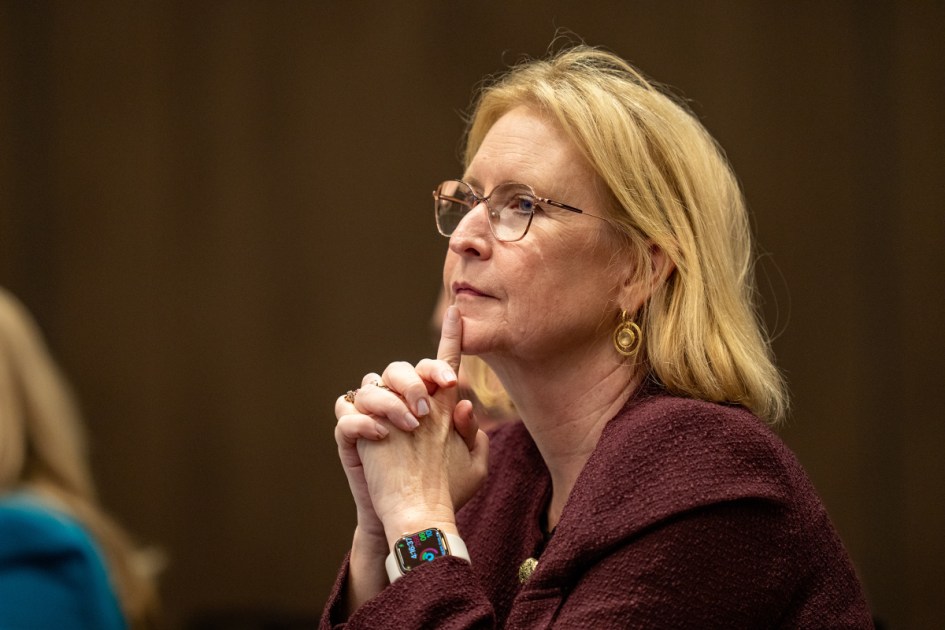

Texas A&M University’s new president could earn more than $1.7 million a year under a five-year contract as the state’s largest public university tries to steady itself after years of political scrutiny and leadership turmoil.
Susan Ballabina’s agreement gives her a $1.25 million base salary, eligibility for an annual merit-based retention bonus of up to 25% of that salary and $150,000 in deferred compensation beginning next year, according to records obtained by The Texas Tribune.
The agreement offers a glimpse into what Texas A&M leaders are willing to pay for stability after the flagship campus cycled through presidents and became a flashpoint in the state’s broader political fight over higher education.
The board of regents confirmed Ballabina, who most recently served as executive vice chancellor of the system, as president in May.
She replaced former President Mark A. Welsh III, who resigned last year amid backlash over a secretly recorded classroom discussion of gender identity. Welsh’s predecessor, M. Katherine Banks, stepped down in 2023 after Texas A&M recruited Kathleen McElroy, a Black journalism professor and Texas A&M graduate, to revive its journalism program, then repeatedly weakened the terms offered to McElroy amid concerns about her work on race and diversity in newsrooms.
In a June message to campus, Ballabina said one of her priorities is to “restore trust” in the university. She is also searching for a new provost after Alan Sams, who has held the role since 2023, told her he would not seek another term. Ballabina said the university aims to have his successor in place by January. Sams’ office also recently named Simon North dean of the College of Arts and Sciences, which was at the center of the controversies that contributed to the departures of Welsh and Banks.
Welsh’s departure proved costly for the system, which agreed to pay him more than $3.5 million after he resigned. His contract ran through December 2028 and included a $1.1 million annual salary, eligibility for a $150,000 retention bonus on each anniversary of the agreement and a $150,000 annual housing allowance.
Ballabina’s base salary matches that of University of Texas at Austin President Jim Davis, whose employment agreement pays him $1.25 million a year, according to UT System board agenda materials. The signed letter included in those materials also provided Davis a one-time $50,000 payment for transitional expenses, but it does not appear to include the annual retention bonus or deferred compensation included in Ballabina’s contract. Unlike Ballabina’s five-year agreement, the UT materials say Davis serves without a fixed term, subject to approval by the UT System chancellor and board of regents.
Ballabina’s potential compensation could reach $1,712,500 once deferred compensation begins next year and if she receives the full retention bonus. The agreement says the bonus is not guaranteed and subject to approval by the board of regents after a review of her annual performance.
Her contract also spells out conditions under which regents may fire her for good cause. Those reasons include a felony indictment; certain misdemeanor allegations involving theft, dishonesty or moral turpitude; intentional and material violations of system or university policies; insubordination; personal dishonesty; and a conflict of interest involving personal financial gain.
The agreement also allows termination for “an act that generally brings public disrespect, contempt or ridicule on the system or university, or creates a material adverse effect on the reputation and/or brand of the System or the university, as determined by the Board.”
The Tribune has requested Welsh’s original employment agreement to determine whether his contract included similar termination language.
The Texas Tribune partners with Open Campus on higher education coverage.
Disclosure: Jim Davis, Kathleen McElroy, Open Campus, Texas A&M University and The University of Texas at Austin have been financial supporters of The Texas Tribune, a nonprofit, nonpartisan news organization that is funded in part by donations from members, foundations and corporate sponsors. Financial supporters play no role in The Texas Tribune’s journalism. Find a complete list of them here.
Source link