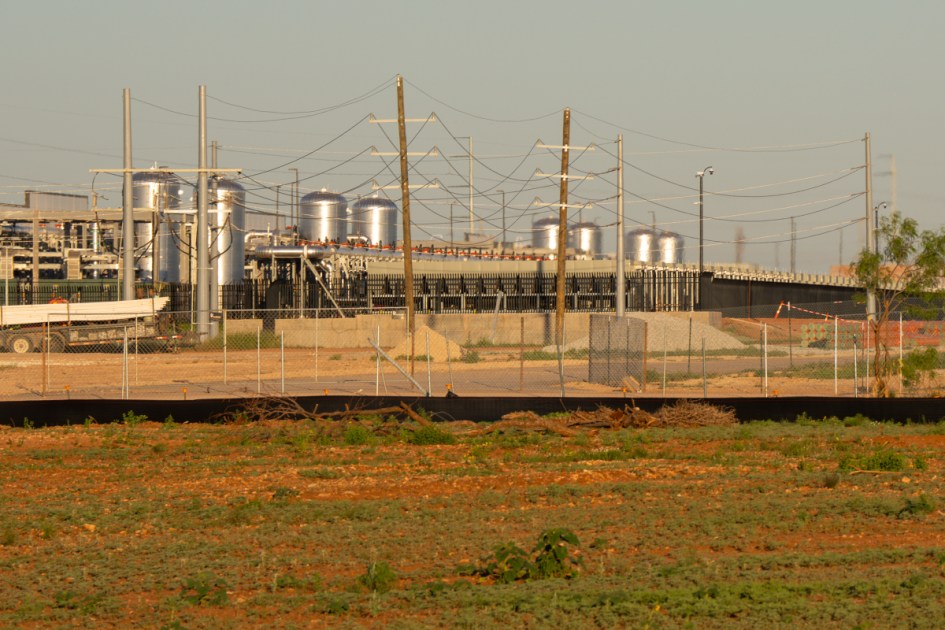

The U.S. Environmental Protection Agency is proposing to change its rules for permits issued to so-called minor air polluters by handing states greater power to decide how much notice and public input residents receive before such permits are approved or denied.
For Texans, the rule change could limit their right to speak out about a type of pollution permit that’s commonly issued to concrete batch plants and rock crushers, but is becoming increasingly used by massive data centers coming to the state.
It would allow the Texas Commission on Environmental Quality — the state’s environmental regulator — the authority to rewrite its own rules, which could include scaling back opportunities to protest or challenge permits before they are issued.
If the EPA makes the change, any subsequent change TCEQ seeks to make would go through its own rulemaking process, where people can give input.
The EPA says the change is “intended to reduce administrative burden and responsibly speed up permitting, supporting American economic development and energy dominance” by putting state agencies “most familiar with local issues in the driver’s seat.”
“States will be given the CHOICE to decided what was best for their communities,” said Carolyn Holran, an EPA spokesperson. “Our proposal does not alter emission standards or weaken environmental protections. EPA’s air permitting partners would still be required to meet all applicable statutory and regulatory requirements to maintain the utmost human health and environmental protections.”
But environmental advocates in Texas say the proposal could help strip away one of the few tools residents have to challenge industrial development in a state where regulators have already been criticized as weak enforcers.
The EPA will hold a virtual public hearing on the proposal July 22. People who want to participate must sign up by July 19, although the agency will accept written comments through Aug. 21.
The timing is especially significant, advocates say, as Texas experiences an unprecedented surge in data centers to power the artificial intelligence boom, many of which apply for minor pollution source permits for the diesel generators and certain gas turbines to power their facilities.
“Our fear is that having the EPA say, states can set their own rules, that the TCEQ — given that they are already reluctant to provide rigorous oversight — is then going to adopt its own set of rules in response that eliminates the public participation requirements,” said Jennifer Hadayia, Executive Director of Air Alliance Houston.
“If the rule passes, community voices across Texas and other states would be silenced,” Kathryn Guerra, the director of Public Citizen’s Watchdog Campaign and former regulator at the EPA and the Texas Commission of Environmental Quality, said in a social media video.
Holran, the EPA spokesperson, said that claim is incorrect and that the agency is not cutting people out of the process.
The permits are meant to ensure facilities follow federal limits on six airborne pollutants that are regulated by the Clean Air Act, which are aimed to protect human health and the environment, and other pollutants linked to asthma, heart disease and cancer.
The proposal does not apply to major sources of pollution such as large oil and gas refineries or chemical plants that require federal operating permits. Instead, it focuses on facilities considered minor sources of air pollution, which includes concrete batch plants, rock crushers, metal recyclers, dry cleaners, auto body shops and backup generators powering AI data centers.
The TCEQ did not respond to requests for comment on this concern or whether it would consider changing its public participation rules if the EPA is finalized.
Texas history of public participation
A review conducted in 2022 by Texas Sunset Advisory Commission on TCEQ’s effectiveness concluded that the agency’s commissioners had become “reluctant” to regulate industry and recommended more transparency from the agency, like increasing the notice it gives the public about its meetings and the period of time people can give input.
The review led lawmakers during the 2023 Legislative session to require reforms, culminating in new public participation rules, after years of pressure from communities living near industrial facilities for more engagement.
Now advocates worry the EPA proposal to turn over authority to the state could leave those new rules at risk of rollback.
“Texas generally doesn’t go above federal requirements,” said Cyrus Reed, conservation director for the Lone Star Chapter of the Sierra Club.
Yvette Arellano, founder of Fenceline Watch, an environmental watchdog organization, worries that the rule “would undercut the general public, communities’ right to know, transparency and accessibility of information to communities who are harmed first and worst. We’re talking about low-income, low-resource, underfunded areas that are largely minority communities.”
Opponents of the EPA proposal have zoomed in on the fact that multimillion-dollar data center projects that often install dozens — or even hundreds — of individual diesel generators still qualify for these minor permits.
According to reporting by Floodlight, at least 38 Texas data centers have received minor source permits for on-site power since 2024, allowing more than 2,100 diesel backup generators to be installed statewide.
Data center developers have increasingly adopted a “bring your own power” strategy as they race to meet AI’s growing electricity demands, with some projects proposing their own natural gas power plants to power data centers instead of — or in addition to — connecting to the state power grid.
The Vantage data center outside San Antonio, for example, received permission to emit 99.8 tons per year of nitrogen oxides, which is a pollutant linked to respiratory illness and premature death.
“We’re already concerned that TCEQ is giving a lot of these minor permits without looking at cumulative impacts and doing it in a very fast way. This [EPA proposal] would just make it worse,” Reed said.
Advocates also worry developers can hide the cumulative impacts of these projects by applying for permits in phases, starting with relatively small applications before expanding later.
Minor source permits can have major impacts
For residents, the permitting process is often the first indication that those facilities are coming to their area.
Those opportunities are especially important in Houston, where zoning laws offer little separation between homes and industrial development, said Hadayia, the Air Alliance Houston executive director.
“Houston is a zoning-free city,” she said. “There are minimal, if no, other protections between my house and the metal recycler that is literally a quarter mile from my house. The only protections we have are what’s in the permit and the opportunity to participate in that process.”
Reed said states remain free to preserve, or even strengthen, their own public participation requirements.
“When there’s pressure on officials and companies, you tend to get better permits,” Reed said. “When things are done more in the dark, where it’s just a registration and approval process with no ability for the public to weigh in, there tends to be more pollution and the problems tend to be worse.”
Disclosure: Air Alliance Houston, Floodlight and Sierra Club have been financial supporters of The Texas Tribune, a nonprofit, nonpartisan news organization that is funded in part by donations from members, foundations and corporate sponsors. Financial supporters play no role in The Texas Tribune’s journalism. Find a complete list of them here.
Source link