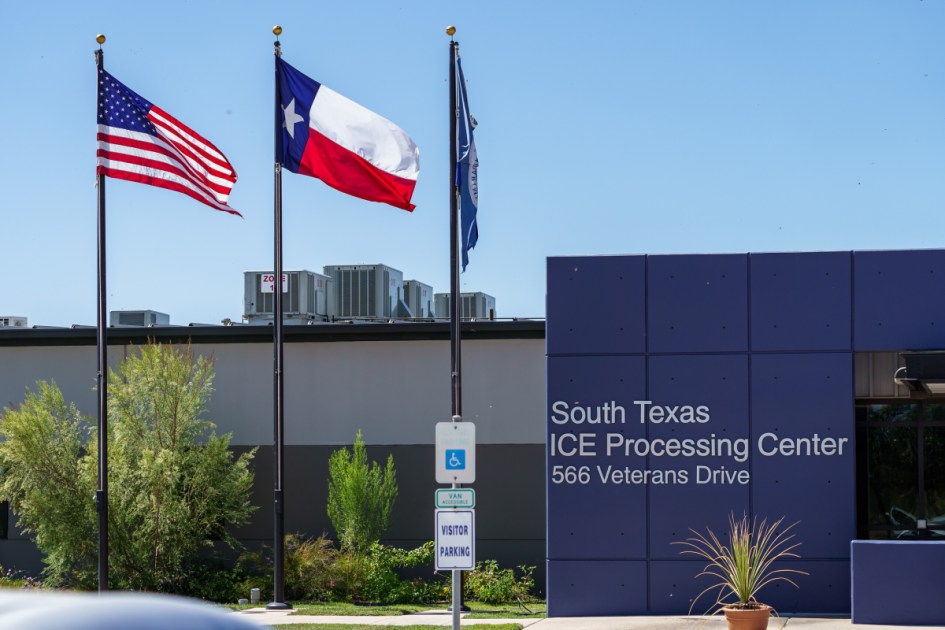

A 55-year-old legal permanent resident from Trinidad and Tobago who was deported last year is seeking $10 million from the Trump administration, claiming that he experienced medical neglect and mistreatment while he was detained at a South Texas immigration detention center.
The tort claim, a possible precursor to a lawsuit, was filed Thursday on behalf of Elton Purvis by the American Civil Liberties Union Foundation of Texas. It’s part of a nationwide effort by the ACLU, which filed more than 50 claims across 17 states and Washington, D.C., alleging that immigration officials and subcontractors neglected detained immigrants’ medical and food needs.
Purvis, who was held in detention for seven months across different facilities, spent most of that time in the South Texas Detention Complex in Pearsall, where staff repeatedly ignored his requests for help when he was experiencing medical emergencies, the ACLU claim says.
“The injustice that Mr. Purvis was forced to endure while in detention is tragically representative of the experience of thousands of detainees in Texas immigration detention centers,” said Caro Rivera Nelson, attorney at the ACLU of Texas, who is representing Purvis.
“Individuals are left in inhumane conditions for months on end without access to adequate medical care, edible food, potable water, or a way out,” Rivera Nelson added. “While in detention, Mr. Purvis filed over 100 grievances to ICE and followed every channel available to ask for medical help — nothing worked.”
Purvis was then deported in December.
Rivera Nelson said the reason her client was deported is still unclear to him. The U.S. Department of Homeland Security didn’t respond to questions about the reason for his deportation.
“Mr. Purvis’s case shows that even people with valid status are being deported,” Rivera Nelson said in a statement to The Texas Tribune.
The claims come as immigrant detainees in Texas and across the country have said they are housed in harsh conditions that have led to people getting sick by detention center food and water.
Under the second Trump administration, as of June 4 there have been 52 deaths inside detention centers — a record number, according to Human Rights Watch, an international advocacy group. Of that number, according to a Tribune analysis of federal detainee death notifications and media reports, at least 14 of those deaths happened in Texas facilities since January 2025.
“The mortality rate of deaths in ICE custody is at its highest level in over a decade and has more than doubled since Trump’s second term began,” according to a report by Human Rights Watch.
DHS referred all questions to the U.S. attorney’s office handling the case, citing pending litigation. The U.S. Attorney’s Office for the Western District of Texas declined to comment.
U.S. Immigration and Customs Enforcement detained Purvis, a father of nine U.S. citizen children, on May 13, 2025, at Boston Logan International Airport as he was returning home for two sons’ graduation ceremony. Purvis, a Rastafarian priest with Type 1 diabetes, had been suffering from malaria when he landed in Boston, the ACLU claim says.
The claim says ICE agents ignored his symptoms, which included high fever, chills and profuse sweating, for the first 12 days he was in custody before taking him to a Harlingen hospital for treatment of malaria.
The claim also says ICE confiscated his prescription diabetes and malaria medication and didn’t allow him to take the medication.
At least three times, Purvis was found unresponsive by guards inside his detention cell, according to the claim, and at least three times, “not necessarily the same times as when he was found unconscious,” he was taken to the hospital because of dangerously low blood sugar levels.
On June 2, 2025, the claim says, Purvis was taken to Valley Baptist Medical Center in Harlingen for emergency treatment of hyperglycemia and dehydration. A week later, he experienced hypoglycemia and was initially treated at the medical unit at the South Texas Detention Complex in Pearsall, then taken to University Hospital in San Antonio for emergency medical treatment.
The claim also says that on June 19, 2025, Purvis was transported to Frio Regional Hospital in Pearsall for emergency medical care related to his diabetes.
When Purvis sweated, felt shortness of breath, lightheadedness and fainting — symptoms related to hypoglycemia — he would ask the guards to seek medical help, the claim says. But the guards often didn’t take him seriously and “would ignore his pleas for help,” the claim says.
In one instance, Purvis begged for help from a nurse walking by his cell, the claim says. The nurse requested that guards take Purvis to the detention center’s medical unit but the guards ignored the nurse’s request, the claim says, “leaving Mr. Purvis to experience diabetic shock and desperation.”
At the Pearsall detention center, he told staff that he followed a strict vegetarian diet as part of his religion and because he was allergic to eggs and lactose, but he also needed to eat regularly because of his diabetes, the claim says.
The staff gave him meals that included meat, the claim says, and told him they could not accommodate both his vegetarian and diabetic food requirements.
He “relied on leftover pieces of cornbread from his fellow detainees in order to try and prevent the onset of hypoglycemic shock,” the claim says. The drinking water was dirty and he would create his own filters to be able to drink the water, the claim says.
“ICE’s refusal to comply with Mr. Purvis’s dietary needs, both medical and religious based, led to frequent life-threatening medical neglect,” the claim says. “This included hospitalization, malnourishment, frequent diabetic episodes of extremely high or low blood sugar levels, and extreme diarrhea and gastrointestinal distress for more than two months.”
Disclosure: ACLU Texas and Valley Baptist Medical Center have been financial supporters of The Texas Tribune, a nonprofit, nonpartisan news organization that is funded in part by donations from members, foundations and corporate sponsors. Financial supporters play no role in The Texas Tribune’s journalism. Find a complete list of them here.
Source link