|
Only have a minute? Listen instead |
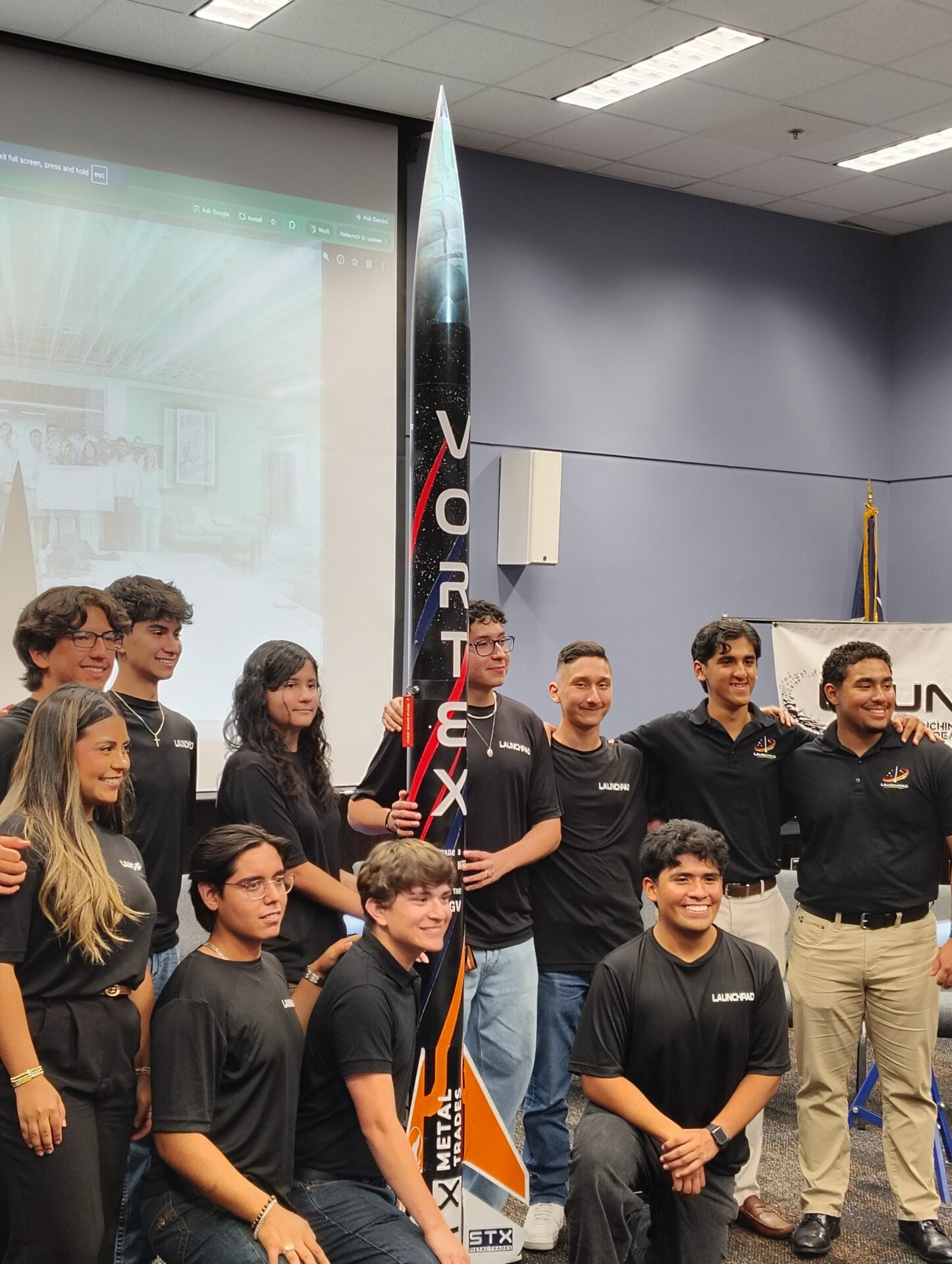
A 12-foot rocket built in Brownsville by a team from the South Texas Astronomical Society launched Saturday morning to a height of 10,032 feet from a launchpad near College Station.
The successful launch marked the culmination of idea born about three years ago and an initiative launched this past October called Project Vortex, said Phil Donaus, a STARS board member and rocket project sponsor who directed the organization back when the idea was taking shape.
STARS is a 501(c)(3) nonprofit organization dedicated to promoting astronomy and science education in South Texas. Through community events, educational programs and public outreach, STARS is dedicated to inspiring curiosity about the universe and connecting people of all ages with science, the organization states on its website.

The Project Vortex team has 15 members from across the Rio Grande Valley organized into four groups: structure, avionics, operations/recovery and business, Donaus said.
The rocket is an L-3 kit rocket that requires assembly and must meet rigorous FAA launch standards. The Project Vortex team has been building the rocket since being selected in November, said Sabian Cardenas, team advisor and a senior mechanical engineering student at the University of Texas Rio Grande Valley.
The rocket uses the same basic technology as a SpaceX or NASA rocket and cost about $5,000, donated through sponsorships by the H-E-B grocery chain and the Brownsville Economic Development Corporation, team members said during an event Wednesday evening at the Brownsville Public Library.
Members proudly unveiled the rocket and answered questions about how it is designed to reach its apogee, or maximum altitude, before parachutes deploy to float the nose cone and two lower stages softly back to earth.
If everything worked, the rocket was to be thrust into the air by black powder charges in combination with an M-1800 FJPS Black Max engine from a components supplier named Aerotech, Cardenas said.


Video provided to The Brownsville Herald showed that was exactly what happened. The rocket follows a path similar to its larger counterparts, leaving a gray vapor trail against a clear-blue sky.
Then, as the parachutes and components fall into view 2:03.98 minutes later amid shouts of “we did it,” the team erupts into congratulatory hugs.
“I actually get to practice a lot of my rocketry skills here and at the same time teach the next generation of rocketeers. We have high school students, one freshman, all the way to seniors who have already graduated and are going to college, so that’s the scale we work with,” Cardenas, 21, and a Los Fresnos High School graduate, said Thursday night.
The launch window Saturday was from 8 a.m. to noon, weather permitting, Kayla Cisneros, the team’s business manager, said as the group was leaving Friday morning to ferry the rocket to the launch site in Hearne, about a six-hour drive from Brownsville.
The team built the rocket at STX Metal Trades, 835 W. Price Road, a trade school and also a sponsor.
STARS plans to make Project Vortex an ongoing effort, with the next team due to be named on a timeline similar to the current team.