
By DIANTÉ MARIGNY
editor@sbnewspaper.com
Sections of this story are attributed to the Texas Parks & Wildlife website entry on the American Alligator.
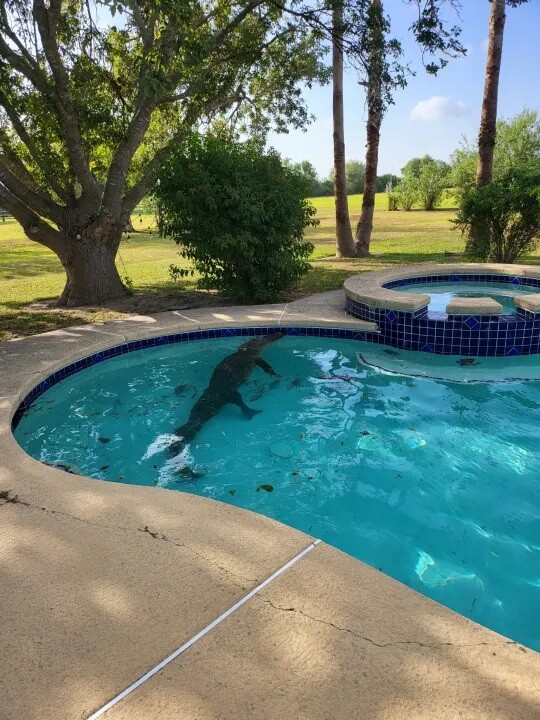
LOS FRESNOS, TX— A local family recently had an unexpected visitor when they discovered a 10-foot American alligator swimming in their backyard pool.
Jacob Reinbolt, an alligator expert, educator, and licensed nuisance alligator trapper with the South Padre Island Birding, Nature Center & Alligator Sanctuary, responded to the call after homeowners initially estimated the reptile measured between six to eight feet.
When Reinbolt arrived, he found the alligator measured closer to 10 feet. He and his team safely captured and relocated the animal in about 15 minutes.
Reinbolt said the alligator appeared to have survived years in the wild, bearing scars from fights with other alligators, a gunshot wound to its snout, and a partially missing tail. He believes the mature alligator may have been displaced while searching for new territory before ending up in the residential neighborhood.
The South Padre Island Birding, Nature Center & Alligator Sanctuary reminded residents that alligators are a protected native species in Texas.
If residents encounter one, they should never attempt to capture, feed, or approach the animal. Instead, they should contact Texas Parks & Wildlife or a licensed nuisance alligator trapper.
Experts also recommend supervising children and pets near canals, resacas, and other bodies of water, especially in the evening, when alligators are most active.
The rescue drew praise on social media for Reinbolt and the sanctuary’s swift response.
“Thank God you are in the RGV to assist with these situations, using your knowledge and expertise, Mr. Jacob Reinbolt!” Dora Margarita Polin wrote. “I’m glad you were available to assist.”
Rossy Cepeda also commended Reinbolt’s work, writing, “He is very professional. I saw him give a talk at the Birding and Nature Center in SPI.”
The South Padre Island Birding, Nature Center & Alligator Sanctuary regularly responds to nuisance alligator calls across Cameron County while educating the public on safely coexisting with the region’s native wildlife.
Reinbolt has previously assisted with several high-profile captures, including an 11-foot, 10-inch alligator found in a Los Fresnos neighborhood earlier this year and smaller alligators found in residential swimming pools.
According to the TPW website, the American alligator, Alligator mississippiensis, once on the verge of extinction, has made a tremendous comeback over the past 30 years.
In 1969, Texas provided complete protection for the American alligator and classified it as endangered after the Texas Endangered Species Act was passed in 1973.
Under this protection, along with federally implemented regulations that eliminated unregulated alligator hide markets in the United States, the species has fully recovered and was delisted from endangered status in 1985.
According to TPW, the American alligator is a large, semi-aquatic, armored reptile that is related to crocodiles. Almost black in color, the American alligator has prominent eyes and nostrils with coarse scales over the entire body.
It has a large, elongated head with visible upper teeth along the jaw edges. Its front feet have five toes, while its rear feet have four webbed toes.
An agile swimmer, the American alligator often floats or swims with only its eyes and nostrils exposed.
The American alligator is carnivorous and will eat anything it can catch, including fish, turtles, lizards, snakes, small mammals, water birds, crustaceans, and other alligators.
They can be extraordinarily vocal; the young typically bark, and adults will bellow, grunt, or hiss, depending on the circumstances.
American alligators normally avoid humans, but they can become perceived as a nuisance when they establish territories around people.
As human populations in Texas continue to expand, there have been an increased number of encounters between people and alligators. Alligators have been known to prey on pets and must be treated with caution. Alligators can be surprisingly quick on land and are capable of running over short distances.
Life History
Alligators in Texas are mostly inactive from mid-October until early March. Alligators emerge from hibernation in March. March 1 through May 30 is the peak time for breeding and nesting.
During breeding season, females remain near their home territories, while males may occupy ranges up to ten square miles.
The female builds a nest of local vegetation up to six feet across and several feet high. She lays her eggs in the center of this mound, allowing the decaying vegetation and sunlight to provide the warmth needed to incubate them.
Females typically lay over 35 eggs. Each egg is about three inches long.
The eggs incubate for about two months, and the female will guard the nest during this time. As the young hatch, they “yip,” and the female helps by digging them out of the nest. Hatchling alligators are about nine inches long and will stay near the female for up to two years. The female will continue to protect them during this period.
During breeding season, alligators from four to five feet long are also very transient while searching for territories of their own. Periods of extreme weather conditions such as drought or heavy rains can result in an increase in alligator movements.
Habitat and Distribution
Alligators are found in or near water. The American alligator is common in swamps, rivers, bayous, and marshes of the southern U.S., including the eastern third of Texas.
While typically found in fresh-water, they can tolerate brackish water as well. Formerly an endangered species, the alligator is now a protected game animal in Texas. Special permits are required to hunt, raise, or possess alligators.