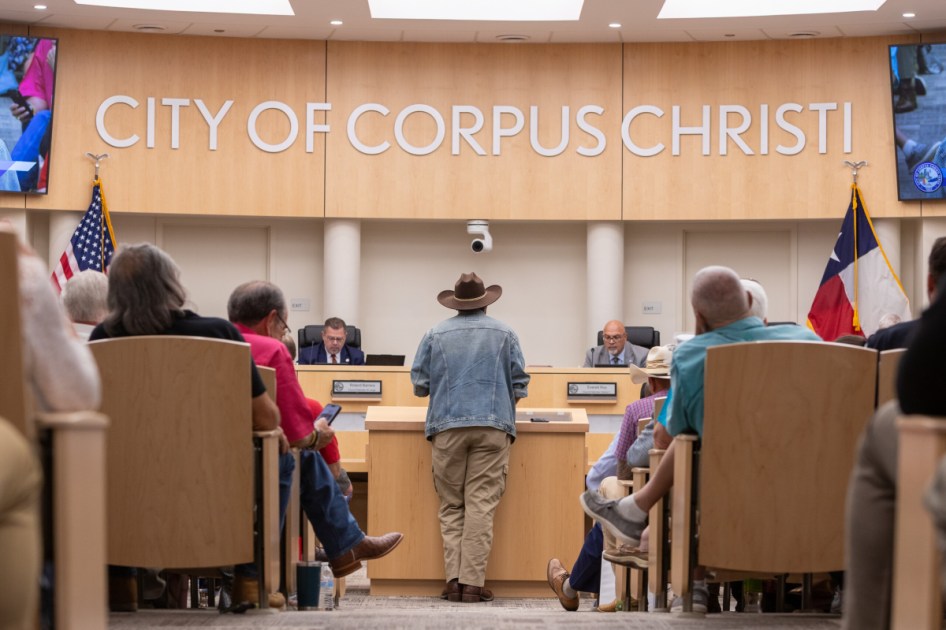

The Corpus Christi City Council voted 5-3 Tuesday night to reject, again, an almost billion-dollar water treatment plant after a decade of effort and its long-term water supply still in question.
The proposed desalination plant was intended to provide a drought-proof source of drinking water, but opponents questioned its high cost and the environmental impact of its salty discharge on Corpus Christi Bay.
The vote was being watched by Gov. Greg Abbott, who criticized the City Council after it rejected the plant one year ago, saying the state might have to “micromanage” the city to protect the region’s water supply.
Before Tuesday’s vote, Abbott chief of staff Robert Black called the proposed desalination plant “a tremendous opportunity to finally get ahead of the curve and be proactive to solve their long-term water challenges.”
“Will they do the right thing and move forward, or will they punt the future of Corpus Christi to someone else to fix?” Black said in a written statement, adding that the state has “done its part” by providing loans and other funding. “All that’s left is courage and vision from the City Council.”
A five-year drought had pushed Corpus Christi to the brink of a water emergency last spring when projections showed the city was months away from demand outpacing its supply, a point that would require customers to cut water use by 25%.
Recent rain, including summer floods in the Hill Country, has boosted the city’s reservoirs from a combined 15% capacity six months ago to 48% currently — allowing Corpus Christi to loosen restrictions on watering lawns and washing vehicles.
Even so, projections show the city on course for a water emergency in fall 2028.
The desalination plant could have begun operating in 2030.
The city water department had already secured contractors to begin building the plant. It’s fully permitted, about 60% designed, and would be built along the bay in Hillcrest, a historically Black neighborhood. It would have been capable of producing about 30 million gallons a day, roughly more than a third of the city’s daily demand, and could be expanded to treat 80 million gallons a day.
The project’s “preliminary guaranteed maximum price” was $978.8 million, about 25% cheaper than previous estimates, but it wasn’t enough to convert opponents.
The city in 2017 received a $2.75 million loan from the state for the project’s preliminary stages. The state provided $222 million in loans three years later, then agreed to loan the city more than half a billion dollars in addition, of which $10 million has been disbursed.
Council Member Gil Hernandez said he has consistently voted against the plant because of its cost, location and potential for environmental harm.
“I want to say that I am for water, I’m not against seawater desal,” Hernandez said. “I just don’t like this particular project, and I’ve been consistent with this since 2020.”
Council Member Carolyn Vaughn echoed the sentiment: “I want desal, but I want it in the right place. I want it to be safe for our bay, for our environment, and I want the cost to be good, and I want it discharged in the ocean.”
Before Tuesday’s vote, the council heard a presentation about a separate desalination proposal — the Harbor Island Desalination Project — by John Byrum, executive director of the Nueces River Authority.
The project, which needs one more permit before construction can start, aims to serve multiple cities in the Coastal Bend with about 100 million gallons a day.
In October, Corpus Christi paid $2.7 million to reserve about 50 million gallons a day from the alternative plant after it comes online. At least one council member, Kaylynn Paxson, said she favors the Harbor Island project.
Dolly Trolley, executive director of Voices for Coastal Bend Energy and a supporter of the plant, told the City Council that dozens of wells drilled by the city, and the sudden surge of pumping in Nueces County, has rural residents concerned.
“They’re losing faith in us in being good neighbors,” Trolley said. “They see us relying a lot on our groundwater projects, and they don’t see us … doing a lot of forward planning and relying on our own long-term sustainable projects.”
Council Member Everett Roy understood that the plant would be expensive but said the city needs to take drastic measures.
“It is a big risk, and I’ve always stated that I back water,” he said. “I’m not going to sit there and I’m not going to turn water down. And so, for that, I support this project. And hopefully, we can get through this, whether it’s with this council or the next.”
All nine City Council seats, including the mayor, are up for election in November, and debate over the city-owned desalination plant has emerged as a leading campaign issue.
Two council members who voted to end the desalination project Tuesday are challenging Mayor Paulette Guajardo, a pro-desalination plant vote. In addition, two council members who voted on opposite sides of the issue are not seeking reelection.
Of the remaining three running for another term, two opposed the plant and one favored it. All council members voted the same way they did a year ago.
Guajardo was not at City Hall on Tuesday because the council suspended her for 30 days over accusations she committed perjury regarding an ongoing trial to impeach her. Allegations that led to the trial are related to a $2 million tax incentive agreement in 2024 with a hotelier.
Opponents of the project on Tuesday expressed concern about its impact on Corpus Christi Bay, with many doubting the reliability of an environmental study that concluded the plant’s salty discharge would not affect marine life.
Other opponents said oil refineries, petrochemical plants and other large industrial users — not residents — should bear the burden of funding new water sources.
“That’s incredibly backwards,” Armon Alex, co-chair of the city’s Democratic Socialist of America chapter, told the City Council. “Our economy should provide for human needs. Human beings should not be organized around the needs of an economy built on endless industrial expansion.”
Isabel Araiza, co-founder of For the Greater Good, which opposes the desalination plant, said Coastal Bend residents and local businesses don’t want it.
“Heavy industry and those who want industrial buildout want these projects. Local companies that stand to make a killing off of public tax dollars want these projects,” she said.
Corpus Christi is under pressure to find long-term solutions to its city’s water woes. Perry Fowler, executive director of the Texas Water Infrastructure Network, a trade association for water construction businesses, sent a letter last week imploring the City Council to move the project forward.
“Putting citizens first means making decisions today that reduce the likelihood that future residents will once again face emergency restrictions, economic uncertainty, and a scramble for new supply because long-term action was deferred when conditions temporarily improved,” he wrote. “Water infrastructure must be planned in decades, not according to the level of the reservoirs on any particular day.”
Fowler said the city’s decisions will have large ripple effects.
Corpus Christi is home to a busy port and one of the nation’s largest industrial corridors, including crude oil refineries such as Valero Refining and Flint Hills Resources. Together, roughly 20 large industrial companies make up around 60% of the city’s water demand, local officials say.
“Reliable water infrastructure is strategic infrastructure,” Fowler wrote.
Source link