|
Only have a minute? Listen instead |
Twenty-five years ago on Sept. 15, with the country still in shock from the Sept. 11 terror attacks, the communities of Port Isabel and South Padre Island were blindsided by a massive catastrophe of their own, one that reverberated beyond South Texas even as the attacks dominated the headlines.
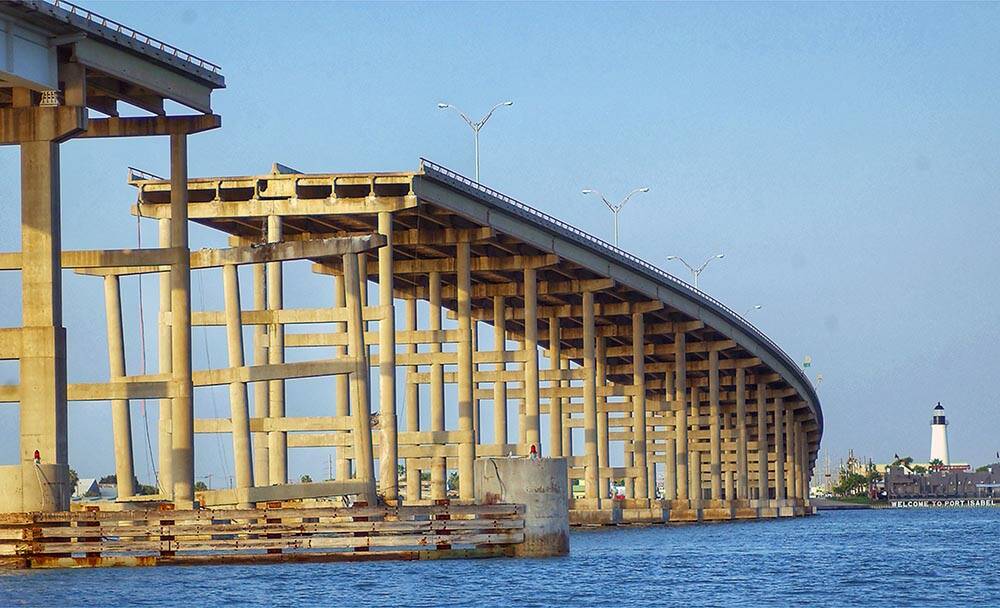
In the early morning hours of Saturday, Sept. 15, a towboat pushing four barges hit a pillar supporting the Queen Isabella Causeway, causing two 80-foot sections to plunge into the Laguna Madre.
Ten vehicles, all coming from the Island, dropped into the abyss and eight people were killed: Robert “Bob” Harris, Hector Martinez Jr., “Harpoon” Barry Welch and Chelsea Welch, all of Port Isabel; Julio Mireles of Los Fresnos, Robin Leavell of Mercedes, Gasper S. Hinojosa of Kingsville and Stvan Francisco Rivas of Humble.
A third section of causeway fell later that day. Three people survived the initial disaster: Brigette Goza of Port Isabel, Rene Mata of Laguna Vista and Gustavo Morales Jr. of Brownsville.
The Port Isabel Event & Cultural Center, 317 E. Railroad Ave., will host a special event commemorating the tragedy and remembering the victims this Tuesday, Sept. 15, starting at 11 a.m.
Valerie Bates, marketing director for the city of Port Isabel, said the event is free and open to the public and will feature a color guard, speakers, a panel discussion and a Texas Department of Transportation documentary on the tragedy.
“We’re still building the program out,” she said. “There’ll be a slideshow of photos and just an opportunity for communities to come together and kind of remember what we’ve all been through.”
Bates was there 25 years ago.

“I started photographing it at 4:30 that morning, because somebody called and said the bridge was broken,” she said. “And so I got myself involved in that, and then it turned out TxDOT was stretched pretty thin because of 9/11, and so my photography ended up contributing to their documentation.”
She remembers the anxiety of families and friends suddenly being cut off from each other, phone lines overwhelmed by people frantically trying to reach loved ones.
“Two and a half miles away, we can see the Island, but we can’t communicate with them, nor they us,” Bates said. “It was not something you could have ever really drilled for. There were so many layers to it. And so, you know, in hindsight, I’m sure everybody did the very best they could because they were all motivated by saving lives and then recovery.”
Many assumed terrorism was behind the incident, coming as it did on the heels of 9/11, though it turned out to be simple human error on the part of the towboat captain, who failed to account for strong currents while attempting to negotiate the causeway supports, according to an ensuing official investigation.
Bates called it a “terrible coincidence” so soon after the terror attacks, and one that could easily have happened before.
“That is the most difficult turn on the whole Intracoastal Waterway infrastructure,” she said.
Reopening the bridge, rechristened the Queen Isabella Memorial Causeway in honor of the souls lost, took 50 days “from handshake to ribbon cutting,” Bates said.
At the time, 50 days seemed like an eternity, she noted.

“And then the repair itself to go on to be an international award-winning project for its ingenuity really demonstrated leadership in South Texas, partnership in South Texas, and what everybody can do when they have this common goal,” Bates said.
An emergency alert system was installed and other safeguards enacted in hopes of preventing anyone from getting hurt if anything like it ever happens again.
Ironically, the tragedy that temporarily severed the physical connection between the two communities resulted in a different sort of connection, one that endures to this day, Bates said, since everyone on both sides of the Laguna Madre was touched by the events of that day — directly or otherwise.
“We still feel very connected with our neighbors with a much deeper appreciation of the meaning of a bridge,” she said.
Bates said the Sept. 15 commemoration at the Event & Cultural Center is a chance to “generate a conversation” about the event and its aftermath.
“It’s not a celebration, but it certainly is a recognition of what we’ve learned and hopefully the good that’s come out of it,” she said.