
In the NFL, good vibes are fleeting.
Just 19 months ago, the Eagles and Commanders were headed into the offseason feeling like they had world-beaters at quarterback. Philadelphia had just conquered the football world, blowing out the Chiefs in Super Bowl LIX with Jalen Hurts taking home MVP honors.
Washington, meanwhile, was fresh off its first NFC Championship Game appearance in over 30 years with rookie phenom Jayden Daniels leading the way. Life was good, and that conference championship game felt like the first installment of the NFL’s next great quarterback rivalry.
The 2026 season opener will be the first time Hurts and Daniels have faced off since that playoff game and there’s been a significant vibe shift on both sides of the matchup. Both quarterbacks are coming off frustrating 2025 seasons that may have cast some doubt on their long-term future with their respective teams.
Hurts and Daniels will be seeking massive contract extensions in the offseason. At that point, Hurts will have one year left on the extension he signed in 2023, and Daniels will be entering his third offseason, when first-round quarterbacks either sign their first big-money extension or end up in contract purgatory, a la Bryce Young in Carolina.
So, the stakes are clear for both quarterbacks in 2026: A bounce-back season will be rewarded with a big payday. But if last year’s struggles bleed over into this season, contract talks might be put on hold.


The bar for a successful season is lower for Daniels than it is for Hurts, with Washington expected to finish in the bottom half of the NFC East.
If the third-year pro can just stay healthy for the full 17-game slate, that will be considered a win. If Daniels stays healthy and rediscovers his 2024 form, Washington will write him a blank check in the spring. It’s just hard to envision a repeat of that magical rookie season given the current state of the Commanders offense.

Jayden Daniels faces a crucial upcoming season amidst uncertainties around the Commanders roster. (G Fiume/Getty Images)
The offensive line was an issue last season and will be worse off in 2026 with star left tackle Laremy Tunsil out indefinitely with a torn triceps. Also, it will be up to first-year offensive coordinator David Blough, who’s just three seasons into his coaching career, to work around that massive weakness.
It would be understandable if Daniels doesn’t fully bounce back, but Washington may be reluctant to fork over a top-of-the-market deal for a player coming off two disappointing seasons, especially if more injuries pop up. The Commanders wouldn’t have to move off Daniels, but they’d likely push contract talks into the following offseason, which is typically a bad sign for a first-round quarterback.
Daniels had issues targeting the middle of the field in 2025, but it was less about his reluctance to make those throws and more about his inability to complete them. Per Pro Football Focus, his accuracy rate on intermediate throws dropped by nearly 10% compared to his rookie season. There were a lot of poorly placed passes on his 2025 film.
But the statistical dip can’t be pinned entirely on Daniels, who was throwing into tighter windows last season. With wide receiver Terry McLaurin out hurt, the Commanders were trotting some abysmal receiving groups out there. It got to a point where tight end Zach Ertz became Daniels’ best option against man coverage. Ertz is still a useful player, but when a 35-year-old is your most reliable option on key passing downs, it’s awfully hard to play quarterback.
Daniels’s regression from Year 1 to Year 2 can mostly be explained by his performance against man coverage and the blitz, which are closely linked. Washington didn’t have receivers who could punish a defense for playing aggressively, and Daniels loses accuracy when he’s forced to drive a throw into tight coverage. He’s one of the NFL’s better quarterbacks when throwing with touch in between the lines of a zone defense. He just didn’t get to do it often last season.
Washington’s offense should be more equipped to deal with aggressive coverage in 2026. Stefon Diggs, who joined via free agency, was one of the NFL’s most productive receivers against tight man-to-man coverage last season. McClaurin is healthy again. And the team prioritized explosive athletes to fill out the rest of the receiving corps, including third-round rookie Antonio Williams and former first-round pick Treylon Burks.
Even with the upgrades, this isn’t a world-beating receiving corps, so Daniels will have to take a step as an intermediate passer to make it work.
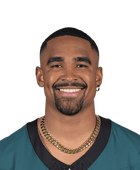

Last week, Eagles general manager Howie Roseman defended Hurts and denied that the clock is ticking on his time in Philadelphia despite the team’s passing game struggles over the past few seasons. “I think the bottom line for us … is winning football games,” Roseman said on a recent appearance on the “Move the Sticks” podcast. “And all [Hurts] does is win football games … for me, the barometer is winning football games.”
I don’t expect Roseman to get into the nuances of quarterback evaluation during a podcast hit, but that’s a reductive view of Hurts that also suggests his value to the team is directly tied to its winning percentage. If the Eagles have a down year, and the passing game doesn’t improve, will the front office view of Hurts shift? If that’s the case, then it does feel like there’s a lot riding on this season in regard to his future with the team.

Last season ended for Jalen Hurts with a wild-card loss at home to the 49ers. (Mitchell Leff/Getty Images)
Supporting talent is less of a concern for Hurts – who is still surrounded by blue-chip players even after the team traded away his top receiver, A.J. Brown – but he’ll also be getting his play calls from an inexperienced offensive coordinator with Sean Mannion coming over from Green Bay.
While Hurts is no stranger to OC changes, this is the first time in his NFL career where he’ll have to learn an entirely new offense from the ground up. Mannion is Nick Sirianni’s fifth offensive coordinator in Philly, but it’s the first time he’s gone outside of his coaching tree to make a hire.
This won’t be some subtle rebrand. The Eagles offense will be an entirely new thing. Hurts won’t be playing in the shotgun nearly as much and there will be fewer spread formations. It will look more like the 49ers and Rams offenses, with the quarterback under center, condensed formations, and a lot of play-action passing.
That’s the hope, at least.
In April, ESPN dropped a report on the team’s growing frustration with Hurts’ reluctance to step outside of his comfort zone, which created a lot of the issues that have plagued Philly’s passing game over the past three seasons.
Here’s a key excerpt from the report: “He has pushed back on changes that would diversify the scheme, sources said, including when it comes to him going under center more. He has shown a reluctance to let it rip at times, particularly against zone coverage.”

Jalen Hurts faces a potentially big adjustment to new Eagles offensive coordinator Sean Mannion’s offense this season. (Mitchell Leff/Getty Images)
The report also covered Hurts butting heads with former offensive coordinator Kellen Moore over the use of pre-snap motion. Moore, who’s been calling plays for NFL offenses since 2019, is a big proponent of the tactic but dialed back his usage in 2024 to suit Hurts’ preferences.
ESPN also quoted sources close to Hurts who denied those claims, but this season will give us a clear answer. Mannion’s offense is built around all the tactics that are supposedly outside of the quarterback’s comfort zone. This system doesn’t work without pre-snap motion. It doesn’t work without going under center. And it doesn’t work when the quarterback is reluctant to “let it rip” over the middle of the field against zone coverage.
Hurts’ reluctance to throw over the middle of the field isn’t just theoretical at this point. Per Next Gen Stats, Hurts targeted the middle third of the field at the league’s lowest rate in 2025. It was the fifth year in a row he’s accomplished that feat. He’s had four different offensive coordinators over that span, so there’s a clear common denominator.
My theory: Hurts doesn’t have top-end arm strength but makes up for it with a keen understanding of his own limitations. Hurts avoids the middle of the field for the same reason Jared Goff doesn’t throw on the run: it’s not his game. Making throws into tight zone windows with repeated success isn’t in his wheelhouse and not a winning strategy for him. It can hold back the offense at times, but it limits turnovers. Here’s an example from the Eagles’ loss to the Broncos last season.
You can see Hurts consider making the stick throw to wide receiver DeVonta Smith between two zone defenders before thinking better of it and settling for an out-of-structure heave downfield.
But when the windows are clearer – or the Eagles are in catch-up mode late and turnovers are less of a concern – Hurts will take his shots over the middle.
If this scheme change is going to work, one of two things needs to happen: Either Mannion is the second-coming of Shanahan and consistently provides Hurts with clear throwing windows over the middle, or Hurts takes more chances, even if it leads to a small bump to his interception totals.
Sunday’s opener will be our first glimpse at the new offenses in Washington and Philadelphia. While it’s important to give these first-year coordinators some grace and give their quarterbacks time to get acclimated to their new digs, the game will provide a perfect stress test for Daniels and Hurts thanks to the defensive matchups on both sides.
How will Daniels fare against an Eagles secondary that closes throwing windows as well as any defense in the league? Will Hurts look comfortable going under center and turning his back to the defense on play-action defense against a Washington scheme built around pre-snap disguises and post-snap chaos?
The answer to those questions will have ramifications that stretch far beyond the final score on Sunday. They’ll determine how far the Eagles and Commanders can go in 2026 and how much confidence they should have in their franchise quarterbacks beyond this season.