
|
Only have a minute? Listen instead |
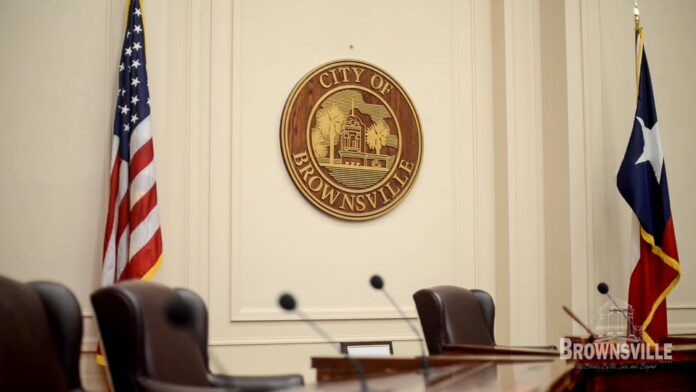
BROWNSVILLE — City commissioners on Tuesday filled most of the positions on the Environmental Task Force that will develop policies on data centers. This follows a Sept. 1 vote to move forward with the process of creating a temporary moratorium on data centers within city limits, which state law requires to conclude with Brownsville adopting regulations after the data center permit suspension eventually ends.
Commissioners also passed a resolution officially identifying water infrastructure projects that qualify for funding under a $220 million agreement with SpaceX that they approved in August.
The Environmental Task Force will be made up of four non-voting experts and seven voting community members appointed by commissioners. The resolution that green-lights the task force states the group will be responsible for delivering a report on data center development that focuses on issues including data centers’ energy use, water use, land use, neighborhood impacts and economic impacts.
For non-voting members, city officials initially recommended Brownsville Public Utilities Board board member Joseph Hollmann, UTRGV associate professor Jude Benevides, Brownsville Health, Wellness and Animal Services Director Arturo Rodriguez, and Deputy City Manager Doroteo Garcia as an infrastructure expert. Hollmann is also president of the Southwest Regional Water Authority (SRWA). Benevides’ areas of expertise are hydrology and environmental sciences.
Commissioners decided on Tuesday to change the deadline for the task force’s final report to March 2027, with an initial report due December 2026.
District 3 Commissioner Gustavo De Leon nominated SpaceX senior environmental regulatory engineer Carolyn Wood; At-Large “A” Commissioner Tino Villarreal nominated public policy researcher Etienne Rosas; Mayor John Cowen Jr. nominated Fulbright scholar and public health expert Lisa Mitchell-Bennett; District 4 Commissioner Pedro Cardenas nominated Hollmann to become a voting community member of the task force; and District 2 Commissioner Linda Macias nominated Cameron County Drainage District No.1 General Manager Scott Fry.
Cowen said he nominated Mitchell-Bennett because her expertise would be a boon to a task force focused on the environment and sustainability, both of which impact public health. During the meeting, he asked city staff about the steps needed to make the task force a standing committee rather than ad hoc.
“She’s a great community advocate, especially for social justice issues and for environmental improvements in our city to make people healthier,” Cowen said of Mitchell-Bennett. “She’s really always been engaged.”
Macias said she nominated Fry because of his knowledge of water and drainage systems. Along with his work with the county drainage district, Fry also is a licensed civil engineer and floodplain manager, according to his LinkedIn page.
“He is very passionate about waterways and making sure that our water is good, that our drainage is good,” Macias said. “I wish he was here because he’d pop out a map and talk to you about water rights. He’s just a genius.”
At-Large “B” Commissioner Nurith Golansky and District 1 Commissioner Bryan Martinez were not present during the nominations and will make their selections during the next meeting.
With Hollmann nominated to join the seven community members on the task force, city staff will identify another non-voting member to represent BPUB.
Several Brownsville residents who attended Tuesday’s meeting said they were disappointed in the nominations, specifically with the reshuffling of Hollmann that will give BPUB two representatives on the task force and with De Leon’s selection of a SpaceX employee. Before joining SpaceX, Wood spent more than 20 years as a natural resources specialist and environmental investigator at the Texas Commission on Environmental Quality.
“With an environmental task force, you have to have people that are qualified to do this sort of research, and to present it in a way that isn’t going to be biased towards the industry that they work for,” Brownsville resident Jacqueline Morales said about Woods’ nomination.
Christopher Basaldú, who also addressed the commission during public comment, said he felt that having a SpaceX employee on the task force undermined the group’s purpose.
“These are people that have no concern for the environment,” Basaldú said, “and to have somebody who’s an employee of SpaceX on this task force is inappropriate, and it’s corruption.”
Rosas, the public policy researcher nominated for the task force by Villarreal, said that the group’s work can’t be boiled down to finding the average perspective among environmentalists, developers, SpaceX and other stakeholders.
“As a principal investigator, there is no role for me to assign any of these people within a research project that addresses sustainability,” Rosas said, “because they’re creating the issue that we are addressing. It would slow us down or compromise a lot of the work.”
The public has previously heard of the two projects identified by the city as set for SpaceX funding.
Project Quantum, as the plans have been dubbed, include a wastewater reclamation project by the Brownsville Public Utilities Board that will increase the city’s water production capacity by about 8 million gallons per day. The other is an expansion of the SRWA’s desalination plant that includes two new water wells, reconstruction of 20 existing water wells and other upgrades.

The agreement does not guarantee SpaceX water access or ownership of water facilities, city attorney Will Treviño said.
Treviño said that the city has created a website that will centralize information about the projects, including updates on their progress, receipt of funding from SpaceX and documents from Texas Public Information Act requests about Project Quantum. The site will go live by the end of the week at www.brownsvilletxwatersecurity.com, he said.
Villarreal said the website was an important tool to hold the city accountable for ensuring the projects come to fruition, particularly given the opposition to the deal by some residents.
“I know it’s not easy,” Villarreal said during the meeting, “but I believe the best we can do is work together as a city with PUB to be as transparent as possible and as up-to-the minute as possible.”
BPUB’s water project is underway, Treviño said, and funding secured through the agreement will close its $27.3 million budget gap. Its total cost is $40 million with an estimated 2030 completion date.
The SRWA expansion, which will allow it to produce an estimated 10 million gallons per day by 2027, will cost about $47 million. The work needed to increase its capacity to 20 million gallons per day by 2030 will cost another $202 million, according to Treviño’s presentation.
Plains Capital Bank was selected as the escrow agent for transactions between the city and SpaceX. An initial deposit of $40 million from SpaceX could arrive as soon as Sept. 28.
The agreement outlines cases in which SpaceX would not be required to continue making scheduled quarterly deposits, such as if the city did not identify projects that fit the parameters of the agreement within two years. It also states that SpaceX will stop making quarterly funding deposits if it is legally prevented from developing its facilities.
The rocket company would no longer be required to transfer any outstanding funds if a legal block on development lasted more than one year. The agreement does not explicitly state whether funding would stop only if SpaceX development was halted by the city, or whether any legal block would cut off the flow of funding.