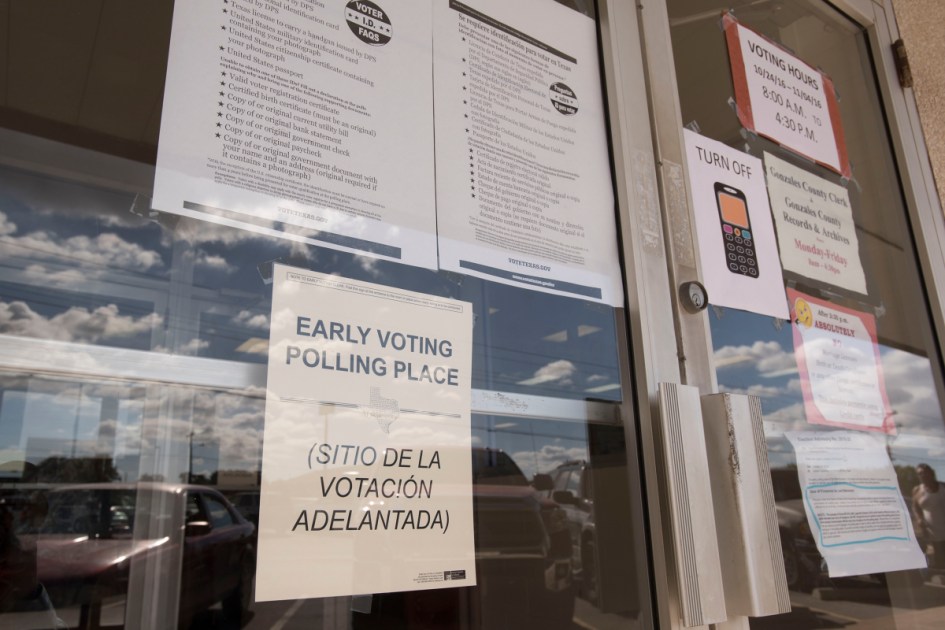

Largely driven by Republicans intent on making elections more secure — and over objections from Democrats who say voting should be made easier, not harder — Texas lawmakers have changed a number of voting laws in the past two decades.
Texas had about 18.7 million registered voters for the March primary election, when nearly one in four registered voters cast a ballot. About 57% voted in the 2024 election, compared with 64% nationally, according to Ballotpedia.
With the midterm election on the horizon, here’s where Texas election laws stand ahead of early voting, which runs Oct. 19 to 30, and Election Day on Nov. 3:
Voter ID
In 2011, then-Gov. Rick Perry signed into law a bill requiring Texans to show a government-issued photo ID before voting, but federal courts blocked enforcement, ruling the Texas law disproportionately burdened voters of color who are less likely to have one of the seven required forms of identification.
The Legislature added additional forms of ID in 2017. The changes took effect a year later when a federal appeals court overruled a district judge who had tossed out the law, ruling that the broader ID policy was not enough to overcome the original law’s discriminatory intent.
Today, Texas voters must show one of seven forms of photo identification at a polling place:
- Texas driver license issued by the Texas Department of Public Safety
- Texas election identification certificate issued by DPS
- Texas personal Identification card issued by DPS
- Texas handgun license issued by DPS
- U.S. military identification card
- U.S. citizenship certificate
- U.S. passport
Voters who lack an approved ID can still cast an Election Day ballot by presenting another form of identification — such as a utility bill, bank statement, paycheck, or any government document with the voter’s name and address — and by filling out a reasonable impediment declaration, according to the Texas secretary of state.
Reasonable impediments include lack of transportation, a disability or illness, lack of birth certificate or other documents needed to obtain an acceptable photo ID, work schedule, family responsibilities, lost or stolen ID, and an acceptable form of photo ID applied for but not received.
Voters who forget to bring a valid ID can cast a provisional ballot, which requires the voter to go to their county voter registrar’s office within a week after Election Day to have it counted.
Texas is one of 36 states that requires identification to vote, and one of 24 states that require photo identification.
Voting by mail
In Texas, voting by mail is limited to those who are:
- 65 or older
- Sick or have a disability that prevents you from voting in person
- Expected to give birth within three weeks of Election Day
- Out of the county during the early voting period and Election Day
- Confined in jail but otherwise eligible (not convicted of a felony)
In 2021, Republicans in the Texas Legislature passed a sweeping election integrity bill that included changes to mail-in voting. Voters now have to include an ID number — such as a driver license number or partial Social Security number — on both the vote-by-mail applications and the mail-in ballots. That number also must match the ID provided on voter registration forms that could have been filled out years or decades earlier.
A year after the law went into effect, more than 18,000 mail-in ballots in the 2022 March primary were rejected. Most were rejected for failing to provide a driver license or Social Security number that matched voter registration forms.
“People were unfamiliar with the process,” said Daniel Griffith, senior policy director at Secure Democracy Foundation, a voting security nonprofit. “That’s another administrative burden that some people will get caught up in, so naturally, we would see an increase in the number of applications and ballots that were rejected.”
Although fewer mail-in ballots are being rejected years after the law came into effect, he said they’re still “higher than they were before the ID requirements came in.”
The state in 2021 also made it a criminal offence for election officials to send unsolicited mail-in ballot applications — voters must ask for an application to receive one. (The deadline to apply for a ballot by mail in the November midterm election is Oct. 23.)
For voters who want to hand-deliver their mail-in ballots, the 2021 law barred counties from providing drop boxes before Election Day. Counties also were limited to one drop box at the county’s election office.
Straight-ticket voting
Voters in Texas no longer have the option of checking a box on the ballot to automatically vote for every candidate from a single political party.
Supporters of the law, which took effect in 2020, said the change would encourage voters to make informed choices about individual races. Opponents said it appeared to target Democratic voters, who tended to use straight-ticket voting more often than Republicans.
One-click voting accounted for 64% of total votes cast in Texas’ 10 largest counties in the 2016 general election. Six other states offer straight-ticket voting.
Voting assistance
Voters with a disability or inability to read or write may be assisted by a person of their choice as long as they are not affiliated with an employer or union. Proof of disability is not needed. In addition, a voter can request help from an election worker during early voting, or two election workers on Election Day.
Under changes adopted by the Legislature in 2021 and affirmed by a federal appeals court in August, people assisting voters can only read a ballot out loud and mark it, and they are prohibited from influencing the voter’s decisions, incorrectly filling out their ballots, or disclosing how they voted.
Curbside and drive-thru voting
Polling sites must provide curbside voting for people with disabilities. Each polling site should have a sign with a button, intercom or phone number to alert an election officer to meet with the voter and assist them.
Drive-thru voting and 24-hour polling places, offered primarily in Harris County in response to the 2020 COVID-19 pandemic, were banned by the Legislature in 2021.
Countywide polling locations
Voters in the 103 counties participating in the state’s Countywide Polling Place Program, created by state lawmakers in 2005, can vote in any polling location in their county through the early voting period and on Election Day. Voters in the remaining 151 counties on Election Day will be limited to polling places within their precinct.
Voters can find polling locations through the Texas’ secretary of state’s portal, where they can also check their voting registration status and view which races will be on their ballots.
Online voter registration
Texas is one of only seven states without online voter registration. An eighth state, North Dakota, does not require registration.
In 2025, state lawmakers held their first hearing in a decade on legislation letting Texans register to vote online, but the bill died on the House floor.
“Online voter registration is a trend that Texas seems to have missed,” Griffith said. “It’s notable that Texas is by far the most populous of those seven states that don’t offer online voter registration.”
Most Texans must fill out a paper registration form and submit it to election officials in their county. Online registration is available through the Department of Public Safety only when those with a Texas driver license go online to renew their license or update their address. This option became available in 2021 after Texas voters and voting rights groups sued the state over its lack of online voter registration.
But that process was recently proved faulty when it was discovered that as many as 500,000 voter registration records were not transferred to county election officials, who scrambled to sort and process the records. The state’s secretary of state’s office and the Texas Association of County Election Officials said Wednesday that they’re not aware of any county still working through the backlog.
Disclosure: Secure Democracy Foundation has been a financial supporter of The Texas Tribune within the past five years. The Texas Tribune is a nonprofit, nonpartisan news organization that is funded in part by donations from members, foundations and corporate sponsors. Financial supporters play no role in our journalism. Find a complete list of them and more information about our financial and disclosure policies here.
Source link