|
Only have a minute? Listen instead |
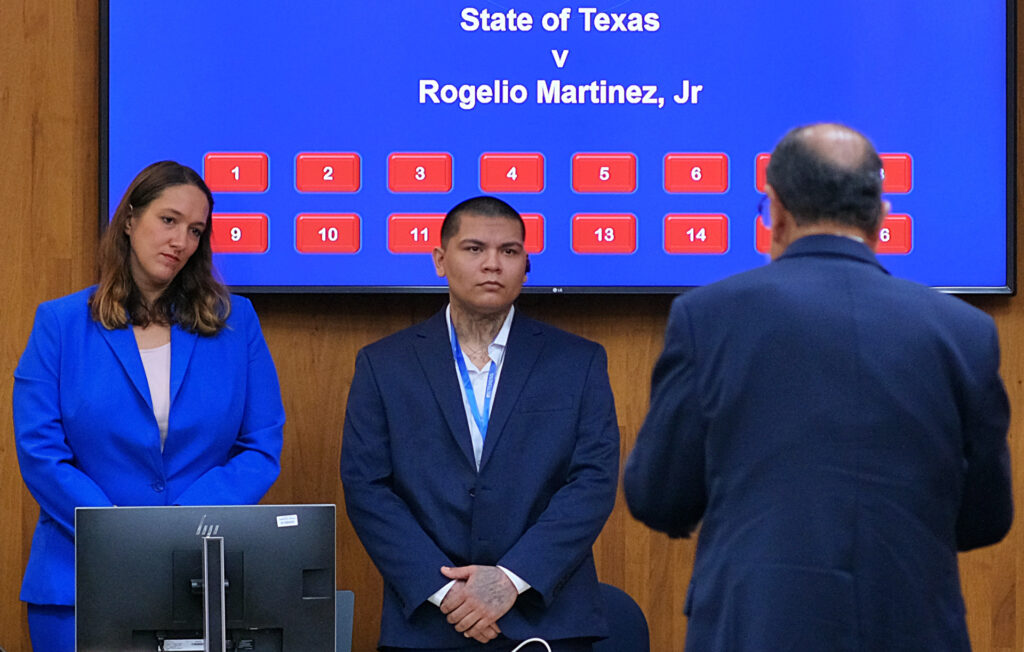
BROWNSVILLE — Testimony on Tuesday indicated the 21-year-old man convicted of killing a police officer had a host of problems including mental illness, abuse, neglect and poverty.
Dr. Antolin Llorente, a court-appointed neuropsychologist who evaluated Rogelio Martinez, told jurors records show the man had more than 75 interactions with Child Protective Services, starting when he was just 4 months old.
He also told jurors how during Martinez’s childhood, he was at times homeless or in foster care and attended 17 different schools as a result of instability, abuse and neglect.
At the age of 12, Martinez was hospitalized at DHR Health in Edinburg for depression and suicidal ideation. At the time he was diagnosed with a disruptive mood disorder and was given antipsychotic medications for depression.
However, throughout his life, Martinez was on and off those medications as there were times when his grandmother could not afford to show up to the visits because she couldn’t pay.
The doctor also testified that at the time of San Benito police Lt. Milton Resendez’s killing, Martinez’s brain had not yet fully developed as he was in his early 20s.
“The developing brain is not able to function like that of an adult,” Llorente said.
Llorente also testified that Martinez has brain damage from the abuse, neglect and malnutrition he experienced while he was growing up.
The doctor interviewed one of Martinez’s former neighbors, who described his home as unstable and said that Martinez and his sister would go to their house asking for food.
Llorente also said that Martinez’s mother received food stamps but she would sell those food stamps to buy drugs and alcohol.
His grandmother also was addicted to drugs and alcohol, he said.
Furthermore, there’s a lot of mental illness in Martinez’s family.
For instance his father, who is in prison, was found mentally incompetent to stand trial in 2017. He was diagnosed with schizophrenia. Martinez also had an uncle who died by suicide.
“There’s an incredible amount of mental illness in this family,” the doctor said.

Furthermore, Llorente testified that there were also allegations of sexual abuse within the household.
He testified that, throughout his life, Martinez has had 10 mental health diagnoses and over nine medications.
Llorente testified that in the 31 years of practice, he’s never seen a case like this.
The expert diagnosed him with major depressive disorder recurring with psychotic factors, or bipolar disorder unspecified. He didn’t come to a conclusion with either because he only examined Martinez for 10 hours.
Tuesday’s testimony comes as the sentencing phase in Martinez’s trial continues.
Martinez was found guilty of capital murder in Resendez’s death on Oct. 8, after a jury deliberated for three hours and 15 minutes to hand down the verdict.
The charge stems from Resendez’s fatal shooting following an hourslong pursuit on Oct. 17, 2023 that began on South Padre Island to Brownsville and then to San Benito, where the 27-year veteran of the San Benito Police Department was shot.
Martinez’s co-defendant, 26-year-old Mexican national Rodrigo Axel Espinosa Valdez, previously pleaded guilty to a lesser charge of murder. Martinez had pleaded not guilty.
Prosecutors are seeking the death penalty.

On Monday, the first witness for the state to testify was Texas Ranger Patrick O’Conner, who led the investigation.
O’Conner described Martinez’s involvement in vehicle theft from the stand and his alleged involvement with the Gulf Cartel.
According to O’Conner, Martinez was involved with at least five vehicle thefts and testified that investigators recovered social media messages that indicated he was involved with crossing those vehicles into Matamoros.
He also reminded jurors that Martinez mentioned during a police interview that he knew a “big guy” involved with the cartel, but at the time didn’t know who he was referring to.
Investigators later learned he was friends on Facebook with a man named Josue Rodriguez Martinez, also known as Pipo Rosas, who O’Conner said was second in command of the cartel’s motor vehicle theft division. On cross examination, however, O’Conner conceded he had no evidence of communication between the men and recovered no social media messages between them.
He also testified to finding lots of evidence in social media accounts and cloud storage of Martinez posing with AR-style rifles, including one where he may have been as young as 13 years old. Those messages also included exchanges about drugs and drug paraphernalia; firearms, firearms transactions, and the buying and selling of guns; and invitations to criminal enterprises.
The Texas Ranger also testified that when he informed Martinez that Resendez had died, he showed no remorse and didn’t cry. The only emotion Martinez showed during that initial police interview, he smiled.
Throughout the trial and outside the presence of jurors, Martinez has often been seen smiling, including shortly after his conviction when jurors left the courtroom.

On Monday afternoon, Vanessa Acero, a gang investigator who works at Cameron County Carrizales-Rucker Detention Center also testified that Martinez admitted to joining the Westside street gang at the age of 13. Then, in 2025, he told her that he was a prospect in Raza Unida, a prison and street gang.
Juan Antonio Gonzalez Jr., a floor sergeant with the Cameron County Sheriff’s Office who works in the jails, also testified to how Martinez had tried to carve a hole in the wall of his cell at the jail by the courthouse. The street was on the other side of the wall he was trying to carve through.
He also testified to how Martinez told him he had been caught with a handcuff key and “joked” with Gonzalez that he could get another one and laughed about it.
An official with the Texas Department of Criminal Justice also testified, telling jurors how classification of inmates in the state jail system works and what kind of living conditions those classifications have on inmates within the prison system.
The state rested Monday afternoon.