|
Only have a minute? Listen instead |
HARLINGEN — While area leaders are urging AEP-Texas to run a 765-kilovolt extra-high-voltage transmission line into the Rio Grande Valley, the company is planning to upgrade its current 138-kilovolt line to help fuel Cameron County’s booming growth.
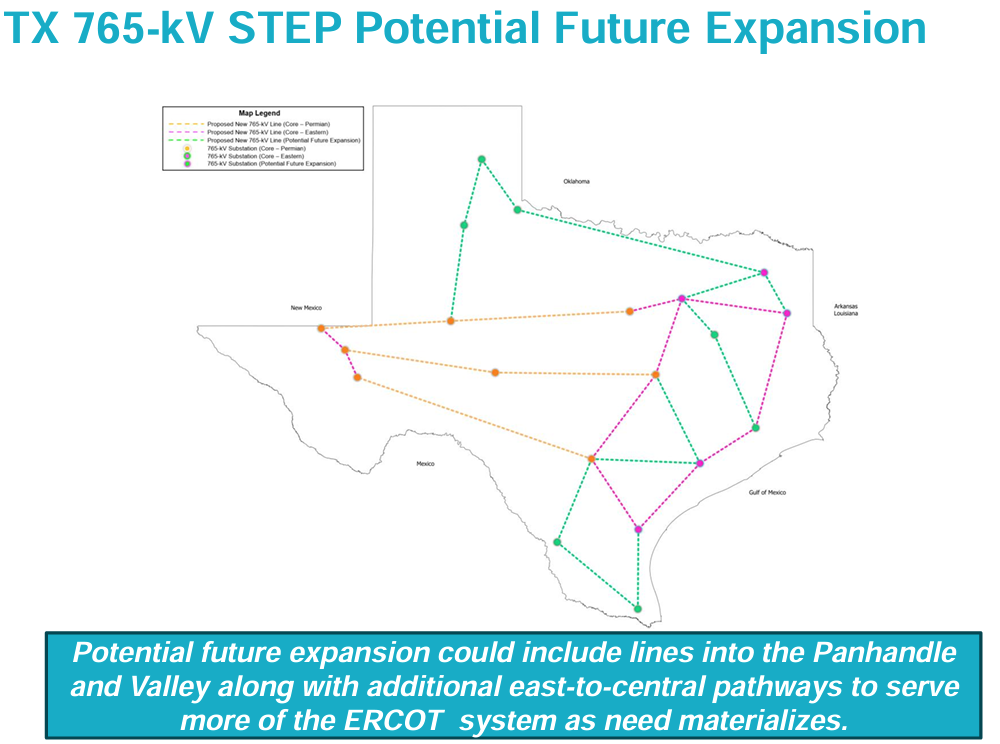
Meanwhile, AEP is proposing construction of a 765-kV loop, running two separate paths, including the Rio Grande Valley, while also proposing 345-kV upgrades, a project plan said.
Next week, AEP officials are planning to hold open house meetings in Brownsville and San Benito to update residents on the project to rebuild the 138-kV line across 44.5 miles “to enhance electric reliability for area residents and businesses,” the company’s project plan said.
“It’s just an upgrade of necessary projects due to the growth of that area,” Hill Cocke, AEP’s external affairs manager, said in an interview.
While they’re set to meet with residents at Texas Southmost College’s Jacob Brown Auditorium in Brownsville from 5 to 7 p.m. Wednesday, AEP officials are planning to meet at the San Benito school district’s Veterans Memorial Academy’s cafeteria in San Benito from 5 to 7 p.m. Thursday.
During the presentations, officials are planning to update residents on “what the structures look like, the width of the easements and the line route,” Cocke said.
As part of the project, AEP is planning to build electrical towers rising about 85 feet to 100 feet, stretching 400 feet to 600 feet apart, with about 100-foot rights-of-way, the project plan said.
Across the Valley, area leaders are urging AEP to run a 765-kV transmission line into the region.
“Let’s face it — our region is booming,” Orlando Campos, chief executive officer of the Harlingen Economic Development Corporation, said in a statement.
In Brownsville, companies such as SpaceX and Saronic Technologies are helping to drive the region’s growth, he said.
Meanwhile, developer Fluidstack has launched construction of Cameron County’s first data center, a planned 1,100-acre campus between Harlingen and Rio Hondo described as the project’s $4 billion first phase.
“The demand for power becomes clearly evident,” Campos said. “It’s not just about data centers as many people would like to think, but about the new industries that are bringing thousands of jobs to our region. When you couple this with new residential neighborhoods being built, the demand for power increases.”

At EDC offices, Texas’ Governor’s Office for Economic Development, along with national site selectors, are sending proposals for new projects, Campos said.
“Many of these are manufacturing companies that are high-power-demand users,” he said. “In order for our region to remain economically competitive to attract higher-paying jobs, the need for more power capacity becomes a necessity.”
In Brownsville, Gilberto Salinas, chief executive officer of the Greater Brownsville Incentives Corporation, said the region needs more energy to launch “game-changing projects.”
“We’re being as loud as we can to get that power down here,” he said in an interview. “There’s projects in the pipeline, other game-changing projects, that are dependent on that line coming down here. We’ve been working our lives on these projects to happen. Now they’re happening and there’s more coming. They’re vital to our economic growth. It’s a giant snowball and that snowball is getting bigger, faster.”
Now, the Electric Reliability Council of Texas and the Public Utility Commission of Texas are planning a $32.99 billion project to build a 765-kV transmission line to help fuel a region including Dallas, Houston, San Antonio and Corpus Christi, the project plan said.
“Unprecedented load growth coupled with the utilization of current transmission system capacity prompted discussions about introducing 765-kV extra-high-voltage infrastructure to the ERCOT transmission grid,” the plan said. “The 765-kV addition will enable power to flow more efficiently through long-distance transmission from resource-rich regions to load centers, such as the Dallas-Fort Worth, Houston, San Antonio and Corpus Christi areas.”
In the 1970s, projects built two 345-kV transmission lines in the Valley, while AEP’s launched multi-line build-outs along with ongoing upgrades, expanding the region’s 345-kV grid capacity.