|
Only have a minute? Listen instead |
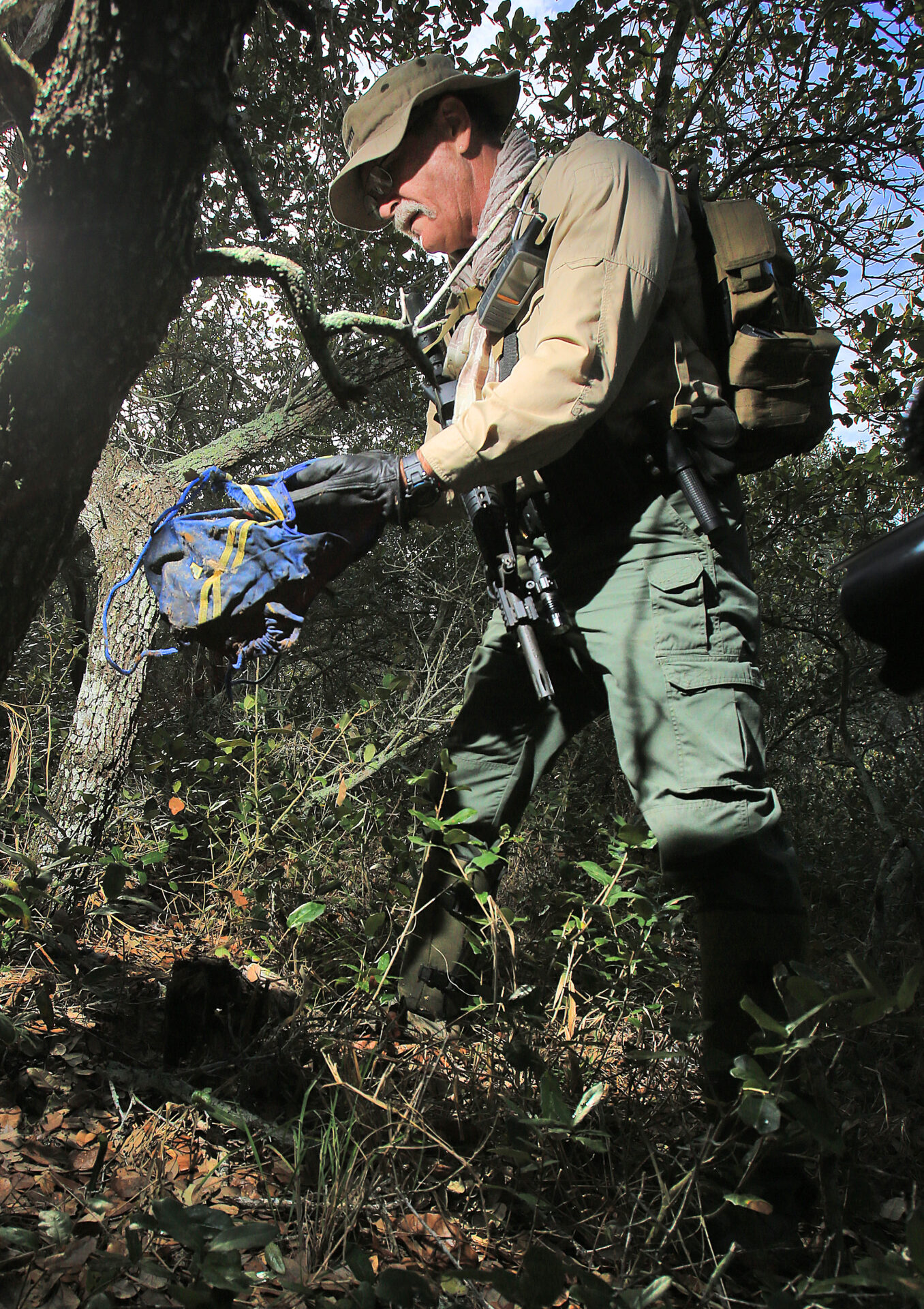
For the last 12 years, Don White has conducted countless searches in the harsh brush country of Brooks County.
He has two missions: To find the remains of migrants who lost their lives trying to circumvent the Border Patrol checkpoint and to rescue those who have not yet succumbed to the brutal South Texas elements.
When White finds remains and clues around those bodies, such as billfolds, backpacks, phones and other items, he works with a network that includes forensic pathologists and human rights groups to identify those remains and reunite them with their families for dignified burials.

But now, with Texas Democrats stunning the nation and taking control of nearly all aspects of the state’s government with the exception of the state Senate, White worries his rescue efforts may come to a complete stop.
That’s because he is reimbursed for his searches — which cost approximately $32,000 annually — through Operation Lone Star.
Outgoing Gov. Greg Abbott initiated the program in 2021, citing former President Joe Biden’s “open-border policies.” The program has cost Texas taxpayers $11 billion since its initiation, the Texas Tribune has reported.
While Operation Lone Star is funded by the Texas Legislature, Abbott has used continuous emergency declarations to surge law enforcement resources to border regions.
As Rio Grande Valley residents know, the area is saturated with Texas Department of Public Safety troopers, the Texas National Guard and national guard members from states like Florida and Georgia. Helicopters buzzing through the sky at all times of the day are the norm and it’s also not unusual to spot drones aloft.
Critics of Operation Lone Star complain of the militarization of the Rio Grande Valley. They also cite high-speed chases, including fatal crashes over the years, and members of the military and law enforcement response here on the border have also been charged with crimes, including fatal drunk driving crashes and in one known instance, human and cocaine smuggling.
Proponents of Operation Lone Star cite a reduction in crime along the border and a decrease in illegal crossings.

But as White points out, there’s more to Operation Lone Star than the increased presence of DPS troopers along the border.
For one, there’s his difficult work.
But Operation Lone Star also provides grants to help detention facilities support functions associated with illegal migration surges; to help support medical examiner officers with the humane processing of the remains of undocumented migrants; to help support courts with court proceedings of people arrested and charged during Operation Lone Star; and grants to increase capacity for emergency service personnel who are critical in assisting DPS and Border Patrol when medically distressed migrants are encountered, according to information regarding available grants through Operation Lone Star from the state of Texas.
That leaves the elephant of a question in the room remaining: What will be the fate of Operation Lone Star under Democratic leadership in Texas?
MyRGV.com reached out to Gov.-elect Gina Hinojosa’s campaign last Thursday to ask for her take on the operation’s future and to ask if she is aware of White’s recovery and rescue efforts funded under the program.
Hinojosa’s campaign responded on Saturday that they were not immediately available for comment, citing a voluminous amount of press inquiries following Hinojosa’s historic election win.

However, in October 2025 she told the Texas Observer that Operation Lone Star was “a waste of taxpayer dollars” and said its funding was a “misappropriation of our taxpayer dollars.”
On Oct. 29, Hinojosa told KRGV that Operation Lone Star “needs to only exist to make us safer” and that it needs to be reviewed.
In an Oct. 2 press release, Hinojosa said Abbott spent $11 billion to grandstand.
“Greg Abbott spent $11 billion in taxpayer money to grandstand, took half a decade to get it back, and Texans still don’t have their money,” Hinojosa said in the release. “Billions of working Texans’ tax dollars used to pay for locking up immigrants, to pay for prosecuting them, and to pay for their defense — all for them to go back into our communities. Now, Abbott wants people to thank him for wasting their money and taking years to reimburse them. Abbott once bragged about suing the federal government every day, and now he capitulates to them. As governor, I’ll put in the work to secure the border, not waste working Texans’ money on political theater.”
But for White, the remote searcher and rescuer, an end to Operation Lone Star is an end to his work.
Prior to Operation Lone Star, White, who began his efforts in 2014, was self-funded.
“I was to the point where I was just basically out of money,” White said of self-funding his work. “I burned through my retirement savings.”

His costs include fuel, which has risen since the Iran war. White also pays for fuel for two other people who travel from San Antonio and Victoria to assist him. White also lives in San Antonio with his daughter. He had to sell his house and move in with her.
“I’m on my third vehicle right now,” White said of the wear and tear the searches, travels and subsequent repairs place on the heavy duty trucks he has to purchase to even get into areas to conduct the searches.
He said each tire for his truck costs $600 dollars. Then there are the drones he uses, which cost about $210 apiece.
White uses the drones to cover vast stretches of terrain. Those drones are equipped with AI that runs through the photos the drones take — up to 500 apiece — to help him figure out where he needs to search manually.
But those costs are nothing when confronted with the human factor of a family searching for a lost loved one.
“It comes down to when a family reaches out and says, can you help us? What am I going to say, no?” White asked.

Without reimbursements from Operation Lone Star, White said he would just be sitting on the couch.
“Not too many people want to do this,” White said.
He also said he can’t imagine a family having no place to reach out when a loved one is lost in the brutal brush of Brooks County or elsewhere in the vast remoteness of South Texas.
“It’s all the human factor. It really is,” White said. “I can’t imagine a family having no place to reach out. I mean, Border Patrol can search, but they can only spend so much time.”
But White has that time.

He says he just needs the funding to do the difficult, dangerous work.
White’s efforts have resulted in around a dozen rescues over the last 12 years — highlighting just how dangerous it is to try and traverse the brush country — and the recovery of hundreds of bodies, many of which remain unidentified.
He conducts over 100 searches a year and as he says, without him, “nobody would be doing them.”