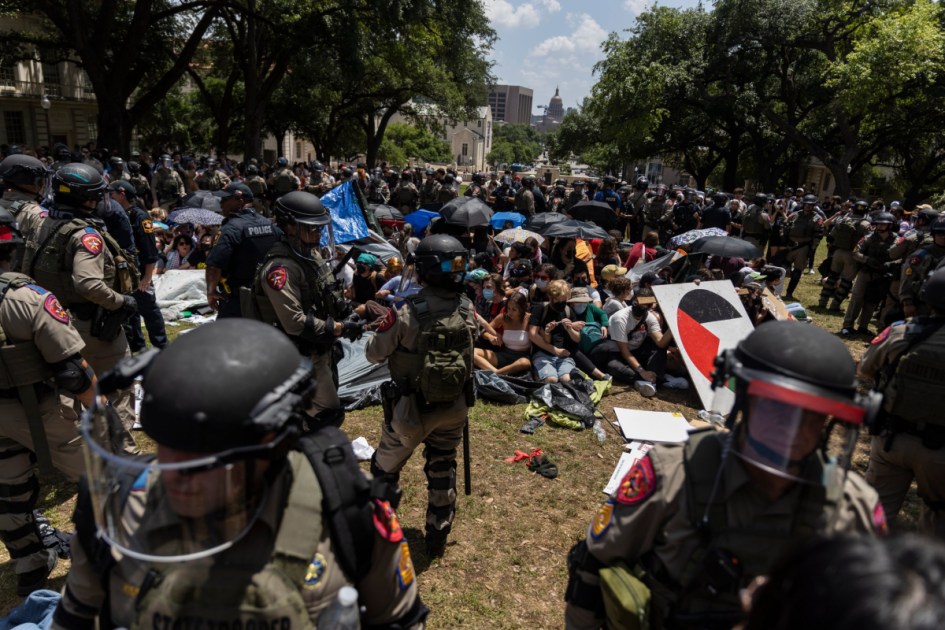

A University of Texas at Austin student is asking a federal district judge to strike a suspension from his academic record over his participation in the pro-Palestinian protests in April 2024 .
U.S. District Judge Robert Pitman will rule this week on whether the state’s flagship university’s handling of the protest was a violation of free speech rights or lawfully managed.
Ammer Qaddumi, a student organizer with the Palestine Solidarity Committee, was among the first to be arrested at a protest in April 2024. He was later suspended for three semesters. Qaddumi is set to graduate from the school this month, but the suspension could still threaten his employment, Pitman has said.
The protest at the center of the suit was a chaotic scene where state troopers used horses and riot gear to get protesters to disperse. The protesters were calling for UT-Austin to divest its multibillion dollar endowment from manufacturers supplying Israel weapons in its strikes on Gaza.
What UT-Austin says: In its first public defense, UT-Austin justified its suspension of Qaddumi on Monday, saying his conduct, not his position on Palestine, led to the discipline.
School officials said they had ordered PSC to cancel the protest, and that Qaddumi’s failure to cancel and proceed with the protest made him responsible for any disruption that followed.
“The documentation shows in his student conduct record he led students to violate university policy,” Katie McGee, the associate vice president and dean of students until last month, said. “There was a pattern of noncompliance that seemed to be entrenched.”
In explaining efforts to cancel the event, the university said they had reason to believe the protest would be disruptive because of a pair of Instagram posts that used near identical imagery to pro-Palestinian student groups at other college campuses, like Columbia University, where encampments had popped up.
Lawyers representing UT-Austin referenced “the Tinker test,” which came out of the 1969 landmark case Tinker v. Des Moines Independent Community School District and allowed schools to limit students’ free speech if they can prove substantial disruption.
McGee also was asked about Gov. Greg Abbott’s executive order which directed universities that spring to revise free speech policies to prevent antisemitism. McGee said it had no part in how the school sanctioned students.
Why the student sued: Lawyers for Qaddumi argued UT-Austin restricted the student’s free speech because of his pro-Palestinian position for UT to divest.
“What Ammer Qaddumi did on April 24 is critical for protected speech,” said Grace Darrah, an attorney for the student. “UT targeted Ammer’s speech, specifically when it comes to encampment.”
UT-Austin had never pre-emptively canceled a protest before, nor did they discipline a smaller pro-Israel group that had gathered that day, according to the lawyers and school officials.
Lawyers also showed a series of videos and emails that demonstrated Qaddumi and the PSC had no intent to be disruptive during the protest. The group had never hosted an encampment before and had a longstanding presence on campus.
And as protesters gathered that day, Qaddumi directed them to not use amplified sounds or tents and to disperse after police orders to do so.
Qaddumi’s arrest marked a turning point in the protest, where tensions escalated, both parties agreed. But Joe Ahmad, an attorney representing Qaddumi, described an “irony” to blame Qaddumi for disruption that followed his arrest, given his efforts to urge students to follow school rules.
Why it matters: Qaddumi’s suit against UT-Austin could become a major test of how far public universities can go in policing political protest without violating the First Amendment. It may shape the ways universities can preemptively limit demonstrations in anticipation of disruption.
The Texas Tribune partners with Open Campus on higher education coverage.
Disclosure: University of Texas at Austin has been a financial supporter of The Texas Tribune, a nonprofit, nonpartisan news organization that is funded in part by donations from members, foundations and corporate sponsors. Financial supporters play no role in the Tribune’s journalism. Find a complete list of them here.
Source link