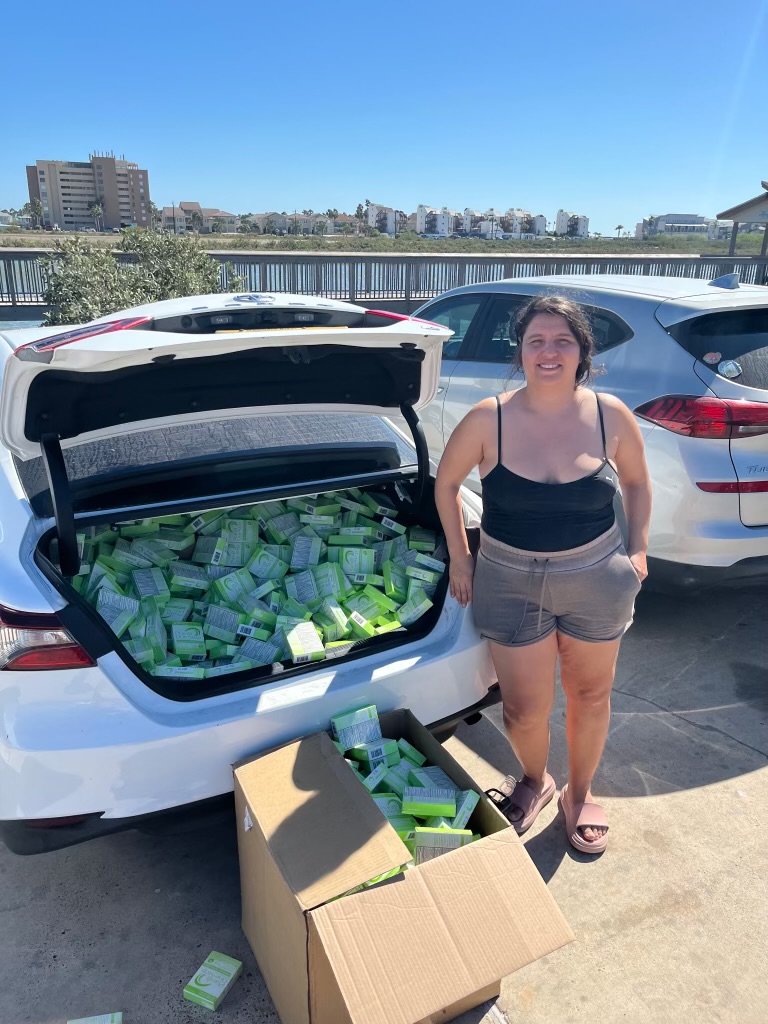
(Distribution efforts by RGV Harm Reduction during spring break 2026. courtesy/ Loro Jurkin)
By DIANTÉ MARIGNY
editor@portisabelsouthpadre.com
Amid the crowds, music and parties that filled South Padre Island during Spring Break, a different kind of outreach was quietly taking place—one focused on saving lives.
A small group from the Rio Grande Valley handed out thousands of doses of naloxone, a medication used to reverse opioid overdoses, along with emergency contraceptives, directly to beachgoers and visitors across the island.
The effort was led by RGV Harm Reduction, founded in 2022 by Sara Chavez in response to overdose deaths within her own circle.
“The goal was just to prevent death,” Chavez said. “That’s always been the goal.”
Naloxone—commonly known by the brand name Narcan—can rapidly reverse the effects of an opioid overdose if administered in time. During Spring Break alone, Chavez said the group distributed thousands of doses across South Padre Island, targeting areas where large crowds gathered, including the beach and party hotspots.
They also handed out hundreds of Plan B pills, which were gone within an hour.
“It was basically a frenzy,” said Alexandrea Bailey, a journalist, and former PRESS editor, who joined the effort this year. “But I’m just happy people got what they needed.”
Bailey said the response from the public varied. Some people were unfamiliar with naloxone, while others immediately recognized its importance.
“When people knew what it was and understood that it saves lives, they were incredibly excited,” she said. “A lot of them were grabbing multiple doses to take back to their schools or communities.”
She noted that many young people today have already been impacted by the ongoing fentanyl crisis.
“Almost any young person you ask knows someone who has overdosed or had an experience with fentanyl,” Bailey said.
Chavez said the need for harm reduction efforts in the Rio Grande Valley is significant, pointing to both rising overdose concerns and limited access to lifesaving resources.
Since its founding, RGV Harm Reduction has distributed supplies including naloxone, fentanyl test strips and clean-use materials, and has documented more than 600 overdose reversals.
“That’s what keeps it going,” Chavez said.
In addition to street outreach, the group operates a public vending machine in McAllen stocked with free harm reduction supplies. The machine distributes hundreds of doses of naloxone each month, along with Plan B and other resources.
Still, the work is not without criticism.
Some online commenters have argued that providing these resources encourages drug use or risky behavior—something Bailey strongly disagrees with.
“People are going to do what they’re going to do,” she said. “There’s no harm in preventing additional harm.”
She added that much of the negativity comes from misunderstanding.
“My advice would be to actually research what harm reduction is,” Bailey said.
For both women, the work is deeply personal.
Chavez said her mission began after losing friends to overdose, while Bailey said she participated in honor of her stepbrother, who died from an opioid overdose at just 16 years old.
“To be able to pass out that medication for free and know that at least one life could be saved—it makes everything worth it,” Bailey said.
As Spring Break crowds leave the island, Chavez says the need doesn’t go away.
“It’s about more birthdays,” she said. “That’s what matters.”