
|
Only have a minute? Listen instead |
SpaceX has landed Super Heavy boosters back at the launch site on three occasions, as well as in the Gulf of Mexico, following launch and stage separation from Starship minutes into the flight.
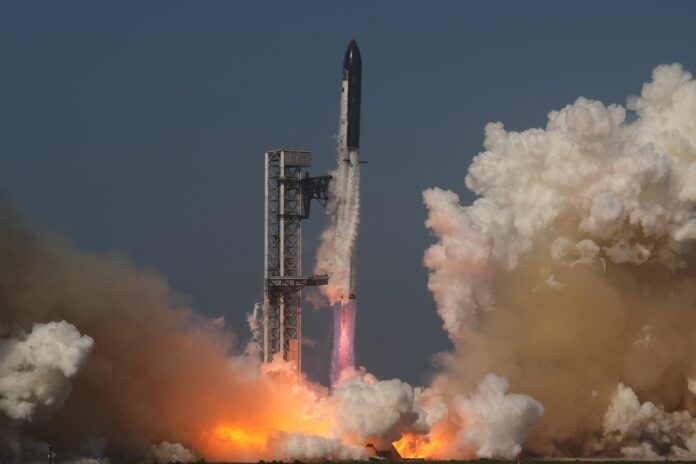
Super Heavy B19, the first Version 3 (V3) of the booster, did not manage a Gulf splashdown on May 22 as part of SpaceX’s Starship Flight 12. Instead, the vehicle lost its engines prematurely, preventing a planned soft splashdown, and slammed into the waves at a high rate of speed.
“Looks like booster’s coming in hot,” noted a SpaceX live-stream commentator shortly before contact was lost with the booster.
It’s not clear whether the booster self-destructed before hitting the water or did so intact.
By Federal Aviation Administration standards, the incident was serious enough to warrant an investigation into why Super Heavy failed.
“The FAA defines a mishap as meeting one of several criteria, including the failure to complete a launch or reentry as planned,” the agency said.
The investigation will be led by SpaceX and overseen every step of the way by FAA, which said the decision to call for an investigation followed a “thorough assessment of the operation.”
The agency said there were no reports of injury to the public or damage to public property. Starship S39 (also the third and newest version to fly) continued its suborbital trajectory to a controlled splashdown in the Indian Ocean 200 miles from Australia on May 22.
The FAA said the purpose of a mishap investigation will be to “enhance public safety, determine the root cause of the event, and identify corrective actions to avoid it from happening again.”
Meanwhile, further Starship-Super Heavy flights are grounded until the agency gives SpaceX permission to resume, which won’t happen until SpaceX completes the investigation, according to the FAA.
“A return to flight of the Starship-Super Heavy vehicle is based on the FAA determining that any system, process, or procedure related to the mishap does not affect public safety,” the agency said.
The FAA said it had activated a Debris Response Area and “determined that the booster debris fell inside the hazard area.”
“During the event there were six (aircraft) departure delays, five airborne holding events, and no aircraft diversions,” the agency said.
The last FAA mishap investigation involving SpaceX involved Starship S34 on March 6, 2025. In that instances, the stage-two Starship disintegrated over the Caribbean Sea less than nine minutes after liftoff from Boca Chica.
The FAA is likewise overseeing SpaceX’s investigation into the Flight 8 Starship mishap on March 6. Again, the Starship — S34 this time — was lost over the Caribbean less than nine minutes after liftoff from Boca Chica. That investigation was closed on June 12, after a determination that loss of Starship was likely due to an engine hardware issue.
Flight 7 on Jan. 16, 2025, was also the subject of a mishap investigation after Starship S33 malfunctioned and exploded over the Caribbean minutes into the flight. That investigation was closed on March 28, 2025.